
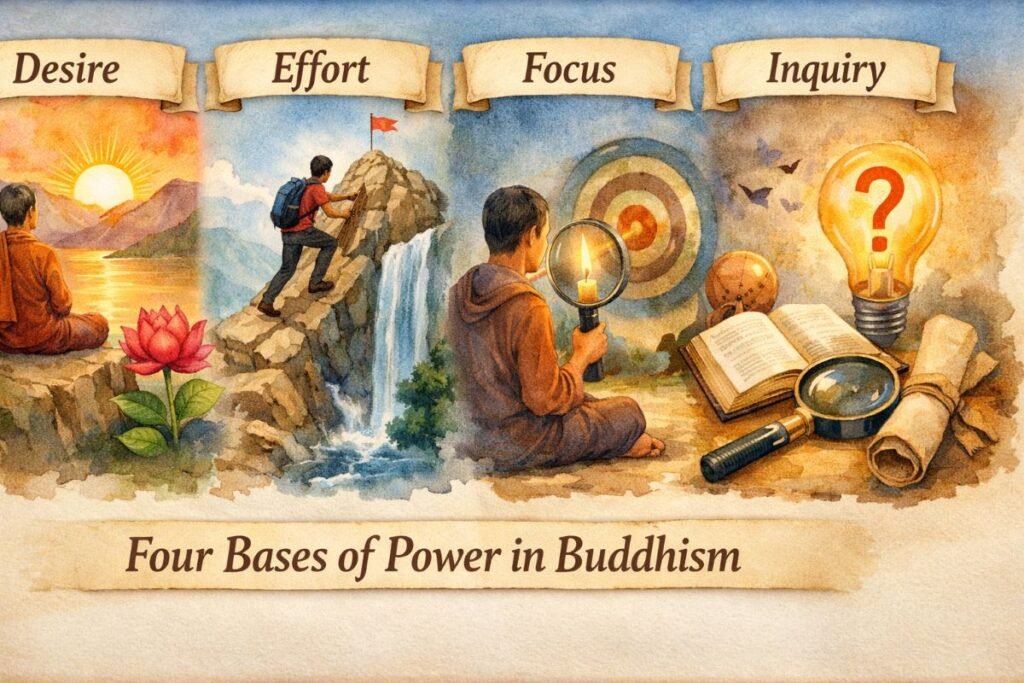
Key Takeaways
- The Four Bases of Power [Iddhipāda] are a set of four mental qualities traditionally taught as supports for deep concentration and liberation, yet their principles can be applied to any significant undertaking, whether spiritual or worldly.
- These teachings are preserved in the Pāli Canon and belong to the shared early Buddhist heritage; they are most prominent in the Theravāda school but are recognized across all major traditions as part of the 37 Factors of Enlightenment.
- The four components are wholesome desire, persistent energy, focused intention, and investigative inquiry.
- In modern life, these bases serve as a framework for overcoming procrastination, maintaining focus, and achieving professional or personal excellence without burnout.
- Success is understood not as luck but as the result of intelligently balancing these four specific inner strengths.
1. Introduction
In a world that constantly demands achievement, we often lack a clear internal map for sustaining our efforts over time. The Buddha offered such a map through a teaching known as the Four Bases of Power [Iddhipāda]. While the term “power” can evoke supernatural abilities, the heart of this teaching is the power of accomplishment—the inner capacity to bring a chosen task to its successful completion.
These four qualities are not reserved for monastics or advanced meditators; they are universal inner strengths. Whether you are learning a new skill, building a career, or cultivating a calm and peaceful mind through meditation, the four bases provide the structural support needed to prevent burnout and ensure steady, balanced progress. When we understand how to harmonise desire with effort and intention with investigation, our ordinary daily actions can become a steady path of meaningful growth.
2. The Buddhist Schools and Origins
The Four Bases of Power [Iddhipāda] are preserved in the Pāli Canon, the earliest complete collection of the Buddha’s discourses. They therefore belong to the shared heritage of early Buddhism. Today they are most prominent in the Theravāda school, the “School of the Elders,” practised widely in Sri Lanka, Thailand, Myanmar, Cambodia, and Laos. However, these bases are not confined to one tradition. They form part of the 37 Factors of Enlightenment [Bodhipakkhiyādhammā], a comprehensive set of qualities leading to awakening that is accepted and studied across the Mahāyāna and Vajrayāna schools as well. In those traditions, while the emphasis may shift toward the benefit of all beings, the psychological mechanics of the four bases remain a vital component of training.
The word [Iddhipāda] is made of two parts: [Iddhi] means power, success, or spiritual potency, and [Pāda] means foot, base, or foundation. Together they point to the “footing for success.” In the Iddhipāda Saṃyutta, the Connected Discourses on the Bases of Power (SN 51), the Buddha explains that anyone who neglects these four bases neglects the path that leads to the end of suffering, while those who undertake them undertake the path to liberation.
2.1 The Canonical Context: Concentration and Striving
For a complete picture, it is helpful to know that in the discourses the four bases are not taught as isolated attitudes. Each base is presented as a compound: concentration [samādhi] founded upon that quality, together with the mental fabrications of striving [padhānasaṅkhāra]. For example, the base of wholesome desire is described as “concentration due to desire, with volitional formations of striving.” The same structure applies to the bases of energy, mind, and investigation. This means that in their original meditative setting, the Iddhipāda are deeply intertwined with the calm and collectedness of samādhi.
The present article focuses on the psychological qualities themselves because they can be developed in everyday life long before deep concentration is established. When you later bring these qualities into meditation, they naturally mature into the full canonical form. Keeping this meditative horizon in mind prevents the teaching from being reduced to a productivity technique and honours its ultimate purpose: liberating the heart.
3. The First Base: Wholesome Desire [Chanda]
The first base of power is wholesome desire [Chanda]. Many people know that Buddhism often speaks of desire as a cause of suffering. The Pāli language, however, makes a crucial distinction between [Taṇhā]—blind craving or “thirst” that grasps and clings and [Chanda], which is a neutral or wholesome “will to act” or “zeal.” When the texts point to desire as a base of power, they never refer to craving; they refer to the bright, interested energy that moves us to engage with life skilfully.
Understanding Wholesome Desire
Wholesome desire is the initial spark. It is the genuine liking, the natural curiosity, and the felt sense of “yes, this is worth doing.” Without this quality our work becomes a heavy chore and our spiritual practice turns into a dry obligation. On the path, wholesome desire arises when we clearly see the value of a goal and the mind leans toward it not out of compulsion but out of intelligent appreciation.
The Buddha encouraged us to nurture this quality so that it is neither too sluggish nor too active. When desire is too weak, we never begin. When it is too frantic, it slips into craving and anxiety. Balanced, it feels like a steady, warm interest that carries us forward without tension.
Practical Application in Modern Life
- Connecting to a larger purpose: To cultivate wholesome desire, link your daily tasks to something that matters. If your work feels difficult, reflect on the desire to support your family, to be genuinely helpful to colleagues, or to develop a skill that will benefit others. This turns resentment into willing engagement.
- Visualising the benefit wisely: Take a quiet moment each morning to reflect on the beneficial results your actions can bring. If you plan to meditate, dwell gently on the inner peace and clarity a settled mind gives rise to. This builds a natural, gentle pull toward the activity rather than forcing yourself through willpower.
- Noticing the feeling-tone of desire: Check in with yourself. Does the desire feel heavy and driven? That is likely craving. Does it feel flat and lifeless? That is sluggishness. Adjust by either softening the urgency or refreshing your sense of purpose until the quality of interest feels easy and buoyant.
- Starting with a small, likable step: If a goal feels overwhelming, break it down until you find one tiny action that sparks a little genuine interest. The simple felt sense of “I want to do this small thing right now” is wholesome desire in action. From that foothold, you can gradually extend your reach.
4. The Second Base: Persistent Energy [Viriya]
Once wholesome desire has lit the spark, it must be sustained by persistent energy [Viriya]. This is the quality of effort, vigour, and courage. It is the inner strength that keeps us going when the initial excitement of a new project naturally fades. In the ancient texts, [Viriya] literally means “the state of a hero,” pointing to a brave and unwavering heart rather than mere physical drive.
The Nature of Effort
Persistent energy is not about forcing or straining. It is a sustained, balanced application of effort. A famous Buddhist simile compares it to the tuning of a lute: if the string is too tight, it breaks; if it is too loose, it makes no sound. Effort must be tuned to the middle; firm but relaxed, steady but not rigid.
The teachings speak of four right efforts: preventing unwholesome states from arising, abandoning those already present, generating wholesome states, and maintaining and perfecting those wholesome states once they have arisen. In modern terms, this means actively protecting your mind from negativity, letting go of distractions, and then nurturing the positive qualities you wish to see grow.
Practical Application in Modern Life
- Harnessing consistency over intensity: Small, regular actions are far more effective than occasional heroic outbursts. Committing to ten minutes of language practice or meditation each day builds strong inner momentum and reshapes the mind gently, while a massive effort once a week often leads to exhaustion and avoidance.
- Starting before you feel ready: Procrastination often means that energy is blocked by a mental hindrance such as doubt or sloth. A simple, effective remedy is to agree to do the task for only five minutes. This tiny, manageable movement of effort often breaks through the resistance, and persistent energy begins to flow naturally once you are in motion.
- Guarding against burnout: Wise energy knows when to rest. The Buddha cautioned against energy that is “outwardly scattered” on too many projects and distractions. Focus your effort on the most essential actions and schedule genuine periods of rest and renewal. This keeps your inner string perfectly tuned.
- Drawing energy from inspiration: When energy runs low, a skilled practitioner can “gladden” the mind. Read an uplifting passage, listen to a Dhamma talk, or bring to mind the good qualities of someone you admire. This is not escapism; it is the wise means of re-arousing the heroic heart when it has grown tired.
5. The Third Base: Focused Intention [Citta]
The third base is focused intention [Citta]. In ordinary Pāli, [Citta] means mind or consciousness. However, in the specific context of the Iddhipāda, the term refers to the mind that is wholehearted, collected, and fully dedicated to the object or task. It is the quality of not being distracted or half-hearted. A mind scattered across many thoughts has little power, while a mind that is unified and deeply attentive carries a natural weight and influence.
The Power of a Dedicated Mind
Focused intention means being “all there.” The Viraddha Sutta (SN 51.2) explains that neglecting the four bases is to neglect the path itself. A central part of undertaking that path is the capacity to keep the mind steady. When we multi-task, we do not actually do two things at once; we jump rapidly between objects, leaving the mind agitated, shallow, and easily fatigued.
The development of focused intention is closely connected with mindfulness [Sati] and concentration [Samādhi]. Mindfulness remembers to stay present; focused intention immerses the whole collected mind in the chosen activity. It is the difference between reading a book while mentally rehearsing your to-do list, and reading with such complete absorption that you lose track of time and truly understand what you read.
Practical Application in Modern Life
- Embracing single-tasking: In a world of constant notifications, practising focused intention means choosing one thing and giving it your full attention. When you eat, eat. When you listen to a friend, truly listen. Notice the urge to switch, and gently decline it.
- Building the monitoring habit: Periodically pause and ask, “Where is my mind right now?” If it has wandered into a daydream about the future or a replay of the past, gently guide it back to the physical sensations and task of the present moment. This gentle returning is the training of the third base.
- Creating an environment that supports focus: Your outer space influences your inner state. Clearing your desk, turning off the television, and placing your phone out of sight are acts of compassion toward your own mind. They make it easier for focused intention to arise and stabilise.
- Using an anchor: When the mind is especially restless, anchor it in the body. Before you begin, take three conscious breaths and feel the weight of your body on the chair. Let the mind settle into the body. Then, start your task with this unified mind-body presence, returning to the breath as an anchor whenever you feel scattered.
6. The Fourth Base: Investigative Inquiry [Vīmaṃsā]
The fourth base is investigative inquiry [Vīmaṃsā]. This is the analytical, reflective faculty of the mind. It is the ability to examine, evaluate, and intelligently adjust your approach based on the results you are actually getting. Without this quality, a person can work very hard (persistent energy) on something they love (wholesome desire) with great concentration (focused intention), yet be doing it in a completely ineffective way. Investigative inquiry is the inner check and balance that keeps effort skilful.
The Role of Analysis
Investigative inquiry is not yet the perfected wisdom [Paññā] of full awakening, but it is a vital, wisdom-adjacent function. It looks closely at cause and effect: “When I do this, that happens. Is that the result I intended?” It is the inner scientist, the problem solver, the quality that asks “why?” and “is there a better way?” In the path of liberation, this faculty examines the nature of body, feelings, mind, and mental objects, seeing their impermanent and impersonal nature. The same reflective muscle we use to improve a work project is, when refined and deepened, the very tool that cuts through ignorance.
In the Pubba Sutta (SN 51.11), the Buddha describes how, before his awakening, he developed these four bases, and that development became a support for his final liberation. This shows that the faculty of wise investigation, cultivated over time, leads far beyond ordinary problem-solving.
Practical Application in Modern Life
- Building a personal feedback loop: At the end of a day or a week, take a quiet five minutes for honest review. Look at your actions and their results without praise or blame. Ask: “What did I do that led to a good outcome? What led to stress? What one small thing might I adjust tomorrow?” This is the direct cultivation of investigative inquiry.
- Questioning your own assumptions: We often operate on habits and beliefs we have never examined. When you feel stuck, investigative inquiry invites you to ask, “Is the obstacle really out there, or is my approach, my interpretation, or my resistance causing the trouble?” By gently questioning your own narrative, you open up creative solutions that were hidden.
- Knowing when to pause: Sometimes the most skilful action is to stop. Investigative inquiry recognises when persistent energy has become blind striving. If you are studying hard but nothing is sinking in, a wise analysis might suggest you take a walk and let the mind process. This is not laziness; it is intelligence.
- Learning from every outcome: This faculty sees setbacks as valuable information. When a project does not go as hoped, an untrained mind falls into despair. A mind strengthened by inquiry asks, “What can I learn from this? What boundary did I discover? How can I approach it differently next time?” This attitude, explored in the Brahmana Sutta (SN 51.15), transforms even difficulty into a teacher.
7. Balancing the Four Bases
The true power of these four bases does not lie in any single one of them but in their intelligent integration. They function as a living system, each one counterbalancing the excesses of the others. A person with immense wholesome desire but weak investigative inquiry will be enthusiastic but will likely repeat the same mistakes. Someone with keen inquiry but feeble persistent energy will be an armchair thinker who never actually accomplishes anything. Focused intention without desire can turn cold and mechanical, while energy without focus leads to scattered busyness.
The Buddha explicitly taught that these bases should be developed so that they are “neither overly sluggish nor overly active.” This is a direct application of the Middle Way, the central principle of Buddhist practice. It means developing the sensitivity to know which quality needs strengthening in a given moment.
- If you feel overwhelmed and rigid, too much forced energy is present. Step back and reconnect with wholesome desire by remembering why the task genuinely matters to you.
- If you are daydreaming and procrastinating, the bases of energy and intention need a gentle boost. A short, focused burst of action, just a few minutes, can restore the balance.
- If you are working hard but seeing no progress, it is time to bring investigative inquiry to the front. Ask what needs to change rather than simply doing more of the same.
- If your mind is scattered and anxious, focused intention has been lost. Anchor yourself in the body, simplify to one single-pointed task, and give it your wholehearted attention.
This dynamic balancing is a continuous, living practice, not a one-time fix. Over time, the mind learns to read its own state and apply the right medicine almost automatically. The result is a mind that is resilient, adaptable, and quietly powerful, capable of completing tasks without burning out and of pursuing the deepest spiritual goals without becoming rigid.
8. Glossary of Terms
- Chanda: Wholesome desire, zeal, or the will to act. The interested, energetic spark that initiates a task, entirely distinct from blind craving.
- Citta: Mind or consciousness. In the Iddhipāda context, it specifically means the mind that is wholehearted, collected, and fully dedicated to the object.
- Iddhi: Power, success, or spiritual potency. Practically, it refers to the ability to bring wholesome aims to completion.
- Iddhipāda: The Four Bases of Power, the foundations for success. The set of four inner qualities that lead to mastery and achievement.
- Padhānasaṅkhāra: The mental fabrications of striving or volitional formations of effort. In the canonical formula, these accompany each base together with concentration.
- Pāli: The ancient Indian language in which the earliest complete Buddhist scriptures (the Pāli Canon) are recorded.
- Samādhi: Concentration or meditative collectedness. The unified, settled quality of mind that is integral to the full development of the Iddhipāda.
- Theravāda: The “School of the Elders,” the oldest surviving branch of Buddhism, which relies on the Pāli Canon as its scriptural authority.
- Vīmaṃsā: Investigative inquiry, analysis, or scrutiny. The reflective, analytical quality that examines and intelligently adjusts one’s approach.
- Viriya: Persistent energy, effort, or vigour. The sustained, courageous strength that carries action forward over time.
9. Conclusion
The Four Bases of Power [Iddhipāda] offer a timeless inner framework that is as relevant in a busy modern life as it was in the ancient monastic Sangha. By cultivating wholesome desire, sustaining a balanced energy, maintaining a dedicated mind, and applying investigative inquiry, we move away from a life of accidental outcomes and toward a life of intentional, wise action.
These teachings remind us that success, whether in meditation or in daily responsibilities, is a skill that can be developed. We do not need to wait for inspiration to strike or for circumstances to become perfect. Instead, we can look within, see which of the four bases needs strengthening, and gently bring it into harmony with the others. When these qualities are balanced, the mind becomes a capable instrument, able to meet obstacles with composure and to walk the path toward genuine peace.
Resources and Further Reading
For those who wish to explore these teachings more deeply, the following resources provide both classical and contemporary guidance.
Books:
- The Wings to Awakening by Thanissaro Bhikkhu. A comprehensive and freely available study of the 37 Factors of Enlightenment, with extensive, clear sections on the bases of power. Available at dhammatalks.org.
- Deep Work by Cal Newport. While not a Buddhist work, this modern book on focused accomplishment echoes many of the principles found in the bases of intention and energy, offering practical strategies for a distracted age.
Podcasts:
- The Ajahn Brahm Podcast regularly offers practical, humorous advice on balancing effort, desire, and letting go in daily life. Episodes touching on the bases of power can be found on major podcast platforms.
- Dharmabytes from the Triratna Buddhist Community features short, accessible talks on foundational Buddhist teachings, including the factors of enlightenment and their application in modern contexts.
Suttas:
- The Iddhipāda Saṃyutta (SN 51) on SuttaCentral gathers the Buddha’s discourses on the bases of power. Reading a few suttas directly, such as the Vibhaṅga Sutta (SN 51.20) for definitions and the Viraddha Sutta (SN 51.2) on the danger of neglect, brings the living words of the teaching to life.