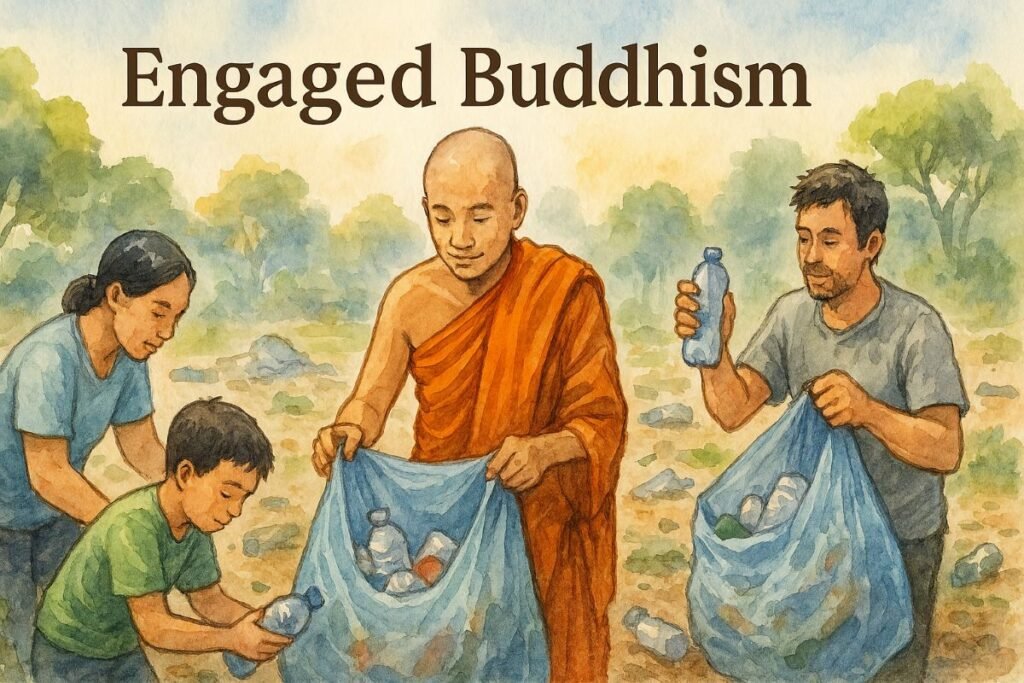
Engaged Buddhism: The Path of Mindful Action for a Suffering World
“There is no enlightenment outside of daily life.” — Thich Nhat Hanh
Key Takeaways
Engaged Buddhism is a modern movement that actively applies Buddhist ethics and mindfulness to social, environmental, and political issues.
It is built on the principle of “Interbeing”, the understanding that personal well-being and societal well-being are inseparable.
Practice is guided by frameworks like the Fourteen Mindfulness Trainings (from Thich Nhat Hanh’s Order of Interbeing) and the traditional Five Precepts, expanded for social justice.
It manifests globally in tangible work for peacebuilding, ecological protection, prison reform, and economic justice.
1. The Heart of Engaged Buddhism: Integrating Inner Peace and Outer Action
Engaged Buddhism is a modern expression of the Buddha’s ancient wisdom that actively applies the Dharma, the teachings on the nature of reality and the path to liberation, to the social, political, economic, and environmental suffering of our time. It is built on the foundational understanding that personal liberation and collective well-being are deeply intertwined. This movement asserts that to seek enlightenment while ignoring the suffering caused by war, injustice, poverty, and ecological collapse is a fundamental contradiction. It moves meditation from the cushion into the local, national, global marketplace and compassion from a feeling into a verb.
While not a separate Buddhist school, it is an approach to practice embraced by practitioners across Theravada, Mahayana, and Vajrayana traditions. It draws directly on core teachings like the Four Noble Truths, diagnosing societal suffering and its causes, and the Noble Eightfold Path, providing a framework for ethical engagement. Its essence is mindful action: social engagement that is rooted in non-attachment, clear seeing, and a commitment to nonviolence (ahimsa), ensuring that the work of changing the world does not come at the expense of one’s own peace or integrity.
2. Historical Roots: From Ancient Ethics to Modern Movement
The seeds of engagement are found in the Buddha‘s own life and the Vinaya (monastic code), which established a harmonious community. However, the term “Engaged Buddhism” was born in the fire of 20th-century crises, formalizing these impulses into a distinct path of practice.
Thich Nhat Hanh and the Birth of a Term: During the Vietnam War, Vietnamese Zen monk Thich Nhat Hanh faced the dilemma of whether monastic life required withdrawal from a society being destroyed. His answer was the creation of the School of Youth for Social Service in the 1960s, where young volunteers practiced mindfulness while rebuilding bombed villages, operating clinics, and resettling refugees. He coined the term to describe this synthesis, famously teaching that one must “be peace” to make peace.
“Personal liberation and collective well-being are deeply intertwined.”
Parallel Streams of Engagement:
B.R. Ambedkar and Social Liberation: In 1956, Indian jurist and reformer B.R. Ambedkar led the conversion of hundreds of thousands of Dalits (formerly “untouchables”) to Buddhism. For him, Buddhism was not merely a personal spiritual path but a revolutionary framework for social equality, dignity, and human rights, explicitly rejecting the Hindu caste system. This created the foundation for the ongoing Dalit Buddhist movement (Navayana).
Sulak Sivaraksa and Structural Critique: Thai intellectual Sulak Sivaraksa, founder of the International Network of Engaged Buddhists, applies Buddhist teachings to critique the “three poisons”—greed (lobha), hatred (dosa), and delusion (moha), as they manifest in global capitalism, militarism, and oppressive political structures.
Institutionalization: Organizations like the Buddhist Peace Fellowship (1978) and the Zen Peacemakers (1996) created global networks to support and coordinate engaged action, demonstrating the maturation of the movement.
3. The Ethical Compass: The Fourteen Mindfulness Trainings
Thich Nhat Hanh distilled the essence of engaged practice into the Fourteen Mindfulness Trainings of the Order of Interbeing, his specific lineage. While these trainings are globally influential and capture the spirit of the movement, it is important to note that they are one expression of engaged ethics; other Buddhist traditions may use different formulations of the Bodhisattva vows or precepts.
They are not commandments but guidelines for mindful living that expand traditional Buddhist precepts into a cohesive framework for social and global responsibility. They form a profound ethical core for many engaged practitioners.
Training Group
Key Precepts & Their Engaged Meaning
Openness & Non-Attachment to Views (1-3)
1. Do not be idolatrous about any doctrine or ideology. Guards against fundamentalism in religion or activism. Truth is found in lived experience, not rigid dogma. 2. Do not think your present knowledge is absolute. Cultivates humility and a lifelong willingness to learn from others. 3. Do not force others to adopt your views. Commitment to change through compassionate dialogue, not coercion.
Awareness of Suffering & Ethical Living (4-8, 13)
4. Do not avoid contact with suffering. The call to “look deeply” into the nature of suffering to understand its roots. 5. Do not accumulate wealth while millions are hungry. Links personal economics to global justice, promoting simplicity and sharing. 13. Do not live with a life of luxury while others suffer. Extends the fifth precept to a mindful, non-exploitative lifestyle.
Cultivating a Peaceful Self (6-7)
6. Do not maintain anger or hatred. Teaches mindful transformation of anger to ensure action arises from compassion. 7. Do not lose yourself in despair. Nurtures resilient hope through practice and community, even amidst great difficulty.
Core Buddhist Precepts in an Engaged Context (8-12)
8. Do not kill. Protect all life; practice nonviolence and work to prevent war. 9. Do not steal. Prevent exploitation; promote economic justice. 10. Do not engage in sexual misconduct. Foster relationships of respect and safety. 11. Do not lie. Practice truthful, loving speech; expose injustice. 12. Do not use intoxicants. Maintain clarity to see the true causes of suffering.
Community (14)
14. Do not separate yourself from the community. Recognizes that awakening and action are communal; we rely on the Sangha (community) for support and insight.
These trainings bridge personal morality and social action, ensuring that engagement is always rooted in ethical integrity and mindful awareness.
4. Core Principles: The Dharma Framework for Action
The Fourteen Trainings operationalize deeper Buddhist principles that form the philosophical foundation of Engaged Buddhism.
Interbeing (Paticca Samuppada / Interconnectedness): This is the cornerstone. Thich Nhat Hanh’s term “Interbeing” captures the teaching of Dependent Origination, that all phenomena co-arise. We “inter-are” with society and the Earth. Therefore, injustice and ecological harm are forms of collective suffering in which we are implicated. Action to relieve them is not separate from self-care; it is care for the extended web of life of which we are a part.
Compassion (Karuna) as Active Love:Compassion is the fuel and direction for engagement. It is defined not by pity but by the determination to remove suffering. In an engaged context, this means creating social structures, laws, and communities that actively prevent harm and nurture well-being for all, not just offering charity.
The Nonduality of Practice and Engagement: This principle dissolves the false barrier between meditation and action. Sitting meditation cultivates the stability and insight needed to engage with chaos without being overwhelmed. Conversely, engaged action is “meditation in motion,” a practice where we encounter our own attachments, aversions, and biases in real-time, providing rich material for deeper self-understanding.
5. Current Areas of Work: Principles in Action
Engaged Buddhist principles are not abstract; they manifest in concrete projects addressing contemporary suffering.
5.1 Environmental Justice: Practicing Interbeing with the Earth
Seeing the environment as an extension of our own body, work here focuses on protection and restoration.
Plum Village’s “Earth Holder” Community: Inspired by the 14th Training (community), global sanghas organize mindful climate action, tree-planting as ceremonies, and advocacy rooted in the First Precept (non-harming) applied to all species.
Monastic Environmental Stewardship: In Thailand, forest monasteries like Wat Phu Chong enact the 1st Precept by ordaining trees and patrolling forests against illegal logging, framing conservation as a sacred duty.
5.2 Social Justice & Human Rights: Applying Compassion to Systems
This work applies the 5th, 9th, and 13th Trainings (on wealth and exploitation) to challenge structural inequality.
The Dalit Buddhist Movement (Navayana): In India, organizations run schools and advocacy groups, using Buddhist teachings as a tool for dignity, education, and political empowerment, directly fulfilling Ambedkar’s vision of Buddhism as social liberation.
Prison & Restorative Justice Programs: Initiatives like the Buddhist Peace Fellowship’s Prison Mindfulness Project apply the 6th Training (transforming anger) and the 11th (truthful speech). They offer meditation and advocate for restorative justice models. Studies, such as those conducted by the Insight Prison Project, have shown that such mindfulness-based programs in prisons can contribute to a significant reduction in recidivism rates, demonstrating how inner transformation leads to tangible social outcomes.
Here, the 3rd Training (non-coercion) and the 11th (loving speech) are key practices.
Sarvodaya Shramadana Movement (Sri Lanka): After the civil war, this grassroots group brings Sinhalese and Tamil communities together for shared development projects, using cooperative labor as “applied mindfulness” to rebuild trust, embodying the 14th Training on community.
Bearing Witness Retreats (Zen Peacemakers): At sites of historical trauma like Auschwitz or on city streets, participants practice “not-knowing” and bearing witness—a deep application of the 1st and 2nd Trainings (non-attachment to views). This profound listening often inspires direct, compassionate service.
6. A Practical Framework for Engaged Living
Engagement is a scalable path, relevant to daily life. This framework shows how engaged principles guide action from the personal to the systemic.
Level of Practice
Core Principle
Personal Application
Collective Action
Foundation: Personal Mindfulness & Ethics
Cultivating a peaceful, ethical self as the ground for action.
Daily meditation. Mindful consumption. Practicing Right Speech in daily conversations.
Supporting mindfulness programs in schools, hospitals, and workplaces.
Relational Practice: Community & Dialogue
Building understanding and community (Sangha).
Deep Listening in conflicts. Resisting gossip. Volunteering locally.
Facilitating interfaith or community dialogues. Participating in a Sangha.
Public Action: Skillful Service & Advocacy
Addressing suffering directly with courage and hope.
Donating mindfully to effective causes. Ethical career choices (Right Livelihood).
Joining or supporting the projects in Section 5. Peaceful, mindful advocacy.
Structural Engagement: Working for Systemic Change
Addressing root causes and ideologies of suffering.
Critically examining the systems one participates in. Lifelong learning about justice.
Advocacy for policy change in climate, justice, or peace. Supporting economic alternatives like cooperatives.
7. Purpose and Reflection: A Complete Path
The purpose of Engaged Buddhism is the fulfillment of the Buddha’s path: the alleviation of suffering (dukkha). It simply recognizes that in our interconnected world, suffering is woven into social fabrics and ecosystems, and therefore the path to liberation must address these dimensions. It is motivated by active compassion and guided by the Bodhisattva ideal, the vow to work for the awakening of all beings.
This path offers a vital corrective to the twin pitfalls of spiritual bypassing (using meditation to avoid the world) and activist burnout (fighting for change without an inner foundation). By weaving together ethical frameworks like the Fourteen Mindfulness Trainings with practical action in areas like ecology and social justice, it provides a complete, sustainable, and compassionate framework for responding to the crises of our age.
It affirms that building a more just and peaceful world is not separate from building a peaceful mind; they are the same sacred work.
Begin Your Micro-Practice Today: Before you post a comment online or engage in a difficult conversation, pause and take three conscious breaths. Use this moment to check in: Is what you are about to say or write true, helpful, and kind? This tiny act of mindful awareness is the first step in practicing Right Speech and bringing engaged principles into your daily digital and social life.
Bodhisattva (Sanskrit): An “awakening being” who vows to attain enlightenment for the benefit of all sentient beings, embodying the ideal of compassionate action central to Engaged Buddhism.
Dharma (Sanskrit/Pali): The cosmic law of reality discovered by the Buddha; also, the teachings that explain this law and the practices that lead to liberation from suffering.
Interbeing: A term coined by Thich Nhat Hanh to express the Buddhist teaching of Dependent Origination (Paticca Samuppada), emphasizing the profound interconnection and interdependence of all phenomena.
Right Livelihood (Samma Ajiva): The ethical principle of earning a living in a way that does not cause harm. Engaged Buddhism expands this to critique systemic economic exploitation and promote just, sustainable economies.
Sangha (Pali): Traditionally the community of Buddhist monastics. In engaged practice, it is often understood as the community of practitioners walking the path together, providing mutual support for both spiritual practice and social action.