Key Takeaways
-
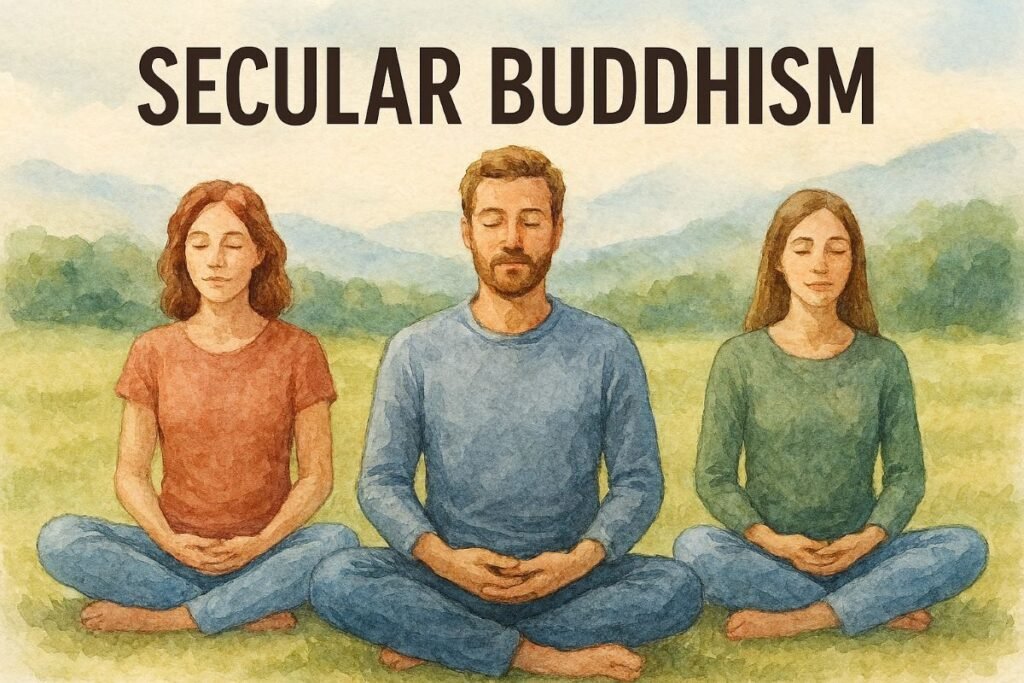
Secular Buddhism is a modern, non-religious interpretation of the Buddha’s teachings, focusing on their ethical, psychological, and practical applications in contemporary life.
-
It actively engages with and reinterprets traditional Buddhist doctrines, viewing concepts like rebirth and karma through a psychological or metaphorical lens, rather than a metaphysical one.
-
The approach emphasizes personal experience, critical inquiry, and compatibility with scientific understanding, while maintaining deep respect for Buddhist traditions.
-
It is not a single, unified school but a diverse movement with internal debates, facing thoughtful criticism from both traditional Buddhist communities and within its own ranks.
-
Core practices like mindfulness, ethics, and compassion remain central, applied to foster well-being, resilience, and engaged citizenship in this life.
-
The path encourages open dialogue, freedom of exploration, and finding a practice that aligns authentically with one’s own worldview and values.
1. Introduction: A Modern Engagement with Ancient Wisdom
In an age shaped by science, pluralism, and rapid change, many seek wisdom and peace but may find traditional religious frameworks challenging to fully embrace. Secular Buddhism emerges in this space, not as a rejection of Buddhism, but as a thoughtful, modern engagement with its deepest insights. It asks a simple, profound question: “How can the Buddha’s core teachings on ending suffering guide us here and now, even if we do not hold certain ancient cosmological beliefs?”
This is not about creating a “better” Buddhism, but an accessible one for those whose worldview is fundamentally naturalistic. It operates on the conviction that the Dharma’s radical insights into the nature of the mind, suffering, and happiness are too valuable to be encumbered by doctrinal requirements that can act as barriers for modern seekers. This article explores Secular Buddhism with balance and respect. We will delve into its principles, practices, and the sincere dialogue, both supportive and critical, that surrounds it. Our aim is not to declare one path superior, but to clearly present this evolving approach, honoring the integrity of traditional practice while acknowledging the authentic search of modern practitioners. This is an invitation to open exploration, grounded in the Buddhist spirit of inquiry and kindness.
2. What Is Secular Buddhism? Definition and Core Intentions
2.1 A Working Definition
Secular Buddhism is a contemporary, non-dogmatic approach to the Dharma. It prioritizes the ethical, philosophical, and meditative dimensions of Buddhism, interpreting them within a naturalistic, this-worldly framework. It focuses on personal and societal flourishing in our current life, using mindfulness, compassion, and wisdom as tools for transformation. The term “secular” here denotes a focus on the “here and now,” separating the practical and philosophical core from religious institutions and supernatural metaphysics.
2.2 Foundational Principles and Intentions
-
Pragmatism and Utility: The primary measure of a teaching is its effectiveness in reducing observable suffering (Dukkha) and enhancing well-being. The famous Kalama Sutta, where the Buddha advises people to test teachings against their own experience, is often cited as a foundational text for this empirical approach.
-
Empirical Emphasis: Belief is secondary to experiential understanding. The instruction is “come and see” (Ehipassiko), not “come and believe.” Practice is a form of inquiry, where meditation and ethical living are laboratories for observing the truths of the Dharma firsthand.
-
Demythologization and Metaphorical Interpretation: Traditional cosmological elements are examined for their symbolic and psychological meaning. A “hungry ghost” (Peta) realm, for instance, can be powerfully understood as a metaphor for the insatiable craving and inner poverty of addiction or consumerism, rather than a literal afterlife destination.
-
Ethical Naturalism: Ethics (Sila) arise from observable realities: empathy, the discernible consequences of actions, and a deep understanding of our interconnectedness. This provides a robust ethical foundation without requiring belief in karmic ledger-keeping across lifetimes.
-
Constructive Dialogue with Modernity: It actively seeks a conversation with cognitive science, psychology, philosophy, and secular humanism. It asks how the Buddha’s map of the mind aligns with or challenges modern understandings, viewing this not as a threat but as a vital enrichment.
3. Historical Context and Lines of Inspiration
Secular Buddhism is not an entirely new invention but a synthesis with clear historical roots.
-
The Early Pali Canon: Proponents often advocate a return to the Sutta Pitaka, the discursive texts of the earliest canon. They argue these texts present a more pragmatic, psychological, and problem-solving teaching, with less emphasis on later scholasticism and cosmology.
-
Western Philosophical Integration: From the 19th century, European thinkers like Arthur Schopenhauer and early translators interpreted Buddhist philosophy through a rationalist, almost atheistic lens, planting seeds for a non-theistic understanding.
-
The Mindfulness Revolution: The clinical and popular success of programs like Mindfulness-Based Stress Reduction (MBSR) was a watershed moment. It demonstrated that the core technique of mindfulness (Sati) could be extracted, taught effectively in a secular context, and yield profound, verifiable benefits for mental and physical health.
-
Key Proponents: Thinkers like Stephen Batchelor have been seminal. In works like Buddhism Without Beliefs and After Buddhism, he systematically articulates a creedless, agnostic approach focused on the “Fourfold Task.” Others, like Jon Kabat-Zinn, provided the practical vehicle through secular mindfulness. Writers such as Robert Wright (Why Buddhism is True) have further bridged the gap by exploring the confluence of Buddhist insight and evolutionary psychology.
4. The Heart of the Practice: Core Teachings Reinterpreted for the Present Moment
Secular Buddhism retains the essential architecture of the Dharma but often shifts the focus from a cosmological to a psychological and ethical timescale.
4.1 The Four Noble Truths as an Operating System for Life
This framework is seen not as a religious creed but as a universal diagnostic and prescription for the human condition.
-
The Truth of Dukkha: This is an honest, clear-eyed acknowledgment, not pessimistic resignation. It includes gross suffering, but more subtly, the pervasive sense that life is never quite perfect or complete, the “pinpricks” of everyday irritation and anxiety. Secular practice starts by turning towards this reality with curiosity, not avoidance.
-
The Truth of the Origin (Samudaya): The root cause is identified with precision as Tanha, the mind’s habitual movement of craving for what it doesn’t have and aversion to what it does. This is observed directly in meditation: the longing for a different experience, the resistance to boredom, the mental chase for pleasure and flight from pain.
-
The Truth of Cessation (Nirodha): This is the pivotal point of hope. It states that the added layer of suffering created by craving can stop. Nirvana is thus understood not as a heavenly realm, but as the lived, tangible experience of peace, freedom, and openness that arises when craving ceases, even momentarily. It is a natural state, not a supernatural reward.
-
The Truth of the Path (Magga): The way to realize this cessation is the practical, cultivable Noble Eightfold Path, a manual for human development.
4.2 The Noble Eightfold Path: A Comprehensive Training Protocol
This path is seen as an integrated training program for cultivating a wise, compassionate, and focused human being:
-
Wisdom (Prajna): This is the cognitive foundation. Right View means understanding life through the lens of the Four Noble Truths, impermanence, and interconnectedness. Right Intention is the commitment to cultivate thoughts of renunciation (letting go), goodwill, and harmlessness.
-
Ethical Conduct (Sila): This is the behavioral foundation, creating the stability and non-remorse necessary for deep meditation. Right Speech, Action, and Livelihood provide clear, practical guidelines for interacting with the world in a way that minimizes harm and builds trust.
-
Mental Discipline (Samadhi): This is the meditative training. Right Effort is the energetic component, consciously nurturing skillful states and abandoning unskillful ones. Right Mindfulness (Sati) is the heart of the practice: the moment-to-moment, non-judgmental awareness of body, feelings, mind, and phenomena. Right Concentration is the development of a steady, collected, and unified mind through focused attention.
For the secular practitioner, mastery of this path is its own reward, leading to a life of profound peace and effective compassion.
5. The Central Dialogue: A Closer Look at Metaphysics Reconsidered
The reinterpretation of karma and rebirth is the most significant and debated aspect. Let’s explore the nuances.
-
Traditional Understanding: Karma is an impersonal, cosmic law of moral cause and effect that operates across lifetimes, determining the quality of future rebirths. Rebirth is the literal continuation of a stream of consciousness (vijnana) or a karmic continuum into a new body after death. The ultimate goal is Nirvana as the final release from this endless cycle of Samsara.
-
Secular Reinterpretations – A Spectrum of Views:
-
Psychological Karma: Every intentional thought, word, and deed shapes the mind in the moment. A moment of generosity creates a mind state of warmth and connection; a moment of hatred creates a mind state of agitation and separation. These patterns become neural pathways, our “character.” This is karma as immediate, observable cause and effect.
-
Social & Systemic Karma: Our actions ripple out into our relationships and society. Lies erode trust, violence begets violence, kindness fosters community. We also inherit the collective karma of our culture, history, and social systems (e.g., racism, environmental degradation). Our practice includes working to understand and transform these wider karmic fields.
-
Metaphorical Rebirth: We are “reborn” countless times each day. When anger arises, we are “born” into the realm of anger. When it passes and contentment arises, we are “reborn” into a different state. The task is to gain freedom from being involuntarily tossed between these “realms.” Furthermore, we are “reborn” in the memories we leave, the work we do, and the children we raise.
-
Agnosticism: A common stance is, “I don’t know what happens after death, and I don’t need to know to practice the path effectively. The teachings work to reduce suffering here and now, regardless of the ultimate metaphysical truth.”
-
Nirvana as Freedom Now: Liberation is the freedom from the tyrannical cycle of craving and aversion in this very life. It is the peace of a mind that is no longer at war with reality as it is.
-
6. A Necessary and Respectful Critique: Understanding the Debates in Detail
A full understanding requires openly acknowledging the thoughtful criticisms from various perspectives. This dialogue is a sign of a living, evolving tradition and is essential for any sincere practitioner to consider.
6.1 Criticisms from Traditional Buddhist Perspectives
Traditional practitioners, monastics, and scholars offer these points not from rigidity, but from a deep concern for the integrity and transformative power of the Dharma as they have received and practiced it.
-
The Risk of Diminishment and Loss of Urgency: A central critique is that removing the framework of rebirth and cosmic karma severs the teaching from its profound explanatory power and its deep motivational engine. Traditional Buddhism asks: “Why be so diligent? Why renounce worldly pleasures? Why devote a lifetime to practice?” The answer, in part, is the vast timeframe of Samsara, the endless cycling through unsatisfactory states. Critics argue that limiting the view to one lifetime can reduce the path to self-improvement or stress management, losing the radical, life-or-death urgency for enlightenment that fuels monastic commitment and profound renunciation.
-
A Cherry-Picking or “Buffet” Approach: The charge is that Secular Buddhism selectively takes the most palatable and marketable parts (mindfulness, compassion, peace) while discarding the challenging, inconvenient, or culturally foreign doctrines (rebirth, merit-making, strict monastic precepts, devotion). This, critics say, risks creating a comfortable, Western-centric self-help philosophy that reinforces the very sense of a “self” the Dharma aims to deconstruct, rather than a path of total, radical transformation.
-
Historical and Textual Integrity: Scholars point out that rebirth and karma are not later accretions but are present in what are widely considered the oldest layers of the Pali Canon. The Buddha is recorded frequently discussing past lives and future rebirths. Critics question whether a teaching that systematically reinterprets or sets aside these repeatedly stated doctrines can legitimately claim to represent the Buddha’s teaching, or whether it becomes a new, different philosophy inspired by Buddhism.
-
Undermining the Teacher’s Authority: This is a logical dilemma. If the Buddha, the fully enlightened one, was either mistaken or speaking purely metaphorically about core doctrines like rebirth, what authority does his insight on other matters, the nature of the mind, the path to cessation, hold? This challenges the traditional act of “taking refuge” in the Buddha as a reliable guide who saw the ultimate truth of things, not just a wise psychologist.
6.2 Criticisms from Within and Around Secular Buddhism
The movement itself is not monolithic and engages in rigorous, necessary self-critique.
-
The “McMindfulness” Critique: This powerful critique, voiced by some Buddhist scholars and practitioners themselves, argues that the secular extraction of mindfulness often strips it of its ethical and wisdom context. When mindfulness is sold as a tool solely for corporate productivity, stress reduction for employees, or better focus for consumers, it can be co-opted to help people function more smoothly within systems that may cause suffering. It becomes a “band-aid” rather than part of a path that questions the root causes of suffering, including societal greed, aversion, and delusion.
-
Cultural Appropriation Concerns: Does Secular Buddhism, led largely by Western academics and teachers, extract and redefine practices from Asian Buddhist cultures without sufficient reverence, context, or reciprocity? Does it ignore the living traditions, communities, and monastics who have preserved these practices for centuries, sometimes while economically marginalizing them in the process?
-
The Challenge of Building Deep Community (Sangha): Traditional Buddhism is upheld by the monastic Sangha, a dedicated, lifelong community with clear rules, roles, and lineage. Can a diffuse, lay-led, often digitally-connected secular community provide the same depth of support, guidance, and challenge for long-term practice? Is there a risk of practicing in an echo chamber without the guidance of experienced teachers grounded in a long lineage?
-
Philosophical Coherence: Some philosophers ask if a truly coherent Buddhist ethics can exist without the framework that originally gave it its ultimate grounding. If there is only one life, and it ends in annihilation, does the imperative for compassion and ethics retain its ultimate force, or does it become a matter of personal preference? Secular Buddhists would counter that empathy and the desire to reduce suffering are intrinsic human values, but the debate is philosophically rich.
6.3 Responses from Secular Buddhist Perspectives
Proponents offer these counterpoints respectfully, aiming to demonstrate the coherence and depth of their approach.
-
Focus on the Core, Pragmatic Purpose: They argue that the Buddha’s central, repeated focus was on the ending of suffering now. He famously refused to answer speculative metaphysical questions, comparing them to a man shot with a poisoned arrow who refuses treatment until he knows all the details of who shot him. The pragmatic test (“Does it lead to the end of suffering?”) is the ultimate authority.
-
Metaphor as Depth, Not Denial: Reinterpreting cosmology as psychology is not a shallow denial but an attempt to find its deepest, most universally accessible meaning. The imagery of the “Realms of Samsara” becomes a powerful map of human psychology. This can make the teachings more impactful, not less, by grounding them in immediate experience.
-
Evolution is the History of Buddhism: Buddhism has never been static. It transformed profoundly as it adapted to the cultures of China (becoming Chan/Zen), Tibet, and Japan. Adaptation to a global, scientifically-literate, post-enlightenment culture is simply the next natural, necessary evolution for the Dharma to remain alive and relevant. It is an act of preservation through translation.
-
Ethics Grounded in Observable Reality and Interconnection: They propose that ethics can be powerfully grounded in the observable reality of cause and effect and the palpable truth of interconnectedness. Compassion reduces observable suffering and fosters well-being for all, including oneself. Greed damages social fabric and the planet. This naturalistic, interdependent grounding can be as existentially compelling as a metaphysical one.
7. Practical Applications for Daily Life: A Detailed Guide
The true value of any path is in its application. Here is a more fleshed-out guide on how these principles translate into concrete practice.
-
Establishing a Mindfulness Practice:
-
Formal Practice: Start with 10-15 minutes daily. Sit comfortably, focus on the physical sensations of the breath. Your mind will wander. The practice is not in stopping thought, but in the gentle, non-judgmental act of noticing you have wandered and returning to the breath. This single act trains Right Effort and Right Mindfulness. Over time, you can expand to body scans, walking meditation, or loving-kindness practice.
-
Informal Practice: Choose a “trigger” activity; making your morning coffee, brushing your teeth, waiting at a red light. Let this activity be a cue to drop into your senses fully for those 30 seconds. Feel the warmth of the cup, hear the sound of the brush, see the color of the traffic light. This wires mindfulness into your daily life.
-
-
Cultivating Ethical Intelligence (Sila in Action):
-
Right Speech Practice: For one week, commit to a “speech fast” from gossip and harsh criticism. Notice the impulse to speak negatively about an absent colleague or to snap at a family member. In that pause, choose silence or a more skillful phrase. Observe the internal and relational results.
-
Right Livelihood Reflection: Conduct an audit of your work. Does your role, or the company you work for, cause unnecessary harm? Does it promote well-being? You may not be able to change jobs immediately, but this reflection can guide future choices and inspire you to find ways to inject more ethics into your current position.
-
-
Working with Difficult Emotions (The Core of the Path):
-
The RAIN Practice: This is a modern, secular-friendly meditation for difficult emotions. Recognize the emotion (“This is anger”). Allow it to be there without trying to fix it. Investigate the physical sensations in the body with kindness. Nurture yourself or Non-identify, see the emotion as a passing weather pattern in the mind, not your core self.
-
Seeing Impermanence in Action: When a strong pleasant or unpleasant feeling arises, literally set a mental timer. Tell yourself, “I will watch this feeling for 90 seconds.” Observe it with curiosity as it peaks, shifts, and eventually begins to dissolve. This direct experience of Anicca is liberating.
-
-
Engaged Practice in the World:
-
Compassionate Listening: In your next conversation, practice giving your full attention. Listen not to reply, but to understand. This simple act of presence is a profound gift and a practice in relinquishing self-centeredness.
-
Systemic Karma Work: Reflect on the “karmic systems” you are part of; your country’s policies, consumer supply chains, social inequalities. Choose one small area (e.g., reducing plastic waste, educating yourself on racial justice, supporting a local charity) and take consistent, mindful action. This is the path of the Bodhisattva, one committed to the liberation of all beings, expressed in secular terms.
-
8. Finding Your Own Path: A Guide for the Sincere Seeker
The debate itself is a valuable teaching on Right View, holding perspectives lightly and investigating for oneself. If you are exploring, consider this advice:
-
Honor Your Integrity: Your spiritual path must be authentic to your own reasoning and heartfelt experience. Do not feel pressured to adopt beliefs that feel incongruent simply to belong. A path built on pretense will not hold.
-
Practice First, Philosophize Later: Engage deeply with the practices themselves. Sit, walk, and practice kindness. The value of mindfulness and ethics often becomes self-evident through direct experience, creating a foundation that is stable regardless of later philosophical explorations.
-
Learn from All Sides with an Open Mind: Read traditional commentators like Bhikkhu Bodhi, who defends the classical framework with great erudition and care. Read modern voices like Stephen Batchelor. Listen to the concerns of traditional monastics and the critiques of post-modern scholars. Let them all inform, but not dictate, your understanding.
-
Seek Community, but Be Discerning: Find a group, whether a traditional temple, a secular meditation group, or a online community, that values sincere practice, open dialogue, and mutual respect. A good community supports but does not demand conformity.
-
Hold Views Lightly: Remember the Buddha’s parable of the raft: teachings are tools for crossing the river of suffering, not doctrines to be carried on your back forever. Use what works for your crossing. The map is not the territory.
9. Conclusion: An Ongoing, Compassionate Conversation
Secular Buddhism represents a sincere, important, and evolving conversation within the broader Buddhist world. It is a testament to the Dharma’s profound vitality that it can inspire such diverse and serious engagement across the spectrum from traditional devotion to radical reinterpretation. This tension is not a flaw, but a sign of health, a living tradition grappling with its meaning in a new world.
Whether one finds a home in traditional practice, in a secular reinterpretation, or in a creative, personal blend of the two, the essential call of the Dharma remains constant: to understand the nature of suffering, to cultivate a boundless heart of compassion, and to walk a path of unwavering ethical integrity. The spirit of this entire exploration is perhaps best captured in the Kalama Sutta, where the Buddha himself advised seekers to not rely on tradition, scripture, or authority alone, but to ultimately know for themselves what leads to welfare and happiness. In that open, discerning, and compassionate spirit, a spirit shared by thoughtful practitioners across all Buddhist traditions, the journey of awakening continues.
10. Glossary of Key Terms
| English Term | Pali/Sanskrit Term | Explanation |
|---|---|---|
| The Four Noble Truths | Cattari Ariya Saccani (Pali) | The Buddha’s foundational framework: 1) Life contains suffering/stress (Dukkha), 2) It has a cause (Craving/Tanha), 3) It can end (Cessation/Nirodha), 4) The path to its end is the Eightfold Path. |
| The Noble Eightfold Path | Ariya Atthangika Magga (Pali) | The practical path to end suffering: Right View, Intention, Speech, Action, Livelihood, Effort, Mindfulness, Concentration. |
| Suffering/Stress | Dukkha (Pali) | The inherent unsatisfactoriness, discomfort, and anxiety of conditioned existence. The central problem the Dharma addresses. |
| Craving | Tanha (Pali) | The root cause of suffering: the mind’s habitual pulling towards pleasure and pushing away from pain, wanting things to be other than they are. |
| Impermanence | Anicca (Pali) | The fundamental characteristic that all conditioned things—feelings, thoughts, situations, life—are in a constant state of change and flux. |
| Not-Self | Anatta (Pali) | The teaching that there is no permanent, unchanging, independent soul or self to be found within our ever-changing flow of experience. |
| Mindfulness | Sati (Pali) | The faculty of paying attention, on purpose, to present-moment experience with an attitude of openness and non-judgment. |
| Loving-Kindness | Metta (Pali) | A boundless, warm-hearted friendliness and wish for well-being, cultivated as a meditation towards oneself and all beings. |
| Compassion | Karuna (Pali) | The heartfelt desire to alleviate suffering in oneself and others, accompanied by a commitment to help. |
| Karma/Action | Kamma (Pali) / Karma (Sanskrit) | Literally “action.” Refers to the universal law that intentional acts of body, speech, and mind have consequences. |
| Samsara | Samsara (Pali/Sanskrit) | The cycle of birth, death, and rebirth. Symbolically, the cyclical nature of suffering and habitual patterns. |
| Nirvana/Liberation | Nibbana (Pali) / Nirvana (Sanskrit) | The extinguishing of the fires of greed, hatred, and delusion. The state of peace and freedom that is the end of suffering. |
| The Dharma | Dhamma (Pali) / Dharma (Sanskrit) | 1) The teachings of the Buddha. 2) The ultimate truth or law of reality. |
| The Sangha | Sangha (Pali/Sanskrit) | The community of practitioners. Traditionally the monastic community, but often expanded to include all serious followers of the path. |