Introduction: Taking Refuge in the Present Moment
In the Buddhist tradition, meditation is not merely a wellness technique but a vital component of the path to liberation (moksha, nibbāna). It is the practical means of cultivating wisdom (paññā) and purifying the mind (citta) as taught by the Buddha over 2,500 years ago. For a beginner, starting a daily practice is the first step onto this ancient path, a gesture of taking refuge in your own capacity for awakening.
This guide is rooted in the foundational teachings of the Buddha, presenting meditation as he intended: a systematic training of the heart and mind to understand the nature of reality and end suffering (dukkha). Let us begin with humility, patience, and the joyful determination to see things as they are.
Part 1: The Buddhist View – Why We Meditate
Understanding the Context: The Role of Meditation in the Dhamma
In Buddhism, meditation (bhāvanā, meaning “development” or “cultivation”) is inseparable from ethical living and wisdom. It is one part of the Threefold Training:
- Sīla (ethical conduct)
- Samādhi (meditative concentration)
- Paññā (wisdom)
Sīla provides the stable foundation for a calm mind. Samādhi (cultivated through meditation) steadies and unifies the mind. Paññā, the liberating insight into impermanence (anicca), unsatisfactoriness (dukkha), and non-self (anattā), then arises.
The ultimate aim is not temporary relaxation but awakening. Every sitting is an opportunity to observe the workings of the mind, understand the causes of suffering, and gradually uproot the mental defilements (kilesas) of greed (lobha), hatred (dosa), and delusion (moha).
Foundational Buddhist Meditation Styles for Beginners
- Ānāpānasati (Mindfulness of Breathing): The Buddha’s primary recommended object for meditation. In the Ānāpānasati Sutta, he details how mindful attention to the breath leads to the fulfillment of the Four Foundations of Mindfulness and the Seven Factors of Awakening. It is the cornerstone of developing samādhi.
- Satipaṭṭhāna (The Four Foundations of Mindfulness): The comprehensive framework for all insight practice. We systematically develop mindfulness of:
- The body (kāyānupassanā)
- Feelings (vedanānupassanā)
- Mind (cittānupassanā)
- Mental phenomena (dhammānupassanā)
A body scan is a direct application of the first foundation.
- Mettā Bhāvanā (Cultivation of Loving-Kindness): An essential practice for softening the heart and counteracting ill-will. We systematically radiate unconditional friendliness, starting with ourselves, which is often the most difficult direction, then to a benefactor, a friend, a neutral person, a difficult person, and finally all beings.
- Mindfulness of Daily Activities: Practicing clear comprehension (sampajañña) while walking, eating, and working, seeing these as opportunities for continuous practice, not separate from “formal” sitting.
The Supportive Conditions: Posture and Sacred Space
Posture (Iriyāpatha):
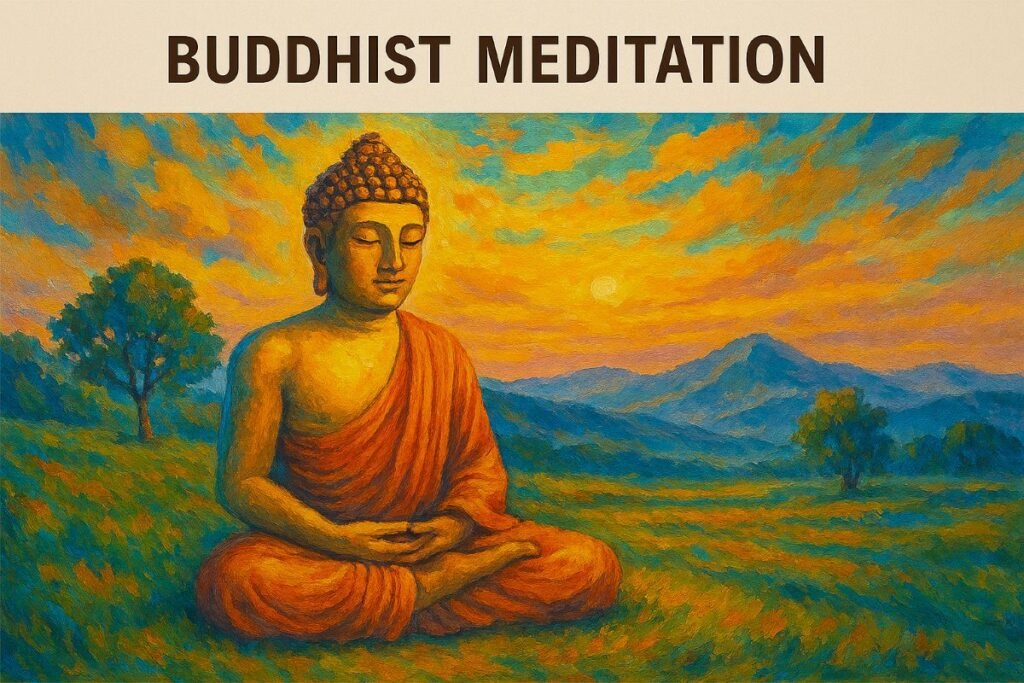
The Buddha often spoke of the four postures for meditation: sitting, standing, walking, and lying down. For sitting, stability and alertness are key.
- The traditional cross-legged postures (full-lotus, half-lotus, Burmese) promote a stable, grounded base.
- If these are difficult, sitting on a bench or chair is perfectly acceptable.
- The back is straight “like a stack of coins.”
- Hands rest in the lap (often right over left, palms up).
- Eyes are gently closed or half-open with a soft downward gaze.
This posture reflects dignity and readiness.
Environment:
Creating a simple altar can be a powerful puja (honoring) and a reminder of your aspiration. It need not be elaborate:
- A small statue or image of the Buddha
- A candle (representing wisdom)
- A flower (representing impermanence)
This space becomes a vihara, a dwelling place for practice, signaling to the mind a shift from worldly concerns to the Dhamma.
Part 2: The Practice – Walking the Buddha’s Path
Phase 1: Establishing the Ground with Sīla and Intention
1. Set Your Motivation (Chanda) in a Buddhist Context:
Reflect on the Noble Truths. Your practice is a direct investigation into the truth of suffering/dukkha and its cessation. Your intention might be: “May this practice be for the benefit of all beings,” or “May I cultivate a mind that is free from greed, hatred, and delusion.” This aligns your practice with bodhicitta or the wish for awakening.
2. Observe the Five Precepts (Pañcasīla) as a Foundation:
Your daily life is the ground of your meditation. Striving to live by the basic training rules creates a mind that is clear, light, and free from remorse, making deep concentration possible. The precepts are to refrain from:
- Harming living beings
- Taking what is not given
- Sexual misconduct
- False speech
- Intoxication
3. Choose Time and Place Consistently:
Dawn and dusk are traditionally auspicious. Mornings set the tone; evenings allow for review. Consistency builds the habit of practice (bhāvanā-maya).
Phase 2: The Core Practice – Ānāpānasati in Detail
Follow these steps, understanding them as the gradual training outlined by the Buddha:
- Preparation:
- Sit before your simple altar. Light a candle if you wish.
- Take refuge in the Triple Gem: “Buddhaṃ saranaṃ gacchāmi. Dhammaṃ saranaṃ gacchāmi. Saṅghaṃ saranaṃ gacchāmi.” (I go to the Buddha for refuge. I go to the Dhamma for refuge. I go to the Sangha for refuge.)
- Set your motivation for all beings.
- Establishing Mindfulness (Satipaṭṭhāna):
- Bring full awareness to the body sitting here. Feel the contact with the cushion, the hands in the lap.
- Gently direct attention to the breath at the nostrils or the abdomen. Don’t control it.
- Know the in-breath as the in-breath, the out-breath as the out-breath.
- Observing the Characteristics:
- As you settle, begin to notice the qualities of the breath—is it long or short, deep or shallow, coarse or subtle?
- Notice the beginning, middle, and end of each inhalation and exhalation.
- The Buddha advised to “calm the bodily formation,” letting the breath become peaceful naturally.
- Working with the Hindrances (Nīvaraṇa):
- When the mind wanders into sensual desire, ill-will, sloth-torpor, restlessness-worry, or doubt—the Five Hindrances, recognize them.
- Name them gently: “wanting,” “aversion,” “sleepiness,” “restlessness,” “doubt.”
- See them not as personal failures but as impersonal mental states that arise and pass. Let go and return to the breath. This is the heart of the training.
- Cultivating the Alternatives:
- Counter the hindrances by cultivating their opposites.
- Counter ill-will with a moment of loving-kindness/mettā.
- Counter sloth by brightening attention to the breath.
- Counter restlessness by relaxing the effort.
- Closing with Dedication of Merit (Pattidāna):
- At the timer’s gentle sound, don’t rush. Acknowledge the stillness cultivated.
- Dedicate the positive energy (puñña) of your practice: “Idaṃ me puññaṃ, āsavakkhayāvahaṃ hotu.” (May this merit of mine lead to the destruction of the defilements.)
- Or simply: “May the benefits of this practice be shared with all beings.”
Phase 3: Integrating with Walking Meditation and Dhamma Study
Walking Meditation (Cankama):
A formal practice, not a break.
- Choose a straight path 10-20 paces long.
- Walk slowly, with mindfulness fixed on the sensations of the feet lifting, moving, placing.
- When you reach the end, stand mindfully, turn, and begin again.
- This develops concentration in movement and bridges sitting with daily life.
Study (Pariyatti):
Your practice is informed by wisdom.
- Read a little of the Buddha’s words daily.
- The Dhammapada, the Satipaṭṭhāna Sutta, or the Mettā Sutta are profound starting points.
- Understanding the map (the Dhamma) helps you recognize the territory (your experience).
Part 3: The Fruits of Practice – Understanding the Benefits
The benefits in Buddhism are progressive milestones on the path:
- Purification of Mind (Cittavisuddhi): The initial calming of the hindrances leads to access concentration (upacāra-samādhi) and deeper states of calm (jhāna or dhyāna), characterized by rapture (pīti) and happiness (sukha) born of seclusion.
- Insight (Vipassanā): With a calm mind, you begin to see the Three Marks of Existence directly in your experience:
- The impermanence of each breath, thought, and sensation (anicca)
- The inherent unsatisfactoriness in clinging to them (dukkha)
- The lack of a permanent, controlling self behind it all (anattā)
- Cultivation of Divine Abidings (Brahmavihāras): Through mettā and related practices, you develop boundless heart-qualities:
- Loving-kindness (mettā)
- Compassion (karuṇā)
- Empathetic joy (muditā)
- Equanimity (upekkhā)
- The Ultimate Goal: The gradual weakening and final destruction of the defilements, leading to stream-entry (sotāpanna) and the successive stages of enlightenment, culminating in the peace of Nibbāna.
Part 4: Meeting Challenges as Part of the Path
The Buddha called obstacles “hindrances” and gave specific antidotes.
The Five Hindrances (Pañca Nīvaraṇāni):
These are not your fault; they are the default state of the untrained mind. Recognize them as the primary opponents to your practice.
| Hindrance | Traditional Antidote |
|---|---|
| Sensual Desire (Kāmacchanda) | Reflection on impermanence; contemplation of the unattractive nature of the object. |
| Ill-Will (Vyāpāda) | Cultivation of loving-kindness (mettā); reflection on the law of karma. |
| Sloth & Torpor (Thīna-Middha) | Applying energy; brightening the mind; reflecting on the preciousness of human birth. |
| Restlessness & Worry (Uddhacca-Kukkucca) | Calming the mind; gentle breath awareness; reflection on peace. |
| Doubt (Vicikicchā) | Study of the Dhamma; association with wise friends; investigation of the teachings. |
Other Common Challenges:
- Doubt About the Practice: This is natural. Counter it by associating with wise friends (kalyāṇamittatā), listening to the Dhamma, and developing a quality of “gladdening the mind” by reflecting on your own progress, however small.
- Laziness and Procrastination (Kusīta): Cultivate the sense of spiritual urgency (saṃvega), life is short, death is certain. Reflect on the preciousness of a human birth and the rarity of encountering the Buddha’s teachings.
- Physical Pain (Dukkha Vedanā): Use it as an object of mindfulness. Investigate it with curiosity as part of the First Foundation. Is it constant or fluctuating? Where exactly is it? This transforms pain from an enemy into a teacher of anicca and dukkha.
Part 5: Deepening – Connecting with the Sangha and the Path
Taking Refuge in the Three Jewels (Tisarana)
Your personal practice is supported by the broader context:
- The Buddha: The guide and inspiration.
- The Dhamma: The teachings and the truth you discover within.
- The Sangha: The community of practitioners. This is crucial.
Find a local temple, monastery, or meditation group. Listening to teachings from a qualified teacher (kalyanamitta) and practicing with others provides invaluable support, guidance, and inspiration.
Making Practice a Way of Life
- Mindful Work as Practice: See your daily tasks as opportunities for mindfulness (sati) and clear comprehension (sampajañña).
- Right Speech Practice: During the day, practice restraint with speech, using it truthfully, harmoniously, gently, and purposefully.
- Generosity (Dāna): Begin your spiritual journey with the practice of giving. Offer support to your local temple or a teacher. This opens the heart and reduces clinging.
Part 6: Traditional Resources for the Path
Essential Suttas (Discourses of the Buddha)
- Ānāpānasati Sutta (MN 118): On Mindfulness of Breathing.
- Satipaṭṭhāna Sutta (MN 10): The Great Discourse on the Foundations of Mindfulness.
- Mettā Sutta (Sn 1.8): The Discourse on Loving-Kindness.
- Dhammacakkappavattana Sutta (SN 56.11): The First Discourse, on the Four Noble Truths.
Books by Respected Teachers
- Mindfulness in Plain English by Bhante Henepola Gunaratana (Theravāda)
- The Heart of the Buddha’s Teaching by Thich Nhat Hanh (Engaged Buddhism)
- Turning the Mind Into an Ally by Sakyong Mipham Rinpoche (Tibetan)
Finding a Community
- Local: Search for Theravāda viharas, Zen centers, or Tibetan Buddhist centers in your area.
- Online: Access talks from Dharma Seed (Theravāda), Audio Dharma, or the Dalai Lama’s official website. Many monasteries now offer online retreats and study groups.
Conclusion: Beginning the Noble Journey
To start a daily meditation practice within the Buddhist tradition is to take your first conscious steps on the Noble Eightfold Path. It is an act of courage and faith—not blind faith, but the confidence to try out the Buddha’s instructions for yourself. You will stumble. The mind will rebel. This is the path.
Each time you sit with patience and kindness, each time you return to the breath, you are watering the seeds of your own buddha-nature. Begin today. Sit, breathe, and observe. Take refuge in the practice itself.
As the Buddha said, “Appamādena sampādetha”—”Accomplish all things with heedfulness.”
May your practice be steady, your heart be light, and may it ultimately bring benefit to you and to all beings everywhere.
Sabbe sattā bhavantu sukhitattā.
May all beings be happy.