Key Takeaways
- Kathina is a traditional Buddhist ceremony where lay followers offer a special robe and other requisites to the monastic community after the three‑month rains retreat.
- The name comes from the wooden frame [kaṭhina] used to cut and sew the robe, and it has come to mean the whole festival of unity and generosity.
- The festival is primarily a Theravāda observance, though related customs exist in some Mahāyāna and Vajrayāna communities.
- At its heart, Kathina is an act of shared giving [dāna], celebrating harmony within the Saṅgha and between monastics and lay supporters.
- The Kathina robe is offered to the entire Saṅgha, not to an individual monk, and the monastics must collectively agree on who will receive it.
- Once the robe is properly offered, the participating monks receive five temporary Vinaya allowances for a period of time, symbolising the fruits of collective merit.
- The ceremony is a powerful reminder that generosity, simplicity, and working together can be practised in daily life, not just in a temple.
- Understanding Kathina helps anyone, Buddhist or not, reflect on the value of mindful giving, community service, and letting go of attachment.
1. Introduction
When you first hear the word Kathina, it may seem like just another religious festival on a calendar. But look a little closer and you will find a rich tradition that weaves together generosity, community, monastic discipline and practical wisdom. Kathina is a celebration that has been observed for over two and a half thousand years, and its lessons reach far beyond the monastery walls. It offers a framework for how we can give with a clear heart, how we can work together in harmony, and how simple acts of kindness can create a lasting sense of purpose.
This article explores Kathina from its scriptural roots to its modern expressions around the world. We will examine the historical background, the core story, the spiritual teachings, the ways the festival is observed, and how its central themes can be applied to everyday life. No prior knowledge is assumed.
2. Origins and Historical Development
The Kathina ceremony finds its origin in the time of the historical Buddha, Siddhattha Gotama. To understand why it began, we first need to understand the monastic practice of the rains retreat, known in Pali as Vassa.
2.1 The Rains Retreat (Vassa)
In the Indian subcontinent, the monsoon season brings heavy rains, flooding and an abundance of new plant and insect life. During the Buddha’s time, wandering monks would travel throughout the year, teaching and practising meditation. However, during the rainy season, walking long distances became difficult and could easily harm crops and tiny creatures on the paths. Many other ascetic groups already observed a rainy‑season retreat, and lay people began to criticise the Buddha’s disciples for travelling while the fields were full of life. In response, the Buddha established a training rule: from the full moon of the eighth lunar month (roughly July) until the full moon of the eleventh month (roughly October), monks and nuns would remain settled in one residence.
This three‑month period of Vassa became a time for intensive practice, study, teaching, and a deepening of the relationship between the monastic community [Saṅgha] and the lay supporters who provided their meals and shelter. At the end of Vassa, the monastics would gather, perform the formal invitation ceremony [Pavāraṇā], and then resume their wandering. It was at this transition point that the Kathina tradition was born.
2.2 How the Kathina Robe Tradition Began
According to the Vinaya Piṭaka, the collection of monastic rules, a group of thirty forest‑dwelling monks from the city of Pāvā, known as the Pāveyyaka monks, once set out to spend the Vassa with the Buddha in Sāvatthi. They were known for their strict ascetic practice and dedication to forest dwelling. They travelled diligently but, as the heavy rains arrived, they realised they would not reach the Buddha in time. They decided to stop and observe the retreat in a town on the way. When the three months ended, they continued their journey in wet and muddy conditions, their robes soaked and heavy. When they finally arrived and paid their respects, the Buddha saw their exhausted and bedraggled state.
Out of compassion and as a way to encourage communal harmony and generosity, the Buddha announced a new allowance: each year, after the completion of the rains retreat, lay followers could offer a special cloth to the Saṅgha. The monks would then cooperate to cut, sew and dye the cloth into a robe within that same day. The monk who received the robe, along with all the eligible monks who participated, would enjoy a set of five temporary Vinaya allowances for the following four lunar months (the kaṭhina period). The cloth itself would be stretched over a wooden frame called a kaṭhina, from which the ceremony takes its name.
Thus, Kathina emerged not as a pre‑planned ritual, but as a practical, compassionate response to real conditions. It immediately involved three essential parties: the lay supporters who gave the cloth, the Saṅgha who worked together to make the robe, and the individual monk who received the privileges.
3. Scriptural Foundations
The primary source for the Kathina ceremony is the Vinaya Mahāvagga, specifically the Kaṭhina Khandhaka (the section on the Kathina). For those who wish to read the original texts, a translation is available as the Vinaya Mahāvagga, Kaṭhina Khandhaka. The rules set out there are remarkably detailed, covering what constitutes a valid Vassa, which monastics are eligible, the correct cloth, the proper boundaries of the ceremony, and the five privileges that follow.
3.1 Eligibility and Conditions
For a Kathina robe offering to be valid according to the Vinaya, several conditions must be met:
- The Saṅgha must have properly completed the three‑month rains retreat in a single agreed residence. Monks who break the retreat without a valid reason are not eligible to participate.
- The cloth must be offered to the Saṅgha as a whole, not to an individual monk. It must be given on a day within the specified period, from the day after the end of Vassa (the full moon of the eleventh lunar month) until the next full moon.
- The offering must be entirely spontaneous and unprompted. Monastics are strictly forbidden from asking for the cloth, dropping hints, or in any way organising laypeople to provide it. If a monk even mentions to a layperson that offering a Kathina robe brings great merit, any cloth given as a result is considered “intimated cloth” [viññatti‑dussa] and becomes invalid for the ceremony. This rule is essential because it ensures the purity of the lay community’s generosity and guarantees that Kathina is genuinely lay‑driven.
- On the day of the offering, the Saṅgha must perform a formal act of agreement. They assemble, accept the cloth, and then collectively decide which monk will receive it. The chosen monk must be one who has completed Vassa correctly and is present and consenting.
- Traditionally, the cloth was cut, sewn and dyed by the Saṅgha, although contemporary practice varies according to Vinaya interpretation and local custom. The essential requirement is that the Saṅgha performs the formal acceptance and determination on the Kathina day; the physical sewing may be symbolic or abbreviated depending on local practice.
These conditions show that Kathina is far more than a donation. It is a communal act that requires the entire Saṅgha to work together, underlining the value of harmony and mutual support.
3.2 The Five Privileges [Pañcānisaṃsā]
Once the Kathina robe is properly offered and accepted, the monk who receives it, and all the monks who participated in the ceremony, enjoy five temporary relaxations of certain training rules. These five benefits [pañcānisaṃsā] are:
- An invitation‑meal allowance: They may accept a meal invitation without prior notice under certain circumstances.
- The extra‑robe allowance: They may keep an extra robe without formally determining its use for a specific period.
- The group‑meal allowance: They may eat in a group outside of the normal communal meal arrangements without offence.
- The choice‑of‑robe allowance: They may keep a robe wherever they like, not necessarily within the usual arm’s reach at night.
- The privilege of the robe‑season: They are entitled to receive robe‑cloth during the four‑month Kathina period and still have it count towards the robe‑season, which is a time when cloth can be properly allocated.
Only one Kathina may be performed per monastery per year, and the privileges arise only from that single act. These allowances are minor but highly practical. They reflect the idea that the collective harmony and generosity of the Kathina act brings an ease to the monastic life, a gentle reward of freedom within discipline. They are not exemptions from moral conduct, but practical accommodations that allow the Saṅgha to focus on teaching and meditation.
4. The Core Story
While the Vinaya account provides the framework, the story of the thirty Pāveyyaka monks is a human story of effort, disappointment, compassion and community. It holds lessons that reach far beyond monastic law.
The monks set out with a clear aim: to spend the Vassa near the Buddha. Their journey was motivated by a desire to learn directly from the teacher. When they realised they could not reach him in time, they faced a choice. They could push on and break the rule, or they could accept the situation, settle where they were, and make the best of it. They chose the latter, showing respect for the training and for the natural world that the rule was designed to protect.
When they finally arrived, they came not as triumphant disciples but as weary travellers, soaked and heavy‑robed. The Buddha did not rebuke them for being late. Instead, he recognised their sincerity and their physical state. The allowance he gave was both a material help, a lighter, dry robe, and a spiritual instruction. He transformed a small difficulty into an opportunity for the Saṅgha and the lay community to unite.
This origin story reminds us that disappointment need not lead to discouragement. When we adapt to circumstances with integrity, unexpected opportunities for growth and connection can arise. The monks’ patience became the cause for a lasting institution of generosity.
5. Growth into a Calendar Festival
What began as a practical Vinaya ruling gradually grew into one of the most vibrant and eagerly awaited festivals of the Theravāda year. Over centuries, Kathina absorbed local customs, art forms and community rhythms, yet its core structure remained faithful to the Vinaya.
5.1 From Monastic Ceremony to Community Celebration
In the early days, the offering was probably a quiet, internal affair. As Buddhism spread across South and Southeast Asia, the relationship between Saṅgha and laity deepened. Kings, merchants and village communities began to see the Kathina robe as a way to earn great merit [puñña]. The ceremony became a major public event. The cloth offering was accompanied by parades, music, dance, and the provision of many other requisites for the monastery: food, medicine, building materials and even scholarship funds.
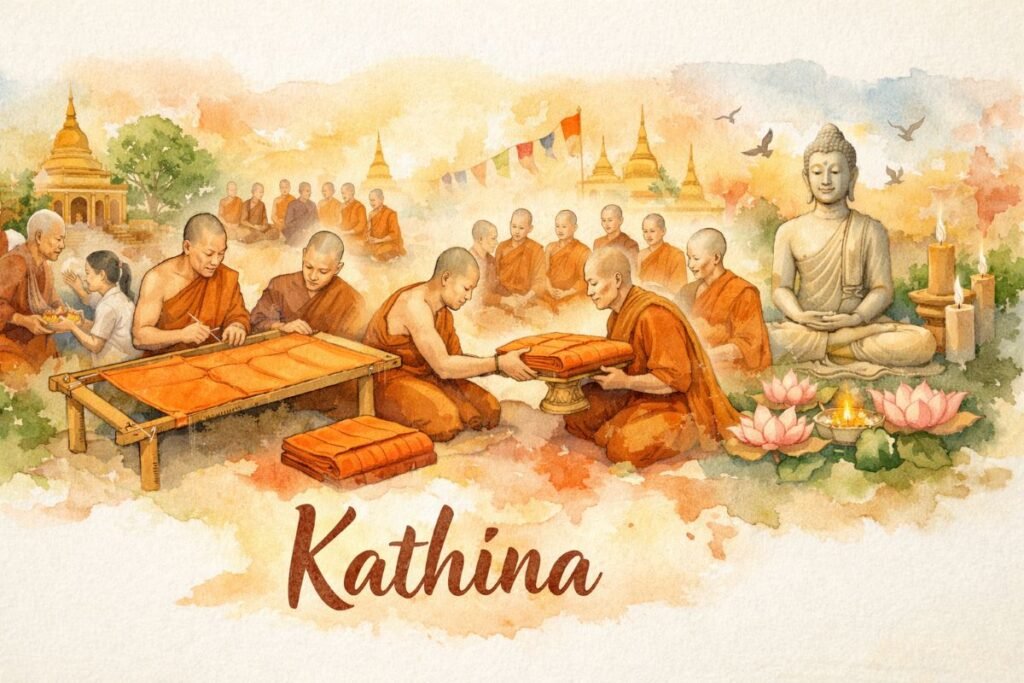
The one‑day cloth‑making process became a symbolic centrepiece. The laity would present the cloth early in the morning. The monks would then work together, cutting, stitching and dyeing the robe, while the community waited, offered food, and participated in devotional activities. By evening, the finished robe would be formally offered to the nominated monk in a ceremony filled with chanting and blessings.
5.2 The Kathina Period and the End of the Festival
The Kathina season lasts for one lunar month, from the day after the Pavāraṇā full moon to the next full moon. During this time, any Saṅgha that has properly completed Vassa may hold its Kathina. Because only one Kathina can be held per monastery per year, the community must organise itself carefully. In areas with many temples, the dates are often staggered so that lay supporters can attend multiple ceremonies, though the offering is traditionally regarded as especially meritorious when made to a united and harmonious Saṅgha.
If no Kathina is performed within that month, the opportunity is lost for the year. This time‑bound nature adds a sense of purpose and urgency. It reminds participants that wholesome actions are best done now, not left to some indefinite future.
6. Spiritual Meaning and Central Teachings
Kathina is not just a cultural event. It is a living expression of several foundational Buddhist principles that can be applied far beyond the temple. At its heart, Kathina embodies the reciprocal relationship between the lay community and the Saṅgha. The lay supporters provide material requisites, and the Saṅgha provides teachings and an inspiring example. This mutual exchange, the giving of material things [āmisa‑dāna] and the giving of the teachings [dhamma‑dāna], is a central dynamic in Buddhist life. Kathina is one of the most vivid expressions of this relationship, specifically focused on the offering of robes and other monastic requisites. The Buddha identified four basic necessities, known as the four requisites, that the laity may offer: robes, food, lodging and medicine. Kathina is essentially a celebration centred on the first of these, though all four are often provided during the ceremony.
6.1 The Main Dhamma Message: Generosity, Harmony and Shared Merit
The most immediate teaching is generosity [dāna]. In the Buddhist framework, dāna is the first of the ten perfections [pāramī] and the starting point for a life of ethical and mental development. Kathina illustrates a particularly deep form of giving because it is directed to the Saṅgha as a whole, with no expectation of personal return. The giver does not even choose the recipient; the Saṅgha decides. This loosens any subtle attachment to controlling the outcome of one’s generosity.
The ceremony also emphasises harmony within the Saṅgha. The monks must agree unanimously on who receives the robe. Disputes or factions would render the Kathina invalid. In the same way, the act of sewing the robe together in a single day requires cooperation, patience and mindfulness. The physical robe becomes a tangible symbol of unity, a garment woven from the collective effort of many hands.
Finally, Kathina is about shared merit [puñña]. In Buddhist psychology, merit is the wholesome potential created by skilful actions of body, speech and mind. When many people contribute to a single act of giving, and when the Saṅgha performs the ceremony together, all participants share in the wholesome karma generated by the collective act. This idea is wonderfully inclusive: a person who gives even a small amount of cloth or a needle and thread participates in the whole. No contribution is too small.
6.2 Symbolism and Its Practical Lesson
The wooden frame, the kaṭhina itself, is rich with symbolic meaning. In Pali, kaṭhina means “firm,” “stable” or “solid.” It is the frame upon which the cloth is stretched so it can be cut and sewn accurately. In the context of the mind, it suggests a firm foundation of virtue and concentration upon which wisdom can be cultivated. The frame is a temporary support, discarded once the robe is made, much like the raft that is left behind after crossing a river in the famous simile.
The robe itself, made from donated cloth, often from multiple pieces, carries its own lessons. In the Buddha’s time, monks collected discarded or unwanted fabric, cloth used to wrap corpses, rags from the roadside, and pieced them together to form the patchwork robe. This practice, known as paṃsukūla, is a meditation on impermanence, simplicity and detachment from appearance. It is worth noting that the paṃsukūla robe and the Kathina robe are distinct: the former is made from discarded cloth gathered by the monk, the latter from cloth offered specifically for the Kathina ceremony. Even though modern Kathina robes are typically made from new, high‑quality cloth, the symbolism remains: the robe represents a life of few possessions, a life dedicated to letting go.
For the lay supporter, offering the cloth is an opportunity to practise non‑attachment. The donor gives away something valuable, knowing it will be transformed into a monastic robe and never returned. In a world that constantly urges us to acquire, keep and display, this simple act is a quiet revolution. It trains the mind to find joy in releasing rather than grasping.
6.3 Frameworks for Understanding
Kathina can be understood through several useful Buddhist frameworks.
The Three Bases of Merit [Puññakiriyavatthu]
The Buddha taught that there are three main ways to create merit: dāna (generosity), sīla (virtue) and bhāvanā (mental cultivation). Kathina involves all three. The lay community practises dāna by giving the cloth and other requisites. The Saṅgha practises sīla by following the Vinaya procedures meticulously. And everyone present has an opportunity for bhāvanā, reflecting on impermanence, cultivating loving‑kindness, and dedicating the merit for the welfare of others.
The Field of Merit
The Saṅgha is often described as an incomparable field of merit for the world, as taught in the Dakkhiṇāvibhaṅga Sutta (MN 142). Just as a farmer plants seeds in a fertile field to yield a good crop, a person who gives to a virtuous and harmonious Saṅgha plants seeds of kusala (wholesome action) that bring results of happiness and well‑being. The Kathina offering is considered especially fruitful because the Saṅgha has just completed an intensive period of practice during Vassa.
The Six Qualities of a Harmonious Saṅgha
The effectiveness of the Kathina hinges on the Saṅgha’s ability to act in concord. The Buddha outlined six qualities that lead to harmony [Sāraṇīya Dhamma]: mettā (loving‑kindness) in bodily action, speech and thought towards fellow monastics, sharing one’s gains, keeping the same ethical precepts, and holding the same right view. Kathina provides a concrete opportunity to put these into practice.
The Household Life and the Holy Life
Kathina is a bridge between the household life and the monastic life. It shows that the two are not separate but interdependent. The lay community supports the Saṅgha materially, and the Saṅgha supports the lay community with teachings and an inspiring example. This mutual exchange is called āmisa‑dāna and dhamma‑dāna, the giving of material things and the giving of the teachings. Both are considered supreme gifts.
7. How the Holiday Is Observed
A Kathina ceremony today is a rich tapestry of sights, sounds and rituals. While details vary by country and local tradition, the core elements remain remarkably consistent.
7.1 Temple and Monastic Practices
Before the ceremony, the monks must have concluded Vassa correctly. On the morning of the Kathina, the laity bring the main cloth, often a large roll of white or off‑white cotton, in a procession to the temple. After taking the Three Refuges and the Five Precepts, the lay representatives formally invite the Saṅgha to accept the cloth.
The monks then hold the Kathina ceremony inside the consecrated boundary [sīmā]. This is a Vinaya act that requires a quorum. The senior monk announces the purpose and asks for the Saṅgha’s approval. Once all consent, the cloth is accepted. The Saṅgha then decides by a formal motion which monk will receive the robe. The chosen monk must be present, have completed Vassa without break, and not be under any disciplinary penalty.
After the formal acceptance, the monks begin the work of preparing the robe. In many traditional temples, they will cut the cloth into the prescribed panels, stitch them together with rapid, co‑operative effort, dye the robe in a saffron or ochre colour using natural dyes, and then dry it. This process can take several hours, often accompanied by chanting and the sounding of drums or bells. In some modern settings, the robe may be pre‑sewn to save time, but the sense of collective ritual remains important. It is worth noting that the physical sewing may be symbolic or abbreviated depending on local practice; what is essential is the formal acceptance and determination by the Saṅgha on the Kathina day.
Once the robe is ready, it is again formally presented. The recipient monk accepts it, and the Saṅgha chant verses of blessing and rejoicing. From that moment, the five privileges come into effect for the monks who participated.
7.2 Lay Observances
For lay Buddhists, Kathina is a day of heightened meritorious activity. Before the ceremony, families and communities may spend weeks preparing. They collect donations, purchase cloth and supplies, and organise transport and food. Many people observe the eight precepts for the day, wearing white and spending the day at the monastery in meditation, listening to Dhamma talks, and helping with the many practical tasks.
The act of offering is not limited to the robe. Lay supporters also provide the full range of monastic requisites: alms bowls, razor blades, medicines, umbrellas, sandals, candles, incense and, very commonly, money for the monastery’s maintenance and charitable work. All offerings are pooled and given to the Saṅgha, not to individuals. This collective approach prevents favouritism and reinforces the principle that the Saṅgha is a community, not a collection of solitary practitioners.
7.3 Community and Family Customs
Kathina is a deeply social occasion. In many villages, it is the largest annual event after the New Year. Families return to their ancestral villages to participate. There are often colourful processions, sometimes with the cloth carried on a decorated float or in a palanquin, accompanied by traditional dancers and musicians.
Food is a central part of the day. Devotees prepare elaborate meals and offer them to the monks in the morning and at noon. After the formal ceremony, the laity share a communal meal. This gathering strengthens social bonds, heals conflicts, and reminds everyone that the temple is a shared spiritual home.
Children are actively involved. They help carry flags, scatter flowers, and join in the chanting. Through these joyful activities, they absorb the values of generosity and respect for the Saṅgha naturally, without the need for formal instruction.
7.4 Liturgical Timing and the Lunar Calendar
The timing of Kathina is tied to the lunar calendar. The Vassa ends on the full moon of the eleventh lunar month, usually in October. The next day, the waning‑moon period begins, and with it, the Kathina season. The season closes exactly one lunar month later, on the next full moon, usually in November. This period is called the Kathina‑māsa, the Kathina month.
Because the lunar calendar shifts relative to the solar year, the dates vary. In different countries, calendars may be adjusted by local astronomical calculations, which can lead to minor regional differences. However, the universal principle is the same: one month, one Kathina per monastery, one opportunity to join together in this unique act.
8. Regional Expressions Across Buddhist Schools
The Kathina ceremony is overwhelmingly a Theravāda institution, but it has travelled and adapted. Understanding its expressions in different Buddhist schools helps us see both its particularity and its universal appeal.
8.1 Theravāda Traditions
Theravāda Buddhism is practised primarily in Sri Lanka, Myanmar (Burma), Thailand, Laos, and Cambodia. In all these countries, Kathina is a major annual festival, often designated as a national holiday or a special day.
- Thailand: Here the ceremony is called Thot Kathin (ทอดกฐิน). It is one of the most important ceremonies of the year. Thailand also preserves the Royal Kathina tradition, where the King or his representatives sponsor a Kathina at prominent temples. At the same time, thousands of local Kathina ceremonies take place in villages and urban monasteries. The procession is often led by a long‑tail boat along klongs (canals), or by a colourful parade with dancers and drummers. The money tree, a symbolic structure with banknotes attached, is a common offering.
- Myanmar: The Kahtein ceremony is a similarly major event. The robe is carried in a grand procession, often with the donors dressed in fine traditional attire. In many communities, a special pavilion is built where the cloth is woven and sewn in a single night by teams of women before being offered at dawn. This night‑long weaving, accompanied by singing and the recitation of protective chants, is a powerful expression of devotion.
- Sri Lanka: The Kathina Cheevara Pooja is a time of great religious fervour. Processions may include drummers, horn players, and even elephants. The ceremony follows the Vinaya procedure carefully, with the robe often being cut and stitched by the monks during the day. Many lay followers observe eight precepts and spend the entire day at the temple.
- Laos and Cambodia: Similar traditions flourish, with the robe procession being a central feature. In Cambodia, the ceremony is called Kathin Tean and is often held at the end of Vassa. In both countries, Kathina is a time for reinforcing communal ties and for making merit on behalf of deceased relatives.
In all these regions, the underlying meaning remains the same. The differences are in the cultural garments, the music and the local flavour, not in the core Dhamma.
8.2 Mahāyāna Traditions
Kathina is not historically part of the mainstream Mahāyāna calendar, because Mahāyāna monastics did not follow exactly the same Vinaya tradition concerning the Vassa and Kathina. However, where Theravāda and Mahāyāna cultures have blended, or where Mahāyāna communities have adopted certain Theravāda customs, some form of robe‑offering ceremony may occur.
For example, in Vietnam, which has a strong Theravāda minority alongside the Mahāyāna majority, Theravāda temples hold Kathina while some Mahāyāna temples have adopted a dâng y (robe offering) ceremony around the same time. The underlying intent of supporting the Saṅgha and honouring the end of the retreat is similar, though the strict Vinaya procedure and the five privileges may not be observed.
In Chinese Buddhism, a similar practice called “robe offering to the Saṅgha” (供僧衣, gōng sēng yī) can take place after the summer retreat. The Chinese monastic tradition also observes a summer rains retreat (安居, ānjū), and the end of the retreat is a time for the laity to offer robes and requisites. However, the specific Kathina frame and the one‑day robe‑making ritual are absent. Instead, the emphasis is on expressing gratitude to the Saṅgha. This illustrates how the same principle, supporting the community of practitioners, manifests in different forms.
8.3 Vajrayāna Traditions
In the Vajrayāna traditions of Tibet, Bhutan, Mongolia and parts of the Himalayan region, the annual monastic cycle also includes a summer retreat, called Yarne (དབྱར་གནས). At the end of Yarne, there is a ceremony known as the “end‑of‑retreat offering.” Lay people bring robes, food and other offerings, and the monastics perform rituals to mark the conclusion of the intensive practice period.
However, the specific Kathina ceremony with the wooden frame, the single‑day robe making, and the five privileges is not part of the Tibetan Vinaya, which follows the Mūlasarvāstivāda tradition. The Mūlasarvāstivāda Vinaya does contain a parallel to the Kaṭhina section, but the practice fell into relative obscurity in Tibet. In recent years, some Theravāda‑Vajrayāna exchanges have led to a revival of interest, but Kathina as such is not a widespread Vajrayāna festival.
8.4 The Holiday in Global and Western Contexts
As Buddhism has spread to the West, Kathina has followed. Monasteries founded by Theravāda communities in the United States, the United Kingdom, Australia, and other Western countries now hold Kathina ceremonies. These events are often adapted to local conditions. The cloth may not be cut and sewn on the day due to time constraints and the small number of resident monks, but the spirit of collective offering remains.
Western Kathina ceremonies often blend traditional elements with contemporary forms. Dhamma talks may be given in English, and the community potluck has become a common feature. The ceremony has become an important expression of Buddhist generosity in multicultural communities, serving as a vital connection point for Asian diaspora communities and as a beautiful introduction for newcomers to Buddhist values of generosity and community.
9. Relevance for Modern Life and Daily Application
The beauty of Kathina is that its core teachings can be put into practice by anyone, regardless of religious background. You do not need to live near a monastery or even be a Buddhist to learn from it.
9.1 Cultivating the Holiday’s Quality at Home
The quality at the heart of Kathina is dāna, giving with a free and joyful heart. You can cultivate this quality in simple, everyday ways.
- Give without expecting anything back. Next time you help a friend or donate to a cause, pay attention to any feeling of wanting recognition. Can you let that go? The gift itself is the reward.
- Practise collective giving. Join with others to support a project bigger than any one person could manage alone. It might be a community garden, a scholarship fund, or a local clean‑up effort. The joy of shared accomplishment mirrors the Saṅgha’s cooperative robe‑making.
- Make time for simplicity. Set aside one day a month to live with fewer conveniences, mirroring the monk’s life of few possessions. Notice what happens to your mind when you cannot reach for your usual comforts.
- Offer the gift of your presence. The Kathina ceremony involves many hours of sitting, listening, and being together. In a world of constant distraction, simply being fully present with others is a profound gift.
9.2 Navigating Challenges with the Holiday’s Wisdom
Life inevitably brings challenges. The story of the thirty monks shows us a wise way to respond when things do not go as planned.
- When plans fail, adapt with integrity. The monks did not abandon their commitment when they could not reach their goal. They found a worthy alternative. When you face a setback, ask yourself: “What is the most wholesome action I can take right now within these new conditions?”
- Transform disappointment into generosity. The Buddha turned the monks’ bedraggled state into a cause for an enduring tradition. In your own life, a moment of struggle can become the starting point for something meaningful if you respond with compassion rather than frustration.
- Work through conflict with the Saṅgha’s harmony in mind. The Kathina requires unanimous agreement. In your family or workplace, when decisions need to be made, can you aim for consensus rather than compromise? This takes time and deep listening, but the result is a much stronger collective commitment.
- Use the five privileges as a metaphor for inner freedom. The monks’ allowances are not licences, but expressions of ease that arise from disciplined practice. Similarly, a well‑ordered life creates space for genuine relaxation. If you find yourself constantly rushing, look at your basic daily discipline. A small adjustment in routine can open up surprising freedom.
9.3 Social and Environmental Dimensions
Kathina has something to say about how we relate to society and the planet.
Social dimension: equality and inclusion. The Kathina cloth is given to the Saṅgha, not to a favourite monk. This prevents the donor‑recipient relationship from becoming personal and potentially unequal. It is a reminder that true generosity does not create dependency. In modern charitable work, this translates to giving in ways that uphold the dignity of recipients and empower communities, rather than creating a saviour‑complex.
Environmental dimension: the paṃsukūla spirit. The original practice of using discarded cloth speaks directly to today’s environmental crisis. The paṃsukūla robe is a statement that what is thrown away can become something sacred. This invites us to reconsider our relationship with material goods. Instead of always buying new, can we repair, repurpose and share? The Kathina frame itself is a tool for mending and making do, not for discarding.
A modern Kathina‑inspired practice might be a community “robe‑making” day where people gather to repair clothing, make blankets for those in need, or learn traditional sewing skills. The act of sitting together, stitching and talking, builds community while reducing waste. This is dāna extended to the earth.
10. Common Misunderstandings and Clarifications
Despite its long history, several misconceptions surround Kathina. Clarity on these points can deepen appreciation and prevent well‑intentioned missteps.
Misunderstanding 1: “Kathina is a festival of robe giving to a particular monk.”
Clarification: The robe is always offered to the entire Saṅgha. The Saṅgha then formally bestows it on one monk. Giving directly to an individual does not constitute a Kathina and does not bring the same privileges.
Misunderstanding 2: “The privileges are special powers or spiritual attainments.”
Clarification: The five privileges are entirely practical Vinaya allowances. They are not signs of holiness or supernatural ability. They simply make the monastic life a little easier for a defined period, allowing the monks to focus on practice.
Misunderstanding 3: “Only rich people can perform Kathina because it is expensive.”
Clarification: While large ceremonies can involve significant expense, the Kathina itself requires only cloth. The Buddha designed it so that even the poorest person could offer a small piece of cloth if the community pooled resources. Collective giving makes it accessible to everyone.
Misunderstanding 4: “The robe must be made from new, expensive fabric.”
Clarification: Historically, the cloth could be new or used, simple or fine. The spirit of the offering is more important than the monetary value. Many temple communities still value the use of humble, hand‑woven cloth.
Misunderstanding 5: “Kathina is a Theravāda‑only holiday that excludes other Buddhists.”
Clarification: While Kathina as a Vinaya procedure is Theravāda, the underlying values of generosity, community support and respect for the Saṅgha are universal. Mahāyāna and Vajrayāna traditions have their own forms of robe‑offering and retreat‑ending celebrations that share the same spirit.
Misunderstanding 6: “If I attend a Kathina, I receive automatic merit without any effort.”
Clarification: In Buddhist teaching, merit arises from the wholesome intention [cetanā] behind the action. Attending with a distracted or prideful mind yields little benefit. The merit comes from genuinely rejoicing in the giving, from purifying one’s own mind, and from dedicating the goodness to the welfare of all. It is an active, not passive, process.
11. Conclusion
Kathina is far more than a robe‑offering ceremony. It is a living lesson in generosity, harmony, simplicity and mutual support. From its origins in the muddy paths of ancient India to its contemporary expressions in cities, towns, and villages around the world, it carries a timeless invitation. It asks us to pause, to look at what we have, and to consider what we can give.
The wooden frame that gives the festival its name reminds us of the need for a firm foundation. Whether that foundation is ethical conduct, a calm mind, or a supportive community, everything else can be built upon it. The cooperative sewing of the robe shows that even a patchwork of many small efforts can become something whole and beautiful. The privileges that follow the ceremony speak of a joy that is not opposed to discipline but grows out of it.
For the layperson, Kathina offers a direct, tangible way to connect with the Buddha’s teaching. You do not need to meditate for hours or master complex philosophy. You simply need to give, with a clear intention, as part of a community. And then you can watch as that simple act ripples outward, strengthening the Saṅgha, preserving the teachings, and inspiring others.
In a fragmented world, Kathina is a reminder that we belong to one another. The lay community and the monastic community are two strands of the same cloth. When we weave them together with mindfulness and care, the fabric of the Dhamma remains strong, generation after generation.
Glossary
- Bhāvanā: Mental cultivation or development, usually through meditation. One of the three bases of merit.
- Cetanā: Volition or intention. The mental factor that gives an action its moral quality.
- Dāna: Generosity or giving. The practice of offering material things, time, or knowledge without expecting anything in return.
- Dhamma (Sanskrit: Dharma): The teachings of the Buddha; the truth about the nature of reality; the path of practice.
- Kaṭhina: Literally “firm” or “solid.” The wooden frame used to stretch cloth for cutting and sewing a robe; the name of the ceremony itself.
- Pañcānisaṃsā: The five benefits or privileges temporarily granted to eligible monks after a valid Kathina ceremony.
- Pāramī (Sanskrit: Pāramitā): A perfection or noble quality developed over many lifetimes. Dāna is one of the ten pāramī.
- Paṃsukūla: Robes made from discarded or rag cloth. A practice that emphasises simplicity and detachment. Distinct from the Kathina robe.
- Pavāraṇā: The invitation ceremony at the end of Vassa where monastics invite each other to point out any faults seen, heard or suspected.
- Puñña: Merit; the wholesome potential created by skilful actions, leading to future happiness and supporting the path to liberation.
- Saṅgha: The community of Buddhist monks and nuns; in its highest sense, the Noble Saṅgha of those who have attained stages of awakening.
- Sīla: Ethical conduct or virtue. The foundation of all spiritual progress.
- Sīmā: A consecrated boundary within which formal Saṅgha acts are performed.
- Vassa: The annual three‑month rains retreat observed by Buddhist monastics, a period of stable residence and intensified practice.
- Vinaya: The collection of monastic rules and procedures that govern the life of the Saṅgha.
- Viññatti‑dussa: Intimated cloth; cloth obtained after a monastic has hinted, asked, or otherwise prompted the offering, making it invalid for the Kathina ceremony.
Further Resources
- Books:
The Buddhist Monastic Code I & II by Ṭhānissaro Bhikkhu, a detailed and accessible explanation of the Vinaya rules, including the Kaṭhina chapter.
What the Buddha Taught by Walpola Rahula, a classic introduction to core Buddhist teachings including dāna, sīla and bhāvanā. - Online Suttas:
Vinaya Mahāvagga, Kaṭhina Khandhaka, the primary scriptural source for the Kathina ceremony.
Dakkhiṇāvibhaṅga Sutta (MN 142), a discourse on the field of merit and the results of giving to different recipients.
Dāna Sutta (AN 7.49), the Buddha’s teaching on the motivations for giving and their fruits. - Podcasts & Talks:
Many Dhamma teachers give annual Kathina talks available on streaming platforms. Look for talks by Ajahn Brahm, Ajahn Sucitto, or Bhikkhu Bodhi, often titled “Kathina Dhamma Talk” or “The Spirit of Giving.”
The Buddhist Society of Western Australia and Abhayagiri Monastery regularly post Kathina ceremony recordings on their YouTube channels. - Experiential Learning:
If possible, attend a Kathina ceremony at a local Theravāda monastery. The experience of being present, offering, and listening to the chanting is a powerful teacher in itself.