Introduction
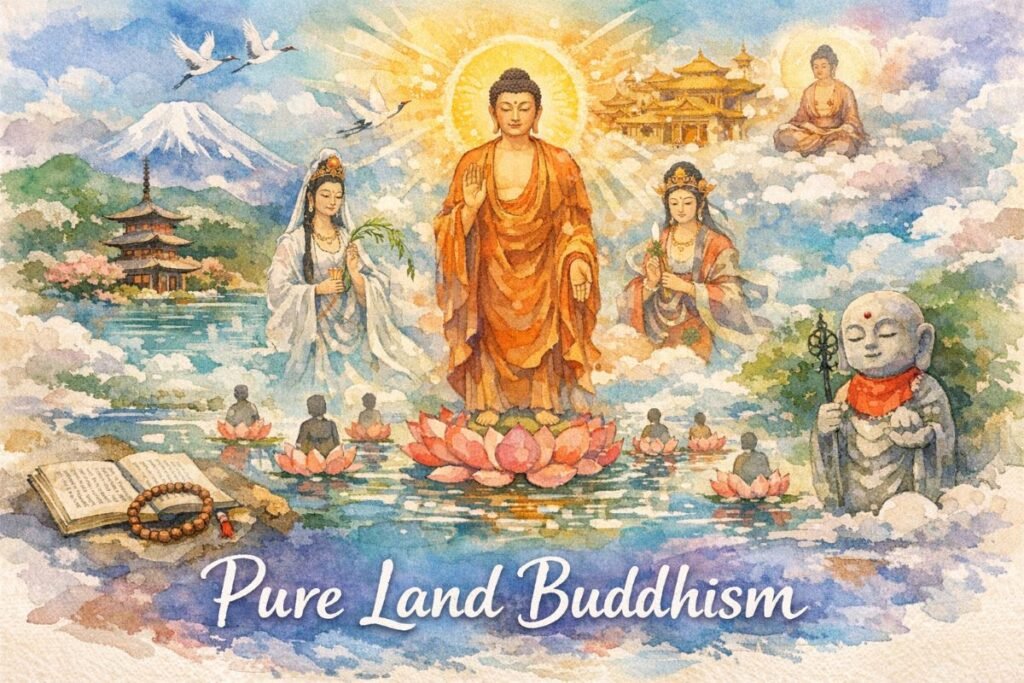
Pure Land Buddhism is one of the most widely practiced traditions within Mahayana Buddhism, with a history spanning nearly two millennia and a global presence today. Centered on trust in the compassionate vow of the Buddha Amitābha and the aspiration for rebirth in his Pure Land of Sukhāvatī, this tradition offers a path to liberation that emphasizes accessibility, devotion, and the transformative power of faith.
This guide provides a short overview of Pure Land Buddhism, examining its historical development, core doctrines, practices, ethical framework, communal life, festivals, and contemporary adaptations.
Part One: Historical Origins and Development
Section 1: Early Foundations in India
The conceptual foundations of Pure Land Buddhism emerged with the rise of Mahayana Buddhism in India around the first century BCE to first century CE. Central to this development was the concept of buddha-fields (buddhakṣetra), transcendent realms purified by a Buddha’s compassion and merit where beings can hear the Dharma without the obstacles of ordinary existence.
Among the various buddha-fields described in Mahayana literature, the western realm of Sukhāvatī, created by the bodhisattva Dharmākara, gained particular prominence. According to the Longer Sukhāvatīvyūha Sūtra, Dharmākara was a king who, inspired by the Buddha Lokeśvararāja, renounced his throne, became a monk, and made forty-eight profound vows. Upon fulfilling these vows, he became the Buddha Amitābha (“Infinite Light”) and Amitāyus (“Infinite Life”), and his land, Sukhāvatī, became the foremost pure land.
The eighteenth vow, known as the Primal Vow, became the cornerstone of Pure Land faith: “If, when I attain Buddhahood, sentient beings in the lands of the ten directions who sincerely and joyfully entrust themselves to me, desire to be born in my land, and call my name even ten times, should not be born there, may I not attain perfect enlightenment.”
Section 2: Transmission and Development in China
Pure Land thought traveled to China via the Silk Road, with key sutras translated as early as the second century CE by figures like Lokakṣema. In 402 CE, the scholar-monk Huiyuan (334–416) gathered 123 like-minded monks, scholars, and laypeople at Mount Lu to form a devotional society focused on rebirth in Sukhāvatī through meditation on Amitābha. This is widely regarded as a foundational moment for organized Pure Land practice in China.
The sixth and seventh centuries marked a period of systematic doctrinal development. Tanluan (476–542), originally a Mādhyamaka scholar, turned to Pure Land practice and wrote a seminal commentary on Vasubandhu’s Discourse on the Pure Land. He introduced the crucial distinction between the “Difficult Path” of self-power (jiriki) and the “Easy Path” of other-power (tariki), arguing that relying on Amitābha’s compassionate vows is like crossing a river by boat rather than swimming.
Daochuo (562–645) further promoted Pure Land practice in his Collection of Passages on the Pure Land, arguing that humanity had entered an age of declining Dharma. His disciple Shandao (613–681) became the most influential figure in Chinese Pure Land, systematizing practice and emphasizing the recitation of Amitābha’s name as the primary method.
Section 3: Transmission to Japan and the Formation of Independent Schools
From China, Pure Land Buddhism spread to Korea, Vietnam, and Japan. In Japan, it developed into independent schools with distinct institutional identities.
The Tendai monk Hōnen (1133–1212), after years of seeking a path accessible to all, encountered Shandao’s commentaries and became convinced that exclusive recitation of the nembutsu was the practice taught for the present age. In his Senchaku Hongan Nembutsu Shū, he established Jōdo-shū (Pure Land School), teaching that rebirth is attained through the nembutsu recited with faith.
Hōnen’s disciple Shinran (1173–1263) deepened this teaching, founding Jōdo Shinshū (True Pure Land School). Shinran taught that salvation comes not through one’s own recitations but through a single moment of true faith (shinjin), which is itself a gift from Amitābha. The nembutsu, then, is not a practice for gaining rebirth but an expression of gratitude for the salvation already assured. Shinran married and raised a family, demonstrating that lay life was no obstacle.
Part Two: Core Doctrines
Section 4: The Human Condition — Mappō and Bombu
A key concept for understanding Pure Land soteriology is the doctrine of the three ages of the Dharma. After the Buddha’s passing, the tradition holds, the world enters three successive periods: the Age of True Dharma (when the teachings are practiced and enlightenment attainable), the Age of Semblance Dharma (when practice continues but enlightenment is rare), and the Age of Dharma Decline, mappō, when the teachings remain but genuine practice and attainment become extremely difficult.
For Pure Land thinkers like Daochuo, this diagnosis explained why ordinary beings found traditional paths overwhelming. The appropriate response is not despair but humility: the recognition that one is a bombu (凡夫), an ordinary being burdened by karmic defilements and limited capacity for self-improvement. As scholars such as James Dobbins have noted, this honest self-assessment is the foundation for genuine trust in other-power.
However, it is important to emphasize that for Shinran and the deeper tradition, reliance on other-power is not merely a concession for a degenerate age. Rather, the Pure Land path is understood as the always-superior way, the “easy path” that transcends historical conditions entirely.
Section 5: The Remedy — Other-Power and the Primal Vow
The distinction between self-power (jiriki) and other-power (tariki) is fundamental to Pure Land thought. Self-power refers to the path of striving for enlightenment through one’s own efforts over countless lifetimes, the “Difficult Path” taught in many Buddhist traditions. Other-power means relying on the compassionate power of Amitābha’s vow, the “Easy Path” of entrusting oneself to the Buddha’s care.
The eighteenth vow, as recorded in the Longer Sukhāvatīvyūha Sūtra, is the scriptural basis for this trust. Pure Land thinkers interpret this vow not as a contractual exchange but as an expression of universal compassion, an unshakable guarantee for all who sincerely entrust themselves to it.
Section 6: The Goal — Sukhāvatī as a Buddha-Field
The Pure Land of Sukhāvatī is not a final destination or a heaven in the ordinary sense. It is a buddha-field, a transcendent environment created by a Buddha’s enlightened activity specifically to facilitate the spiritual progress of beings.
Conditions there are ideal for practice: no physical pain or mental suffering; direct and constant access to Amitābha and great bodhisattvas for teaching; and the assurance of non-retrogression – once born there, beings never fall back to lower states but progress irreversibly toward full Buddhahood. Rebirth in the Pure Land is thus a means to an end: the attainment of Buddhahood, after which one returns to help liberate all sentient beings.
Part Three: The Major Schools of Pure Land Buddhism
Section 7: Chinese Pure Land
In China, Pure Land never developed as a completely independent school with separate institutions in the way it did in Japan. Instead, it has historically been practiced alongside Chan (Zen) Buddhism, a phenomenon known as Chan-Pure Land dual practice. Monks and laypeople often engage in both meditation and nianfo recitation, viewing them as complementary.
The Chinese Pure Land tradition emphasizes a flexible set of practices including recitation of Amitābha’s name (nianfo), visualization practices as taught in the Contemplation Sutra, sutra recitation, and ethical conduct. Figures like Yinguang (1861–1940), regarded as the thirteenth patriarch, emphasized sincerity and continuity in practice.
Section 8: Japanese Jōdo-shū
Founded by Hōnen, Jōdo-shū teaches that rebirth in the Pure Land is attained through the faithful recitation of the nembutsu (“Namu Amida Butsu”). Practice includes both the “definite nembutsu” (recitation with faith in one’s own salvation) and the “continual nembutsu” (recitation throughout daily life). The nembutsu itself is understood as the primary cause of rebirth.
Section 9: Japanese Jōdo Shinshū
Jōdo Shinshū, founded by Shinran, emphasizes faith (shinjin) above all. Key teachings include:
- The Two Aspects of Deep Faith: Faith in oneself as an ordinary being incapable of self-salvation, and faith in Amida’s vow as completely sufficient
- The Nembutsu as Gratitude: Recitation is not a practice for gaining rebirth but an expression of thankfulness for the salvation already given
- Akunin Shōki: The teaching that “even a good person is reborn in the Pure Land, so how much more so an evil person” — emphasizing that salvation is based entirely on Amida’s compassion, not on human goodness. As scholars like Dennis Hirota have explained, this is not an encouragement to commit evil but a dismantling of self-power pride.
Section 10: Korean, Vietnamese, and Tibetan Pure Land
In Korean Buddhism, Pure Land practices such as chanting Amitābha’s name (Korean: Amit’a) are common, especially in funerary and memorial rituals, integrated into the broader Chogye order.
In Vietnamese Buddhism, recitation of A Di Đà Phật’s name is widespread among lay Buddhists, often combined with Zen practice.
In Tibetan Buddhism, while Pure Land is not a separate school, practices aimed at rebirth in Dewachen (Sukhāvatī) exist, particularly phowa (transference of consciousness) practices.
Part Four: Practice Methods
Section 11: The Nembutsu / Nianfo
The central practice across all Pure Land traditions is the recitation of Amitābha’s name: “Námó Ēmítuófó” in Chinese, “Namu Amida Butsu” in Japanese. This can be practiced in several modes:
- Oral Recitation: Chanted aloud, whispered, or repeated silently
- Recitation with Counting: Using a mala to count recitations, maintaining focus
- Recitation with Faith: In Jōdo Shinshū, understood as spontaneous gratitude rather than a causative practice
Shandao identified five main forms of practice: reciting the name, visualizing Amitābha, making offerings, singing praises, and reciting sutras.
Section 12: The Sixteen Visualizations
The Amitāyus Contemplation Sūtra presents a progressive series of sixteen visualizations, taught by the Buddha to Queen Vaidehī, who was distressed after her husband King Bimbisāra was imprisoned by their son Ajātaśatru, and she herself was confined when she tried to help him.
The sixteen contemplations include:
- The Setting Sun: Cultivating one-pointed concentration by visualizing the sun
- The Water Becoming Lapis Lazuli Ground: Imagining water becoming clear, solidifying into ice, and transforming into a vast ground of lapis lazuli
- The Ground in Detail: Seeing the ground supported by jeweled pillars
- The Jeweled Trees: Rows of magnificent trees made of precious substances
- The Jeweled Ponds: Eight ponds of cool, virtuous water with lotus flowers
- The Towered Pavilions: Jeweled towers and pavilions
- The Lotus Throne: The seven-jeweled lotus throne of Amitābha
- The Three Sacred Figures: Amitābha, Avalokiteśvara, and Mahāsthāmaprāpta
- Amitābha’s Body: The detailed form of the Buddha
- Avalokiteśvara: The bodhisattva of compassion
- Mahāsthāmaprāpta: The bodhisattva of wisdom
- One’s Own Rebirth: Imagining oneself born in the Pure Land
- The Three Figures Together: Amitābha and the two bodhisattvas in unity
- The Highest Grade of Rebirth: Descriptions of the highest level of birth for those of superior qualities, subdivided into three levels
- The Middle Grade of Rebirth: Descriptions of the middle level of birth, also with three subdivisions
- The Lowest Grade of Rebirth: Descriptions of the lowest level, emphasizing that even the most evil persons can be reborn through the nembutsu
These visualizations are considered advanced practices, often undertaken during intensive retreats.
Section 13: Supporting Practices
- Sutra Recitation: Daily recitation of the three Pure Land sutras
- Prostrations and Offerings: Bowing and making offerings at home altars
- Dharma Study: Reading commentaries by patriarchs and contemporary scholars
- Ethical Conduct: Upholding precepts as an expression of gratitude
Part Five: Ethics as Expression of Gratitude
Section 14: The Five Precepts
Pure Land practitioners uphold the fundamental Buddhist moral framework of the Five Precepts:
- Refraining from taking life
- Refraining from taking what is not given
- Refraining from sexual misconduct
- Refraining from false speech
- Refraining from intoxicants that cloud the mind
These are expanded in the Ten Good Actions, which add refraining from divisive speech, harsh speech, idle chatter, covetousness, ill will, and wrong views.
Section 15: The Pure Land Ethical Attitude
The Pure Land practitioner approaches these precepts with a distinctive attitude. The precepts function as a mirror, revealing ingrained habits and limitations. This honest self-awareness is not cause for despair but an occasion for deeper reliance on other-power.
Shinran’s teaching of akunin shōki expresses this radically: “Even a good person is reborn in the Pure Land, so how much more so an evil person.” This means that if even a morally good person is saved only by Amida’s grace, then one who recognizes their own foolishness has no ground for self-trust and relies wholly on the compassionate vow.
Section 16: Compassion in Action
This inner attitude of gratitude naturally flows outward. The Jōdo Shinshū concept of dōbō dōgyō (“companions in the practice”) emphasizes mutual support and care within the community. As the Pure Land Buddhism “Worldly Truths” resource explains, living with integrity and compassion in daily life is itself an expression of gratitude to Amida.
Part Six: Daily and Weekly Practice
Section 17: The Home Altar
In many Pure Land households, especially within Jōdo Shinshū, the butsudan (home altar) is the spiritual center. It typically contains:
- A Scroll (go-honzon): Inscribed with “Namu Amida Butsu” or an image of Amitābha
- Offerings: Fresh water, rice or food, tea, flowers, a candle, incense
- A Bell (rin): Struck at the beginning and end of services
Section 18: Daily Service
Twice daily, morning and evening, the family gathers for a short service:
- Opening the butsudan and making offerings
- Striking the bell
- Joining palms in gasshō and bowing
- Reciting sutra passages
- Chanting the nembutsu
- Reading a Dharma passage
- Dedicating merit
Section 19: Weekly Temple Life
- Sunday Service: Chanting, a Dharma talk (teishō or hōwa), and communal nembutsu
- Dharma School: Children’s education in Buddhist stories and values
- Study Groups: Reading and discussing classical texts like Shinran’s Tannishō
Part Seven: Festivals and Life-Cycle Rituals
Section 20: Major Festivals
- Hanamatsuri: April 8, celebrating the birth of Śākyamuni Buddha
- Bodhi Day / Jōdo-e: December 8, commemorating Śākyamuni’s enlightenment
- Nirvana Day: February 15, marking the Buddha’s passing
- Hōnen’s Memorial Day: January 25, observed in Jōdo-shū
- Shinran’s Memorial Day (Hōonkō): January 9–16 (Nishi Honganji) or late November (Higashi Honganji), the most important Jōdo Shinshū observance
Section 21: Seasonal Observances
- Higan: Spring and autumn equinox weeks, for reflecting on the Six Perfections and visiting ancestors’ graves
- Obon: July or August, welcoming ancestral spirits with offerings and Bon dances
Section 22: Life-Cycle Rituals
- Birth Blessing: Infant’s first temple visit (shōshikai)
- Wedding Ceremony: Buddhist wedding with chanting and incense
- Funeral and Memorial Services: Bestowing a posthumous Buddhist name (kaimyō), affirming rebirth, and holding memorials at 7 days, 49 days, 1 year, 3 years, 7 years, and beyond
Part Eight: Community and Modern Adaptation
Section 23: The Lay-Centered Sangha
Pure Land Buddhism has been profoundly lay-inclusive since Huiyuan’s society at Mount Lu. Shinran’s rejection of monastic celibacy and his own marriage demonstrated that the householder’s life is no barrier to assurance of rebirth. The sangha is thus a community of ordinary people supporting one another on the path.
Section 24: The Role of the Minister
The minister is a teacher and guide, a fellow ordinary being who shares the teaching. Functions include Dharma teacher, ritual leader, pastoral counselor, and community builder.
Section 25: Pure Land in the Modern World
- North America: The Buddhist Churches of America, founded 1899, is the oldest Jōdo Shinshū organization in North America
- Translation: The Bukkyō Dendō Kyōkai (BDK) has translated key texts into English
- Digital Dharma: Online services, virtual sanghas, and resources like Shinran Works
- Interfaith Engagement: Dialogue with other religious traditions
- Social Engagement: Prison chaplaincy, hospice care, environmental action
Conclusion
Pure Land Buddhism offers a path to liberation that emphasizes accessibility, trust, and gratitude. Its core teachings: the recognition of human limitation, the compassionate vow of Amitābha, the aspiration for rebirth in the Pure Land as a training ground for Buddhahood, and the practice of the nembutsu, have sustained millions of practitioners across cultures and centuries.
The tradition’s remarkable adaptability is evident in its historical development from Indian sutras through Chinese systematization to Japanese independent schools and contemporary global presence. Throughout these transformations, the essential message remains: all beings, without exception, are held in the boundless compassion of Amitābha Buddha, and the simple, sincere utterance of his name is the expression of trust that connects the ordinary being to the awakened Buddha.
Whether through daily recitation before a home altar, weekly gathering at a temple, annual festivals that mark the seasons, or the final nembutsu whispered at death, Pure Land practice weaves a rhythm of gratitude and hope into the fabric of human life. It is a living tradition, continuously renewing itself while remaining faithful to its foundational insight: liberation is not earned but received, and the response to that gift is a life of gratitude, ethical integrity, and compassion for all beings.
Namu Amida Butsu.
Glossary
Term | Definition |
|---|---|
| A Di Đà Phật | The Vietnamese pronunciation of Amitābha Buddha’s name, commonly recited in Vietnamese Pure Land devotional practice. |
| Akunin Shōki (悪人正機) | A teaching associated with Shinran meaning “the evil person is the true object of salvation.” It emphasizes that reliance on Amitābha’s compassion, rather than personal moral achievement, is the basis of rebirth in the Pure Land. |
| Amitābha (阿弥陀佛) | A celestial Buddha whose name means “Infinite Light.” In Pure Land Buddhism he is the central figure whose vows promise rebirth in his Pure Land for those who entrust themselves to him. |
| Amitāyus | Another name for Amitābha meaning “Infinite Life,” emphasizing the Buddha’s boundless lifespan and compassionate activity. |
| Avalokiteśvara | A bodhisattva associated with compassion who appears alongside Amitābha in Pure Land teachings and iconography. |
| Bombu (凡夫) | A Japanese term meaning “ordinary being,” referring to unenlightened individuals burdened by ignorance, karmic defilements, and limited spiritual capacity. |
| Buddha-Field (Buddhakṣetra) | A purified realm created by a Buddha’s merit and wisdom in which beings can practice the Dharma under ideal conditions. |
| Butsudan (仏壇) | A household Buddhist altar, especially common in Japanese homes, used for daily offerings, chanting, and remembrance of ancestors. |
| Chan Buddhism | A Chinese Buddhist tradition emphasizing meditation and direct insight, known as Zen in Japan. Pure Land practice is often combined with Chan meditation in Chinese Buddhism. |
| Dewachen | The Tibetan name for Sukhāvatī, the Pure Land of Amitābha, described as a realm conducive to spiritual progress. |
| Dharmākara | The bodhisattva who made forty-eight vows to create the Pure Land and later became the Buddha Amitābha. |
| Dōbō Dōgyō (同朋同行) | A concept in Jōdo Shinshū meaning “companions in the practice,” referring to members of the sangha supporting one another spiritually. |
| Gasshō (合掌) | A gesture of respect made by placing the palms together in front of the chest, commonly used during Buddhist prayer and chanting. |
| Higan | A Japanese Buddhist observance held during the spring and autumn equinoxes, traditionally associated with reflection on the path to enlightenment and visiting ancestral graves. |
| Jiriki (自力) | “Self-power.” In Pure Land thought this refers to relying on one’s own effort and spiritual practices to attain enlightenment. |
| Jōdo Shinshū | A major Japanese Pure Land school founded by Shinran emphasizing faith (shinjin) and viewing the nembutsu as an expression of gratitude rather than a means of attaining rebirth. |
| Jōdo-shū | A Japanese Pure Land school founded by Hōnen that teaches recitation of the nembutsu as the primary practice leading to rebirth in the Pure Land. |
| Mala | A string of prayer beads used in Buddhist practice to count recitations or maintain focus during chanting. |
| Mahāsthāmaprāpta | A bodhisattva associated with wisdom who accompanies Amitābha and Avalokiteśvara in Pure Land iconography. |
| Mahāyāna Buddhism | A major branch of Buddhism that emphasizes the bodhisattva path and the liberation of all beings. Pure Land Buddhism developed within this tradition. |
| Mappō (末法) | The “Age of Dharma Decline,” a period in which the teachings of the Buddha remain but people are believed to have diminished capacity to attain enlightenment through traditional practices. |
| Nembutsu (念仏) | The Japanese term for reciting the name of Amitābha (“Namu Amida Butsu”), the central devotional practice of Japanese Pure Land Buddhism. |
| Nianfo (念佛) | The Chinese term for reciting the name of Amitābha Buddha, a key devotional practice in Chinese Pure Land traditions. |
| Obon | A Japanese Buddhist festival honoring ancestors, during which families make offerings, visit graves, and participate in communal dances known as Bon Odori. |
| Other-Power (Tariki 他力) | The compassionate power of Amitābha’s vow that enables beings to attain rebirth in the Pure Land through faith rather than self-generated effort. |
| Phowa | A Tibetan Buddhist practice of transferring consciousness at the time of death, sometimes directed toward rebirth in the Pure Land of Amitābha. |
| Pure Land (Sukhāvatī) | The blissful realm created by Amitābha where beings can pursue enlightenment under ideal conditions. |
| Rin | A small bell used in Japanese Buddhist ritual to mark the beginning and end of chanting or prayer. |
| Sangha | The Buddhist community of practitioners, including monks, nuns, and lay followers. |
| Shinjin (信心) | In Jōdo Shinshū, the awakening of true entrusting faith in Amitābha’s vow, understood as the decisive moment assuring rebirth in the Pure Land. |
| Sukhāvatī | The Sanskrit name for the “Land of Bliss,” the Pure Land of Amitābha Buddha described in Pure Land scriptures. |
| Tariki (他力) | The Japanese term for “other-power,” referring to reliance on Amitābha’s compassionate vow rather than one’s own efforts. |
| Tannishō | A classical text recording the sayings of Shinran and explaining key aspects of Jōdo Shinshū teaching. |
| Ten Good Actions | An expanded ethical framework in Buddhism that includes refraining from harmful actions of body, speech, and mind. |
| Three Pure Land Sutras | The foundational scriptures of Pure Land Buddhism: the Longer Sukhāvatīvyūha Sūtra, the Shorter Sukhāvatīvyūha Sūtra, and the Amitāyus Contemplation Sūtra. |
Here’s a combined “Recommended Reading” list with both Amazon books and free online texts, each with a short descriptive blurb and inline links ready for WordPress:
Recommended Reading – Pure Land Buddhism
Books (Available for Purchase)
1. The Three Pure Land Sutras – Amazon
Complete translations of the Larger and Smaller Sukhāvatīvyūha Sutras and the Amitāyur Contemplation Sutra. Essential for understanding Amitābha Buddha’s vows and the practice of rebirth in the Pure Land.
2. Shinran: An Introduction to His Thought by Dennis Hirota – Amazon
A clear introduction to Shinran’s teachings, explaining faith (shinjin), other-power, and the meaning of the nembutsu.
3. Opening the Pure Land Door: The Path of Shin Buddhism by Alfred Bloom – Amazon
Explores the historical development of Pure Land Buddhism in Japan, Shinran’s life, and the philosophy behind reliance on Amitābha’s vow.
4. Nembutsu: The Buddhist Path of Gratitude by Shojun Sato – Amazon
Focuses on the central practice of reciting Amitābha’s name and living a life of gratitude, including practical instructions for home and temple practice.
I now have everything I need. Here is the complete, fully researched reference list:
Pure Land Buddhism — Recommended Resources
📚 BOOKS
Beginner
1. River of Fire, River of Water – Taitetsu Unno The most widely recommended entry point to Shin Buddhism in English. Written in short, accessible chapters, it introduces Amitābha’s compassion, nembutsu practice, and the nature of shinjin (true entrusting) for readers with no prior background.
2. Pure Land: History, Tradition, and Practice – Charles B. Jones A concise, scholarly yet accessible overview tracing the full arc of Pure Land Buddhism from India through China and Japan to the present day. Ideal for readers wanting historical and doctrinal context before going deeper.
3. In One Lifetime: Pure Land Buddhism – Venerable Shi Wuling A practical, warm introduction to Chinese Pure Land practice — nembutsu recitation, the vows of Amitābha, and the aspiration for rebirth — written for Western lay practitioners.
Intermediate
4. The Essential Shinran: A Buddhist Path of True Entrusting – Alfred Bloom (ed.) Selected writings of Shinran Shōnin organised thematically, with commentary by renowned scholar Alfred Bloom. Covers shinjin, other-power, and Shinran’s interpretation of the Pure Land path. Essential for Jōdo Shinshū students.
5. The Promise of Amida Buddha: Hōnen’s Path to Bliss – Joji Atone & Yoko Hayashi (trans.) The first complete English translation of Hōnen’s Japanese writings, offering an intimate view of the founder of Japanese Pure Land Buddhism and the development of nembutsu practice.
6. Taming the Monkey Mind: A Guide to Pure Land Practice – Cheng Wei-an A practical guide to deepening nembutsu recitation, dealing with mental distraction, and integrating Pure Land practice into daily life. Highly regarded among practitioners seeking genuine instruction.
Advanced / Scholarly
7. Shinran’s Gospel of Pure Grace – Alfred Bloom A rigorous academic study of Shinran’s theology of grace, other-power, and salvation. Bloom’s foundational scholarly work, often compared to Reformation-era Christian thought in its doctrinal depth.
8. Japanese Pure Land Philosophy – Stanford Encyclopedia of Philosophy A thorough philosophical treatment of Hōnen and Shinran’s thought, including their religious anthropology, the logic of other-power, and comparisons with Western theological traditions. Free online.
🌐 WEBSITES
Beginner
9. Pure Land Buddhism Resource Centre – purelandbuddhism.org The English-language website of the Chinese Pure Land Buddhist Association, based on the lineage of Master Shandao. Contains introductory teachings, the Pure Land Charter, articles on nembutsu practice, and multimedia resources for new practitioners.
10. Pure Land Buddhism – pure-land-buddhism.com A broad introductory resource covering sutras, practice guides, books, and video content focused on Chinese Pure Land teachings. Useful one-stop site for beginners exploring the tradition.
11. Buddhist Churches of America – Suggested Reading The BCA’s curated reading list for those approaching Shin Buddhism, with titles graded by experience level and brief annotations. Particularly useful for North American practitioners.
Intermediate
12. Shinran Works – Collected Works of Shinran Online Full English texts of Shinran’s writings, including the Kyōgyōshinshō, Tannishō, and letters, with scholarly notes. The authoritative online source for Shinran’s own words.
13. Shin Dharma Net – Books & Resources A curated library of Shin Buddhist scholarship, book recommendations, and study materials maintained by the Buddhist Study Center, Hawaii. Excellent for intermediate students building a reading list.
Advanced / Primary Sources
14. The Three Pure Land Sutras – BDK America Authoritative English translations of the Larger Sutra on Amitāyus, the Contemplation Sutra, and the Smaller Sutra on Amitāyus in a single volume, translated by Hisao Inagaki.
15. BDK English Tripitaka Series – Full List Complete scholarly translations of Pure Land sutras and commentaries by the BDK Numata Centre, including Tanluan, Daochuo, and Shandao. The most authoritative English-language primary source collection.
16. Pure Land Buddhism WWW Virtual Library The oldest online catalogue of Pure Land internet resources, covering Indian origins, Chinese development, Japanese schools, and Korean traditions. Useful for advanced research and finding primary texts.
🎙️ PODCASTS
Beginner
17. Everyday Buddhism – Wendy Shinyo Haylett A long-running, warmly accessible podcast by a Shin Buddhist lay minister and teacher. Covers Pure Land concepts, nembutsu, and daily practice through personal stories and conversations with teachers. Also on Spotify.
18. Learn Buddhism with Alan Peto Broad Buddhist education podcast with several episodes dedicated to Pure Land practice, Amitābha Buddha, and rebirth teachings. Clear, beginner-friendly explanations. Also on Spotify.
Intermediate
19. From the Pure Land Podcast – Mel Pine A reflective, personal podcast by a long-time Buddhist practitioner exploring what it means to already live within the Pure Land. Thoughtful episodes drawing on Tibetan, Shin, and broader Mahayana perspectives. Also on Spotify.
20. Exploring Pure Land Buddhism – acalaacala A lay Shin Buddhist’s podcast examining Pure Land teachings, Mahayana philosophy, and Amida Buddha across 20 focused episodes. More textually grounded than general Buddhism podcasts. Also on Spotify.