Key Takeaways
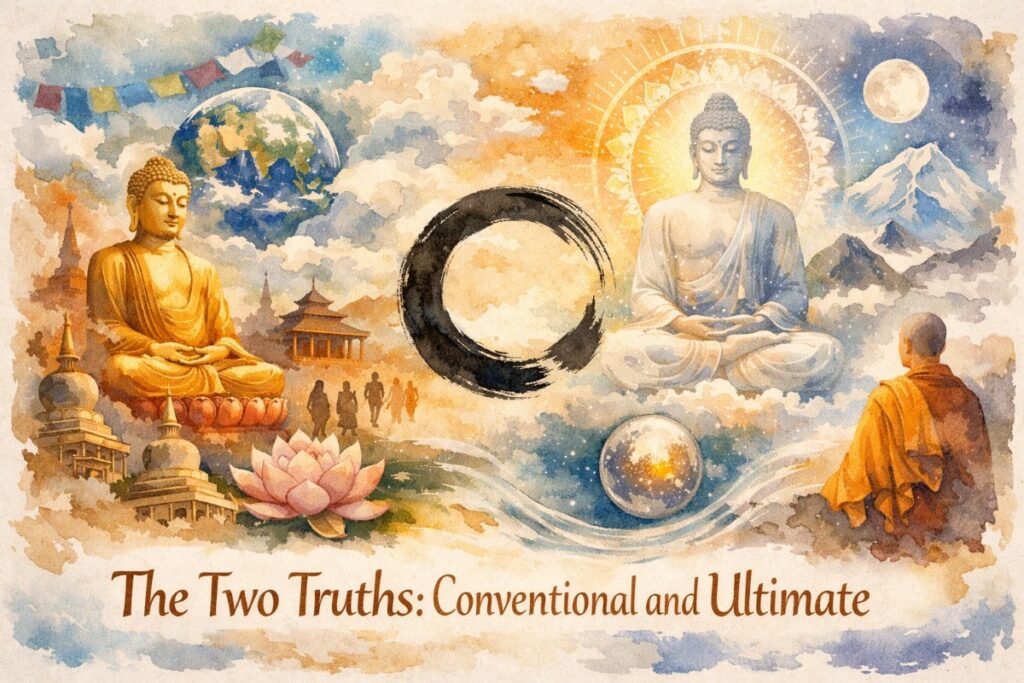
- The Two Truths are a foundational Buddhist framework for understanding reality from two perspectives: everyday life and deepest nature.
- Conventional truth covers practical, relative reality – including cause and effect, ethics, and personal identity.
- Ultimate truth reveals the deeper nature of things as empty of fixed, independent existence (inherent existence).
- Both truths are valid and necessary. Neither is rejected. One is not “higher” or “better” than the other.
- Confusing these two truths leads to suffering. Understanding them brings clarity, compassion, and freedom.
- This teaching belongs to all major Buddhist schools, though each explains it somewhat differently.
- Applying the Two Truths helps with conflict, decision making, relationships, and managing difficult emotions.
1. Introduction: Why Two Truths Matter in Modern Life
You wake up in the morning. You check your phone. There is a message from a colleague that upsets you. Your mind races with thoughts: “They are so unfair. I always work harder than them. This is typical.”
By midday, you feel tired and resentful. Your productivity drops. You snap at a family member later because the anger is still there.
Now consider a different approach. What if, in that moment of reading the message, you could hold two perspectives at once?
On one level, the situation is real. Someone sent a message. You have feelings about it. There are responsibilities, deadlines, and workplace dynamics that matter. This is conventional truth – the world of cause and effect, actions and consequences, people and relationships.
On another level, you recognise that your angry thoughts are just thoughts. They arise due to conditions: tiredness, past experiences, expectations. The “unfair person” you are angry at does not exist as a solid, unchanging enemy. They are a changing bundle of moods, pressures, and misunderstandings. This is ultimate truth – the deeper nature of things as empty of fixed identity.
Holding both truths at once changes everything. You can still address the workplace issue. You can still express your feelings. But you do so without the heavy fuel of resentment. You act clearly rather than react blindly.
This is the practical power of the Two Truths. It is not abstract philosophy for monks in mountains. It is a daily tool for seeing life more clearly and suffering less.
In this article, you will learn what the Two Truths are, which Buddhist traditions teach them, and how to apply them to modern situations including work, relationships, money, and emotional pain.
2. Background and Origins of the Two Truths Teaching
The historical Buddha, Siddhattha Gotama (Siddhartha Gautama), who lived around the 5th century BCE in what is now Nepal and India, often used two different ways of speaking about reality. He used conventional language when discussing people, actions, and things – saying “you” or “I” or “that person did this”. In deeper teachings on liberation, he pointed out that in the ultimate sense, no permanent, unchanging self can be found. Only changing processes.
Later Buddhist analysis understood the Buddha’s teachings as implying two levels of truth. The clearest formal expression appears in the Abhidhamma [higher teaching], a detailed scholastic analysis of experience compiled centuries after the Buddha’s passing. Here, the two truths are explicitly named:
- Conventional truth – sammuti sacca [Pali for “agreed upon truth” or “common understanding truth”]
- Ultimate truth – paramattha sacca [Pali for “truth of the ultimate sense” or “ultimate reality”]
The term sammuti carries the sense of what is agreed upon by common consent. Society collectively agrees that a piece of paper with certain markings has value as money. That agreement is conventional truth.
The term paramattha breaks down as parama (highest, ultimate) and attha (meaning, sense, reality). In scholastic contexts, it points to things as they truly are when analysed without the overlay of conceptual labels.
Around the 2nd century CE, the Indian philosopher Nagarjuna developed the Two Truths into a systematic framework for the Mahayana tradition. His root text, “The Fundamental Wisdom of the Middle Way” (Mulamadhyamakakarika), made the Two Truths central to understanding emptiness (sunyata [Sanskrit for emptiness, openness, absence of inherent existence]).
Nagarjuna warned strongly against mixing up the two truths. A famous passage (paraphrased from Chapter 24, verse 10 of his text) states:
“Without relying on conventional truth, the ultimate truth cannot be taught. Without understanding the ultimate truth, liberation is not achieved.”
This became a standard position across most later Buddhist schools.
Which Buddhist Schools Teach the Two Truths?
All major Buddhist traditions accept the Two Truths, though they explain them differently.
| School | Approach to Two Truths |
|---|---|
| Theravada | Emphasises conventional truth as functionally real. Ultimate truth consists of momentary physical and mental phenomena (dhammas). In Theravada scholastic analysis, these dhammas are considered ultimately real. The self is conventional only. |
| Mahayana (general) | Views both truths as empty of inherent existence. Ultimate truth is the emptiness of all phenomena, including the phenomena of ultimate truth itself. |
| Madhyamaka (within Mahayana) | Holds that all things are empty of independent nature. Conventional truth is how things appear. Ultimate truth is that they lack fixed essence. These two are not separate. |
| Yogacara (within Mahayana) | Retains the Two Truths framework but analyses experience through the “Three Natures” (trisvabhava). Often summarised as “mind-only” (cittamatra), though modern scholars debate how literally this should be taken. |
| Zen / Chan | Teaches the Two Truths through direct experience. Conventional truth is the world of discrimination. Ultimate truth is realised in meditation as “suchness” (tathata). |
| Tibetan Buddhism | Retains the Madhyamaka Two Truths framework. Later Tibetan scholars (such as Tsongkhapa and Gorampa) debated whether conventional truths are “ultimately false” or “trustworthy within their own domain”. |
For the purpose of daily life application, the core insight is similar across all schools: things exist, but not in the way they appear to exist.
3. Defining Conventional Truth
Conventional truth is the reality of everyday experience. It includes:
- Physical objects: tables, chairs, cars, phones
- People: you, me, your neighbour, the bus driver
- Social constructs: money, laws, national borders, job titles
- Time: past, present, future
- Actions: walking, speaking, eating, working
- Cause and effect: if you plant a seed, a plant grows
None of these are false. They function. They have effects. If you step in front of a moving bus, the conventional truth of the bus’s mass and speed will injure your conventional body.
Conventional truth is sometimes called relative truth (because it depends on relative conditions) or everyday truth (because it is how we live most of our lives).
Characteristics of Conventional Truth
- It depends on agreement – Money only works because we collectively agree it works. Different cultures have different conventions about politeness, time, and property.
- It depends on perspective – A “table” from one angle is a collection of wood particles from another. A “person” from a legal perspective is a citizen. From a biological perspective, a collection of cells.
- It functions reliably – Even though conventional truths are not ultimately solid, they operate consistently. Fire burns. Kindness tends to produce kindness in return. Gravity works regardless of your philosophy.
- It is where ethics and karma operate – Actions have consequences on the conventional level. If you harm someone, that person suffers. If you steal, you create conditions for your own future suffering. The ultimate emptiness of these actions does not erase their conventional effects.
Why Conventional Truth Matters
Some people hear about ultimate truth and think conventional truth is worthless. This is a mistake. The Buddha himself used conventional language constantly. He said “I teach” and “you listen”. He referred to himself and to others.
Conventional truth is the only place where practice happens. You cannot meditate without a conventional body. You cannot develop compassion without conventional beings who suffer. You cannot make ethical choices without conventional actions and their consequences.
In daily life, conventional truth is where you:
- Pay your bills (the money is conventionally real)
- Keep promises (the trust is conventionally real)
- Drive on the correct side of the road (the rules are conventionally real)
- Take medicine for illness (the illness and the medicine are conventionally real)
To reject conventional truth is to become unable to function. It is also, in Buddhist terms, a form of wrong view.
4. Defining Ultimate Truth
Ultimate truth is not a “higher” reality floating above ordinary life. It is the deeper nature of conventional things when examined without our usual assumptions.
A simple example (an updated version of the famous ancient Buddhist “chariot” analogy from the Milindapañha): a car. Conventionally, a car exists. You can sit in it. Drive it. Wash it. Sell it. Ultimately, when you look closely, where is the “car”? The engine is not the car. The wheels are not the car. The seats are not the car. Remove all parts, and no “car” remains. The car is a convenient label for a collection of parts arranged in a certain way, functioning together.
This does not mean the car is an illusion. It means the car does not have inherent existence (svabhava) – it does not exist from its own side, independently of causes, parts, and our minds that label it.
Characteristics of Ultimate Truth
- It reveals emptiness – Emptiness (sunyata) does not mean nothingness. It means the absence of fixed, permanent, independent identity. A wave on the ocean is empty of being a separate thing, yet it is a real wave.
- It is non-conceptual – Ultimate truth cannot be fully captured in words or ideas. Words point toward it, but direct insight comes through meditation and lived experience.
- It is always present – You do not need to create ultimate truth. It is already the nature of everything. You only need to stop superimposing false solidity onto experience.
- It liberates – Seeing ultimate truth directly loosens the grip of greed, hatred, and delusion. When you see that the object of your anger is empty of solid “enemy-ness”, anger has less fuel. This direct seeing of ultimate truth is the gateway to Nibbana (Nirvana) — the complete cessation of suffering.
Common Misunderstandings About Ultimate Truth
- Misunderstanding: “Ultimate truth means nothing exists.”
- Correction: Things exist conventionally. They function. They produce effects. They just lack the solid, independent existence we imagine.
- Misunderstanding: “I should ignore conventional truth and live only in ultimate truth.”
- Correction: That is impossible and unwise. Even advanced Buddhist teachers use conventional language, eat conventional food, and respect conventional laws.
- Misunderstanding: “Emptiness is depressing or nihilistic.”
- Correction: Emptiness is actually liberating. If things had fixed, unchanging natures, change would be impossible. Healing would be impossible. Learning would be impossible. Because things are empty, they can transform.
A Note on Different Buddhist Interpretations
In Theravada scholastic analysis, ultimate truth refers to the momentary physical and mental phenomena (dhammas) that are held to be ultimately real. In Madhyamaka (Mahayana), even these dhammas are considered empty of inherent existence. The two schools use the term “ultimate truth” differently. This article primarily follows the Mahayana understanding, as it is more widely used in modern Western Buddhist discussions.
5. The Relationship Between the Two Truths
The Two Truths are not two separate realities. They are two ways of looking at the same reality.
Think of a rainbow. Conventionally, a rainbow exists. You can see its colours. You can point to it. You can take a photograph. Ultimately, a rainbow has no solid existence. It is a play of sunlight, water droplets, and your visual system. Walk toward it, and it recedes. Yet the rainbow is not “false”. It is dependently arisen.
The same applies to you. Conventionally, you exist as a person with a history, a body, a name. Ultimately, you are a changing flow of physical and mental events (the five aggregates). Neither level denies the other.
Nagarjuna’s Middle Way
Nagarjuna taught that the Two Truths are not two different things and not one single thing. They are inseparable. You cannot find conventional truth separate from ultimate truth, nor ultimate truth separate from conventional truth.
A famous analogy from the Chinese Buddhist tradition compares them to the surface and the depth of the ocean. The surface waves are conventional truth – moving, changing, distinct. The deep water is ultimate truth – still, undivided, empty of wave-nature. But you cannot have surface waves without deep water, nor deep water without a surface.
Avoiding Two Extremes
Understanding the Two Truths helps you avoid two unhelpful extremes:
| Extreme | Mistake | Consequence |
|---|---|---|
| Eternalism | Believing things (including self) are permanent, solid, unchanging | Clinging, fear of loss, inability to adapt |
| Nihilism | Believing nothing exists at all, including cause and effect | Reckless behaviour, depression, meaninglessness |
The Middle Way, grounded in the Two Truths, avoids both. Things exist dependently – not solidly, not as nothing.
6. The Two Truths and Dependent Origination
A key principle that makes the Two Truths work is dependent origination (paticcasamuppada [Pali], pratityasamutpada [Sanskrit]). This is the teaching that all phenomena arise in dependence on causes, conditions, and parts.
The Kaccānagotta Sutta (SN 12.15) is one of the earliest sources linking dependent origination to the Middle Way. The Buddha states:
“This world, Kaccana, for the most part depends on a duality – on the notion of existence and the notion of non-existence. But for one who sees the origin of the world as it really is with proper wisdom, there is no notion of non-existence. And for one who sees the cessation of the world as it really is with proper wisdom, there is no notion of existence.”
This is often viewed as an important precursor to later Two Truths formulations. The sutta does not explicitly name “conventional” and “ultimate”, but it contains the core insight.
Nagarjuna famously summarised this relationship in a verse that became central to Madhyamaka philosophy (Mulamadhyamakakarika 24:18):
“Whatever is dependently arisen, that is explained to be emptiness. That, being a dependent designation, is itself the Middle Way.”
This single verse connects:
- Early Buddhism (dependent arising)
- Emptiness (the ultimate nature)
- Conventional designation (naming and labelling)
- The Middle Way (avoiding extremes)
Why Dependent Origination Matters for the Two Truths
The logical sequence in Mahayana thought is:
- Dependent origination – Everything arises due to causes and conditions.
- Therefore, emptiness – Nothing has inherent, independent existence.
- Therefore, Two Truths – Conventionally, things function as dependently arisen. Ultimately, they are empty.
Without dependent origination, emptiness could be mistaken for nihilism. Without emptiness, dependent origination could be mistaken for eternalism (things solidly existing).
A Practical Example
A difficult emotion like anger arises dependently: on a trigger (someone’s words), on your physical state (tiredness), on past conditioning (previous hurts). Because it arises dependently, it has no solid, permanent “anger-essence”. That is its ultimate nature. Conventionally, it still hurts and can cause harm. Understanding dependent origination helps you work with anger at both levels: you can address the conditions that feed it (conventional) while not being overwhelmed by its apparent solidity (ultimate).
7. Practical Applications for Modern Life
This section offers specific, concrete ways to apply the Two Truths to common situations.
7.1 Work and Career
Situation: You receive criticism from a manager. Your first reaction is defensiveness: “They are wrong. They do not understand my effort.”
Apply conventional truth: The criticism happened. Your manager has a perspective. Your work performance matters. Your job, income, and responsibilities are real on this level. Acknowledge these facts without denial.
Apply ultimate truth: The “manager” is not a solid enemy. They have their own changing conditions: pressure from above, lack of sleep, incomplete information. Your “self” that feels attacked is also empty – it is a collection of past experiences, fears, and conditioned reactions. Neither you nor your manager has a fixed, unchanging essence.
Action: You can respond professionally. Ask clarifying questions. Address the valid points in the criticism. But you do so without the heavy weight of a “me versus them” story. This makes your response clearer, calmer, and more effective.
Daily practice: Before a difficult work conversation, take three breaths. Silently remind yourself: “Conventionally, this situation is real. Ultimately, no permanent enemy exists here.”
7.2 Relationships and Conflict
Situation: A partner or friend forgets an important promise. You feel hurt and betrayed.
Apply conventional truth: The promise was made. It was broken. Hurt is a real feeling. Trust has been damaged. These facts matter. Ignoring them is not wisdom; it is avoidance.
Apply ultimate truth: The person who broke the promise is not a fixed “bad person”. They are a changing being, influenced by their own confusion, distractions, or difficulties. Your own hurt is not a permanent wound – it is a set of sensations and thoughts arising and passing. The “relationship” itself is not a solid thing but a flowing process of interactions.
Action: You can still address the broken promise. You can say: “I feel hurt because this promise mattered to me.” But you do not add the extra layer of eternal condemnation: “You always do this. You are so selfish.” That extra layer comes from forgetting ultimate truth.
Practical exercise: When angry with someone, write down three things that are true about them conventionally (e.g., “They arrived late”) and three things that are true ultimately (e.g., “Their lateness arose from conditions, not from a permanent ‘lateness’ nature”).
7.3 Managing Difficult Emotions
Situation: Anxiety arises before a medical appointment or public speaking.
Apply conventional truth: The appointment or event is real. Your physical sensations of anxiety – racing heart, tense shoulders, shallow breath – are real. Anxiety serves a purpose: it alerts you to prepare.
Apply ultimate truth: Anxiety is not a solid “thing” inside you. It is a changing pattern of bodily sensations, thoughts (“What if something goes wrong?”), and urges to flee. Each of these components rises and falls moment by moment. There is no permanent “anxious self” that owns the anxiety.
Action: Instead of fighting anxiety or being overwhelmed by it, break it down. Notice the sensations as just sensations. Notice the thoughts as just mental events. This is called mindfulness of phenomena. The anxiety may still be present, but it loses its grip.
Step-by-step method when anxiety arises:
- Acknowledge conventionally: “Anxiety is here. That is okay.”
- Investigate ultimately: “Where is the anxiety? Is it in my chest? My head? Does it stay still or change?”
- Breathe three times, feeling the breath as breath, not as “my breath.”
- Act anyway, knowing the anxiety is empty of solidity.
7.4 Money and Possessions
Situation: You worry about savings, debts, or comparing your wealth to others.
Apply conventional truth: Money is conventionally real. Bills must be paid. Saving for the future is wise. Poverty causes real suffering. On this level, financial responsibility is part of Right Livelihood.
Apply ultimate truth: Money has no inherent value. A coin or note is just paper or metal. Its value depends entirely on collective agreement. Your sense of “I am wealthy” or “I am poor” is a story. Neither label touches your actual, moment-to-moment experience.
Action: You can pursue financial stability without being consumed by greed or fear. When you notice anxiety about money, ask: “Conventionally, what is a wise next step? Ultimately, am I okay right now, in this breath?”
Daily reflection: Before checking your bank balance, take one breath. Remind yourself: “Numbers will appear. Those numbers are conventionally real. My worth as a human being is not those numbers.”
7.5 Social and Political Issues
Situation: You feel overwhelmed by news of injustice, climate change, or conflict.
Apply conventional truth: Suffering is real. Injustice is real. Actions have consequences. Engaging with social issues is part of compassion in action.
Apply ultimate truth: No situation is fixed forever. No person or group is purely evil. No problem has a single, unchanging cause. Because things are empty of fixed nature, change is possible. This is not naive optimism; it is practical realism.
Action: You can work for change without burning out. You can hold strong ethical positions without dehumanising opponents. You can grieve suffering without falling into despair.
Balanced approach: Engage with social issues with both eyes open – seeing the conventional reality of harm, and the ultimate reality of interdependence and potential for change.
8. Canonical Foundations (Key Suttas and Texts)
For readers who wish to explore the early Buddhist sources that informed later Two Truths thinking, the following texts are particularly relevant.
| Sutta / Text | Reference | Key Teaching |
|---|---|---|
| Kaccānagotta Sutta | SN 12.15 | The Middle Way between “exists” and “does not exist”. Important precursor to Two Truths. |
| Anattalakkhaṇa Sutta | SN 22.59 | The second discourse of the Buddha on not-self. Shows that the five aggregates are not self. |
| Cūḷasuññata Sutta | MN 121 | The Shorter Discourse on Emptiness. The Buddha describes a gradual entry into emptiness. |
| Mahāsuññata Sutta | MN 122 | The Longer Discourse on Emptiness. Expands on the same theme. |
| Neyyattha Sutta | AN 2.21 | The Buddha warns against confusing provisional teachings (neyyattha, requiring interpretation) with definitive teachings (nitattha, direct meaning). This is the earliest root of the Two Truths framework. |
| Milindapañha | Post-canonical | The famous chariot analogy, showing that a “chariot” is a conventional label for assembled parts. Directly supports the Two Truths. |
These texts do not always use the formal terms sammuti sacca and paramattha sacca (those appear later in the Abhidhamma). However, they contain the core insights that later commentators systematised into the Two Truths doctrine.
9. Common Pitfalls and How to Avoid Them
Many people new to the Two Truths fall into one of these traps.
| Pitfall | Description | Correction |
|---|---|---|
| Spiritual bypass | Using ultimate truth to ignore conventional problems (e.g., “It is all empty, so why bother paying taxes or treating illness?”) | Remember: The Buddha took medicine and followed social customs. Ultimate truth does not erase conventional cause and effect. |
| Reifying emptiness | Turning “emptiness” into another solid thing to cling to | Emptiness itself is empty. Do not make it a new belief system. |
| Confusing levels | Applying ultimate analysis to conventional situations where it is not helpful (e.g., telling a grieving friend “Your loss is empty”) | Time and place matter. Use conventional truth to comfort, support, and act. Use ultimate truth for your own inner work. |
| Nihilism | Concluding that nothing matters because everything is empty | If nothing mattered, the Buddha would not have taught ethics for 45 years. Emptiness is not meaninglessness; it is the ground of meaningful change. |
10. Meditation Practices for Understanding the Two Truths
These simple practices require no prior experience.
Practice 1: Labeling Exercise (5 minutes)
Sit quietly. Notice an object in the room – a cup, a book, a phone.
- Conventional level: Say to yourself: “This is a cup. It holds liquid. I can pick it up.”
- Ultimate level: Ask: “Where is the ‘cup’ besides the parts? If I call it a bird, does it become a bird?” Rest in the sense that the label is not the thing itself.
Practice 2: The Self Investigation (10 minutes)
Sit comfortably. Bring to mind a recent situation where you felt strong emotion.
- Conventional level: Acknowledge: “I felt angry/sad/happy. That feeling was real.”
- Ultimate level: Investigate: “Where is the ‘I’ that felt that? Is it in my head? My chest? Does it have a shape? Does it stay the same from moment to moment?” Do not try to find a self. Notice that you cannot pin one down.
Practice 3: Walking Meditation with Two Truths (15 minutes)
Walk slowly, indoors or out.
- Conventional level: Notice “I am walking. There is a path. There are sounds.”
- Ultimate level: Notice that walking occurs, but no permanent self can be found. Steps arise and fall on their own. The path is just earth. Sounds are just vibrations.
Do not force either view. Alternate naturally.
11. Glossary (Alphabetical)
| Term | Language | Meaning |
|---|---|---|
| Abhidhamma | Pali | “Higher teaching”. A detailed scholastic analysis of the mind and phenomena, where the Two Truths are first formally named. |
| Conventional truth | English | Sammuti sacca (Pali). The everyday, agreed-upon reality of people, things, and cause and effect. |
| Dependent arising | English | Pratityasamutpada (Sanskrit), Paticcasamuppada (Pali). The principle that all things arise in dependence on causes, conditions, and parts. The basis for understanding emptiness. |
| Emptiness | English | Sunyata (Sanskrit), Sunnata (Pali). The absence of fixed, independent, permanent existence. Not nothingness. |
| Eternalism | English | The view that things (including self) are permanent and unchanging. One of two extremes avoided by the Two Truths. |
| Five aggregates | English | Pancakkhandha (Pali). The five constantly changing components of a person: form, feeling, perception, mental formations, consciousness. |
| Inherent existence | English | Svabhava (Sanskrit). Existence from one’s own side, independently of causes, parts, or labelling. The Two Truths teach that nothing has inherent existence. |
| Madhyamaka | Sanskrit | “Middle Way School”. Founded by Nagarjuna. Makes the Two Truths central to its philosophy. |
| Middle Way | English | Majjhima Patipada (Pali). The path between eternalism and nihilism, enabled by understanding the Two Truths. |
| Nagarjuna | Sanskrit | Indian philosopher (c. 2nd century CE) who systematised the Two Truths and emptiness for Mahayana Buddhism. |
| Nibbana / Nirvana | Pali / Sanskrit | The cessation of suffering. Realising ultimate truth directly is the gateway to Nibbana. |
| Nihilism | English | The view that nothing exists at all, including cause and effect. The second extreme avoided by the Two Truths. |
| Paramattha sacca | Pali | “Ultimate truth” or “truth of the ultimate sense”. Reality as it is without conceptual overlays. |
| Sammuti sacca | Pali | “Conventional truth” or “agreed-upon truth”. Reality as conventionally labelled and agreed by society. |
| Sunyata | Sanskrit | See “Emptiness”. |
| Theravada | Pali | “School of the Elders”. The oldest existing Buddhist school. Emphasises the Abhidhamma analysis of conventional and ultimate truths. |
| Ultimate truth | English | Paramattha sacca (Pali). The deeper nature of things as empty of fixed, independent existence. |
12. References and Further Resources
Books
- “The Fundamental Wisdom of the Middle Way” (Nagarjuna) – Translation by Jay Garfield. The root text on the Two Truths, with commentary.
- “The Heart of the Buddha’s Teaching” (Thich Nhat Hanh) – Chapter on the Two Truths is very accessible.
- “What the Buddha Taught” (Walpola Rahula) – Clear introduction, including the Two Truths.
- “Emptiness: A Practical Guide for Meditators” (Guy Armstrong) – Direct application to meditation.
Podcasts
- Buddhist Geeks – Episode 235: “Emptiness and the Two Truths”
- Secular Buddhism Podcast (Noah Rasheta) – Episode 47: “The Two Truths”
- Insight Hour (Joseph Goldstein) – Search “Two Truths” for several talks.
Online Resources
- Two Truths: indivisible, Tsoknyi Rinpoche, Lion’s Roar
- Wikipedia: Two Truths Doctrine – Reliable overview with scholarly references.
- DharmaNet: The Two Truths – Search for “Two Truths”.
- SuttaCentral – Search for SN 12.15, SN 22.59, MN 121, MN 122, AN 2.21 for original texts and translations.
Article prepared for buddhistlearning.org. May this teaching serve your everyday peace and clarity.