Key Takeaways
- Buddhist ethics, or sīla, are a comprehensive system of mental and behavioral training rooted in wisdom, compassion, and the observable law of cause and effect (karma). They are principles for personal development.
- This system stands in contrast to commandment-based ethics, which derive moral authority from divine revelation and frame right action as obedience to a lawgiver. Buddhist ethics derive authority from the natural laws of the mind and reality itself.
- The foundational Five Precepts are voluntary training rules phrased as “I undertake to refrain from…” This framing emphasizes personal agency, commitment, and the understanding that ethical conduct is for one’s own peace and the welfare of others.
- Intention (cetanā) is the cornerstone. The ethical quality of an action is determined primarily by the mental state from which it springs, whether it is rooted in the “unwholesome roots” of greed, hatred, and delusion, or their “wholesome” opposites.
- A critical and necessary clarification: This principle-based, internally motivated system in no way provides a justification for ignoring secular laws or engaging in harmful acts. Its profound commitment to non-harming (ahiṃsā) and social harmony means it aligns with and often deepens the purpose of just laws. The ethical training is more demanding, not more permissive.
- Buddhist ethics are context-aware and flexible, designed to cultivate wisdom and discernment. This allows for skillful navigation of complex modern dilemmas, moving the moral question from “What is the rule?” to “What is the most compassionate and wise action in this situation?”
- The ultimate goal of this ethical training is freedom: freedom from the inner impulses that cause suffering, freedom from remorse, and the cultivation of a mind that is intrinsically clear, compassionate, and at peace.
1. Introduction: A Different Compass for Moral Life
In a world where ethical discussions can quickly polarize into debates over rigid rules versus subjective feelings, Buddhism offers a distinct and profound third way. It presents an ethical framework that is neither top-down commandment nor bottom-up relativism, but a middle path of cultivated wisdom and compassion.
For many, morality is synonymous with a system of commandments: rules believed to be handed down by a divine authority, where virtue is obedience and transgression is sin. This model, central to the Abrahamic traditions (Judaism, Christianity, Islam), has deeply influenced global concepts of law and morality. Buddhism, however, emerges from a different set of foundational questions. It is not primarily concerned with “What has God commanded?” but with “What are the causes of suffering, and how can they be ended?”
This article will explore the architecture of Buddhist ethics. We will examine its philosophical foundations, contrast it with commandment-based models, and directly address a vital modern concern: In a system that emphasizes personal understanding over divine decree, what ensures ethical behavior? We will see that the Buddhist commitment to ethics is, in fact, exceptionally strong; rooted not in fear of punishment, but in a clear-eyed understanding of cause and effect and a heartfelt commitment to the welfare of all beings. This understanding reveals why this path is not only compatible with a just secular society but actively contributes to its foundation.
2. The Foundation: Buddhist Ethics as Training (Sīla)
2.1 Grounded in Two Pillars: Wisdom (Paññā) and Compassion (Karuṇā)

Buddhist ethics are not arbitrary social conventions or imposed restrictions. They are the natural, practical expression of two core realizations that form the heart of the Buddha’s enlightenment.
- Wisdom (Paññā): The Law of Karma
The ethical impulse in Buddhism springs first from insight, not from will. The central insight is the law of karma (Pali: kamma). This is not fate or simple reward/punishment. It is a natural law of moral causality, as impersonal and reliable as the law of gravity. The Buddha articulated it simply: actions born of unwholesome mental states lead to suffering; actions born of wholesome mental states lead to happiness and peace.- Unskillful Actions (Akusala Kamma): These originate from what are called the “Three Unwholesome Roots“: Greed (lobha), the drive to pull things toward oneself; Hatred (dosa), the drive to push things away; and Delusion (moha), ignorance of the true nature of reality. Actions rooted here (e.g., stealing out of greed, lying out of hatred, harming others out of delusion) create agitation, fear, regret, and division. They produce a “karmic result” (vipāka) of inner unrest and unfavorable external circumstances.
- Skillful Actions (Kusala Kamma): These spring from the “Three Wholesome Roots”: Non-greed/generosity (alobha), Non-hatred/loving-kindness (adosa), and Non-delusion/wisdom (amoha). Actions rooted here (e.g., giving, speaking kindly, acting with patience) create inner peace, confidence, joy, and connection. They produce a karmic result of mental clarity and harmonious conditions.
Therefore, ethical conduct is, first and foremost, an act of intelligent self-interest and sanity. We refrain from harmful action not because a authority forbids it, but because we understand it is like drinking poison and expecting someone else to get sick. The “punishment” is inherent in the action itself, the immediate corrosion of one’s own peace of mind.
- Compassion (Karuṇā): The Reality of Interdependence
Wisdom reveals a second truth: we are not isolated selves. All beings are interconnected in a web of cause and effect, and all share the fundamental desire to be happy and free from suffering. Compassion is the emotional resonance of this insight. It is the “quivering of the heart” (karuṇā) in response to the suffering of others, coupled with the wish to alleviate it.
Ethical conduct then becomes the natural expression of this care. Non-harming (ahiṃsā) is not a rule; it is the outward manifestation of an inward understanding of our shared vulnerability. This transforms ethics from a duty into a privilege, a way to actively reduce the amount of suffering in the experiential field we all share.
2.2 Sīla: The Training of Heart and Mind
The Pali word sīla is often translated as “virtue” or “morality,” but its root meaning is closer to “habit,” “nature,” or “practice.” This is crucial. Sīla is not a state of being good, but a process of training to become more peaceful, integrated, and free.
- It is a Foundation: The Buddha consistently taught sīla as the indispensable foundation for all spiritual progress. In the Noble Eightfold Path, it comprises Right Speech, Right Action, and Right Livelihood. Just as you cannot build a stable house on sand, you cannot develop deep meditation (samādhi) or liberating wisdom (paññā) on a foundation of ethical compromise, which constantly agitates the mind with guilt, fear, and remorse.
- It is a Shelter: The Buddha called sīla a “shelter,” a “refuge,” and a “cool pond.” A life of ethical restraint provides profound safety. One does not live in fear of exposure, retaliation, or the inner torment of a guilty conscience. This creates the inner security necessary for genuine happiness.
2.3 The Five Precepts: The Training Manual for Laypeople
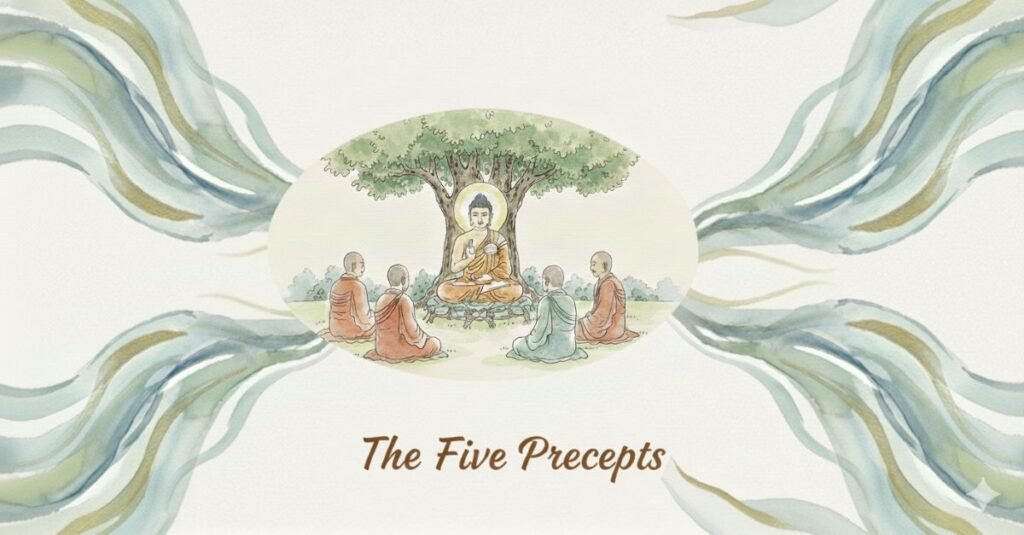
The Five Precepts (Pañcasīla) are the core training guidelines for anyone wishing to live a Buddhist-inspired life. Their phrasing is a masterclass in the Buddhist ethical approach:
“I undertake the training rule (sikkhāpada) to refrain from…”
Let’s break down the power of this phrasing:
- “I undertake…”: This is a personal, voluntary vow. It is an act of agency and commitment, not coerced obedience. The ethical power comes from within.
- “…the training rule…”: It is explicitly a training. We are beginners, practicing. We will stumble. The point is the dedicated practice, not perfection. This cultivates self-compassion alongside effort.
- “…to refrain from…”: The focus is on restraint of unwholesome impulses. By not feeding the roots of greed, hatred, and delusion, we starve them. Simultaneously, we create space for their positive counterparts to grow.
A Deeper Look at Each Precept as a Training Ground:
- To refrain from destroying living beings.
- The Training: Cultivating reverence for life in all its forms. This begins with not killing but matures into an active, protective kindness. It trains us to meet anger, fear, and aversion with mindfulness instead of violence. It asks us to consider our impact on animals and ecosystems, making our consumption a conscious choice.
- Modern Example: Beyond vegetarianism, it applies to workplace dynamics. Refraining from “character assassination” in gossip, or crushing a competitor out of hatred, is an application of this precept. It’s about not “killing” someone’s reputation or spirit.
- To refrain from taking what is not freely given.
- The Training: Cultivating contentment (santutthi) and respect for the boundaries and possessions of others. It targets the mind of poverty and lack that drives greed. The positive practice is dāna (generosity), which actively weakens the clinging “self.”
- Modern Example: This includes not stealing time (being chronically late for meetings), not stealing ideas (plagiarism), not exploiting loopholes in contracts, or expecting underpaid labor. In the digital age, it asks: Are we taking attention without permission? Are we taking data that isn’t freely offered?
- To refrain from sexual misconduct.
- The Training: Cultivating respect, fidelity, and responsibility in intimate relationships. The core principle is that sexuality should not cause harm, emotional, psychological, or social, to oneself, one’s partner, or the wider community (e.g., families).
- Modern Example: This precept is a profound guide for navigating consent, the ethical use of dating apps, and the integrity of committed partnerships. It speaks against manipulation, coercion, and deceit in sexual matters. It emphasizes mindfulness over compulsion.
- To refrain from false speech.
- The Training: Cultivating integrity and truthfulness as the basis for trust. The Buddha detailed “Right Speech” as speech that is truthful, helpful, kind, and timely. This precept trains us to pause before speaking, to examine motive, and to choose words that build harmony rather than division.
- Modern Example: This is essential for social media. Is that share truthful, or is it misinformation? Is that comment helpful, or is it just venting hatred? In the workplace, it means giving honest feedback with care, not spreading rumors, and keeping promises.
- To refrain from intoxicants that lead to heedlessness.
- The Training: Cultivating and protecting mindfulness (sati), the guardian of all virtues. The precept specifically targets substances that “cloud the mind and lead to carelessness,” making one likely to break the other four precepts.
- Modern Example: While directly applicable to alcohol and drugs, it wisely extends to anything we use to “check out” compulsively: binge-watching, doomscrolling, compulsive gaming. The question is: “Does this activity dull my awareness and lead me to act in ways I’ll regret?” It’s a commitment to showing up for one’s life with clarity.
3. A Detailed Contrast with Commandment-Based Ethics
To fully appreciate the Buddhist approach, a nuanced comparison with commandment-based systems is helpful. This is not to judge one as superior, but to clarify distinct operating systems.
| Feature | Buddhist Ethics (Principle-Based / Training Model) | Commandment-Based Ethics (Rule-Based / Legal Model) |
|---|---|---|
| Source of Authority | The Buddha’s insight into Natural Law (Dhamma). The Buddha is a discoverer and teacher of timeless truths about the mind and reality. He said, “Whether Buddhas arise or not, this law of nature exists.” Ethics are verifiable through personal experience and reason. | The will and revelation of a transcendent, personal God. Moral authority is invested in a divine Creator who establishes laws for creation. Scripture is the recorded revelation of this will. |
| Metaphysical Foundation | Dependent Origination and Karma. An impersonal, causal universe where actions have inherent, natural consequences. The system is self-regulating through cause and effect. | Theism and Covenant. A personal universe created and governed by God. Ethics are part of a relational covenant between Creator and creature. |
| Primary Motivator | Understanding and Compassion. Motivation springs from wisdom (seeing the painful results of unskillful action) and empathy (the desire not to add to the suffering of others). The drive is toward inner freedom and peace. | Obedience and Love for God. While love is central, a fundamental motivator is obedience to divine command as an act of faith, love, and worship. Consequences involve divine judgment. |
| Role of Intention | Central and Determinative. “Intention (cetanā), I declare, is karma.” The mental state is the primary karmic seed. A harmful action is unskillful because it is rooted in a harmful intention. | Important but often Secondary to the Act. While intention matters greatly (e.g., in distinguishing murder from manslaughter), the objective act of obeying or transgressing the divine law is paramount. The law exists independently of intention. |
| Nature of the Guidelines | Training Principles (Sikkhāpada). Framed as voluntary commitments for personal development. They are tools for cultivating specific mental qualities (non-greed, non-hatred, non-delusion). | Commandments/Laws (Framed as obligatory duties, statutes, or laws given by the Sovereign of the universe. They define holiness and the terms of the covenant. |
| Flexibility & Context | Inherently Flexible. The “skillfulness” of an action is context-dependent. The precepts are principles to be applied with discernment. The question is: “What action, born of kindness and wisdom, will cause the least harm and most benefit here and now?” | Generally Absolute, with Interpretive Frameworks. Commandments are seen as universal and eternal truths. Their application to complex situations is addressed through scholarly interpretation, jurisprudence (fiqh, halakha), and theology, but the core law is unchanging. |
| Conception of Wrongdoing | “Unskillful Action” (Akusala Kamma). A mistake in understanding, a failure of mindfulness, a reinforcement of harmful mental habits. It is a missed step in training, leading to painful karmic results. | “Sin” (Het, Hamartia). A transgression against divine law, a rupture in the relationship with God, often involving concepts of guilt, stain, and need for atonement or forgiveness. |
| Ultimate Goal | Liberation from Suffering (Nibbāna). Ethical conduct purifies the mind, making it capable of achieving the unconditioned state beyond all suffering. Ethics are both the path and the fruit. | Salvation, Communion with God, Fulfillment of Divine Will. Ethical living is a means to achieve right relationship with God, often with eschatological goals of heaven, resurrection, or the Kingdom of God. |
A Nuanced Note: This table outlines general tendencies. Within commandment-based traditions, there are deep strands emphasizing the “spirit of the law,” inner transformation, and love as the fulfillment of law. Similarly, Buddhist traditions have monastic codes (Vinaya) with numerous rules. The difference lies in the foundational premise: is the ethical imperative rooted in the nature of mind and reality, or in the will of a divine person?
4. The Critical Clarification: Strength, Not License – Buddhist Ethics and Secular Law
One might wonder: If ethics are personal training without a divine punisher, what stops someone from simply choosing not to train, or from twisting the principle of intention to justify bad behavior? This concern leads to the most important clarification about the strength of Buddhist ethics.
Far from being a license for lawlessness, the Buddhist ethical framework establishes a more rigorous, personally enforced, and deeply reasoned commitment to lawful, harmonious living. Here is a multi-layered explanation:
4.1 The Alignment is Inherent, Not Coincidental
The first four precepts form the bedrock of any functioning society’s legal code. This is not an accident. They protect the fundamental requisites for social trust: life, property, relational integrity, and truth-telling.
- A Buddhist upholds these not out of fear of the police, but out of a personal vow rooted in non-harming and karmic wisdom. This creates an ethical actor who obeys the law not as a minimum standard to avoid trouble, but as a natural expression of their deepest values. The law is the outer boundary; the precept is the inner commitment that often operates far inside that boundary.
4.2 Intention is Examined at the Root, Not Used as a Surface Excuse
The focus on intention is not a “get-out-of-jail-free” card. It is a call for radical self-honesty.
- Scenario: A person steals from a large corporation to give to the poor, claiming “compassionate intention.”
- Surface Level: Intention seems good (help the poor).
- Buddhist Analysis (Examining the Roots):
- Greed (lobha)? Perhaps greed for a certain outcome (a world where this act fixes inequality) or for the feeling of being a righteous hero.
- Hatred (dosa)? Likely present as aversion toward the corporation, viewed as a monolithic “bad guy.”
- Delusion (moha)? Certainly present: the delusion that a harmful means (theft, which causes distrust, increases security costs, and is karmically unskillful) can create a purely good end. The delusion that the complex problem of poverty is solved by this single act. The delusion that one is above the fundamental principle of not taking what is not given.
- Conclusion: The action is unskillful (akusala). It violates the precept, breaks the law, and sows seeds of future trouble (karmic result and potential legal consequences). A skillful approach would seek legal, non-harming, and sustainable ways to address poverty; volunteering, advocacy, ethical business models, actions rooted in genuine non-greed, non-hatred, and wisdom.
4.3 The Fifth Precept is a Proactive Guardrail
The precept against heedlessness is a masterstroke of practical ethics. It recognizes that most ethical and legal violations happen when mindfulness is down. By voluntarily committing to mental clarity, a practitioner systematically reduces the probability of finding themselves in a compromised state where they might break precepts or laws. It is proactive ethical risk management.
4.4 Social Harmony is a Stated Goal, Not a Byproduct
The Buddha frequently taught that the health of a society depends on the virtue of its citizens. In the Aggañña Sutta, he describes social decay beginning with ethical decline. In the Cakkavatti Sīhanāda Sutta, poverty is linked to theft, which leads to violence, which leads to societal collapse.
- Therefore, a Buddhist sees ethical conduct as active citizenship. To break a just law is not a private matter; it injects fear, distrust, and instability into the communal fabric. Upholding the law is an act of karuṇā (compassion) and mettā (loving-kindness) towards one’s entire community, aligning perfectly with the Bodhisattva vow to work for the welfare of all beings.
4.5 The Concept of “Skillful Means” (Upāya) Operates Within Firm Boundaries
In Mahayana Buddhism, upāya refers to adapting teachings and actions to best help others. It is not a doctrine of situational ethics where the ends justify the means. Any “skillful means” must be grounded in the perfection of wisdom (prajñāpāramitā) and the fundamental precepts. An action that involves deceit, theft, or violence, even for a “noble” end, would be seen as corrupted by unwholesome roots and incapable of producing a truly pure result. True skillfulness finds creative, non-harming solutions within ethical boundaries.
5. Applying Buddhist Ethics: A Practical Framework for Modern Dilemmas
How does this translate to daily life? Here is a practical, step-by-step framework for applying Buddhist ethics to complex situations.
Step 1: Pause and Establish Mindfulness (Sati)
Before reacting, create space. Take a breath. This simple act disrupts the automatic pilot of habit and emotion.
Step 2: Identify the Relevant Factors
- What are the facts? Strip away the story and see the situation clearly.
- Who is affected? Myself, others directly involved, the wider community?
- What precepts or principles are in play? Is this about honesty? Non-harming? Taking what’s not given?
Step 3: Examine Your Intention (Cetanā)
This is the core inquiry. Ask with ruthless honesty: “What is moving me to act?”

- Scan for the Three Roots: Is there greed (for gain, approval, comfort)? Is there hatred (aversion, anger, resentment)? Is there delusion (confusion, storytelling, ignorance of consequences)?
- If unwholesome roots are present, the action will likely be unskillful. The work then becomes working with that emotion mindfully, not acting from it.
Step 4: Consider Consequences (Vipāka)
Wisely foresee the likely outcomes.
- Short-term: What will this action create immediately? Peace or conflict? Trust or distrust?
- Long-term (Karmic): What mental habits will it reinforce? Will it lead to remorse or ease? What seeds is it planting for my future and the future of others?
Step 5: Seek the Most Skillful (Kusala) Option
Based on the above, ask: “What action, rooted in non-greed, non-hatred, and non-delusion, will cause the least harm and the most benefit in this context?”
- This may not be a simple “yes/no” against a rule. It might be a creative third way.
- Example: A terminally ill friend asks, “Do I look terrible?” A blunt “yes” (strict truth) may be cruel. A false “no” violates speech. A skillful response, rooted in compassion and truth, might be: “You look like someone I love who is going through a very hard time. Your courage is what I see most.” This addresses the heart of their concern without falsehood.
Step 6: Act, Then Reflect
After acting, review the process without harsh judgment. Was your intention pure? Were the consequences as expected? This reflective learning (paccavekkhaṇa) hones your ethical discernment for next time.
6. Living the Training: Personal Application and Daily Reflection
Understanding the framework is one thing; making it a living reality requires consistent, daily practice. Buddhist ethics are meant to be lived, not just contemplated. Here is a comprehensive guide to personal application and integration.
6.1 Morning Intention-Setting
Begin the day by consciously establishing your ethical foundation.
- Practice: Upon waking, before checking your phone, take five minutes of quiet. You might mentally recite the Five Precepts, focusing on what they mean for today. For example: “Today, I will practice non-harming by being patient in traffic and kind in my thoughts. I will practice generosity by offering my full attention to those who speak to me. I will protect my mindfulness by taking breaks from screens.” This sets a conscious trajectory for the day.
6.2 Mindful Check-Ins: The “Pause Practice”
The core of ethical living is interrupting automatic reactivity.
- Practice: Set random alarms on your phone labeled “Pause.” When one sounds, wherever you are, stop for 15 seconds. Notice your body, your emotional state, and your immediate intention. Are you hurrying? Are you irritated? Are you about to send an email fueled by frustration? This tiny pause creates the gap where choice becomes possible. It’s the moment you can choose skillful speech over a sarcastic remark, or choose to put down the third drink.
6.3 The “Precept Scan” During Daily Activities
Weave ethical reflection into routine tasks.
- During Meals: Reflect on the first precept. Consider the origins of your food, expressing gratitude for the life and labor that sustains you. This cultivates reverence and can guide more compassionate consumer choices.
- During Work: Reflect on the second and fourth precepts. In your professional actions, are you giving full value for what you receive (salary, trust)? Are your communications honest and helpful? This transforms “work” into “right livelihood.”
- During Communication: Before speaking or hitting “send,” apply the “Right Speech” filter: Truthful? Helpful? Inspiring? Necessary? Kind? (The THINK filter). If it doesn’t meet most criteria, reconsider.
6.4 Evening Reflection and Review (Paccavekkhaṇa)
This is the most crucial practice for deepening ethical understanding. Dedicate 10-15 minutes before bed.
- The Review Process (Gentle, not Judgmental):
- Recall with Kindness: Sit quietly. Review the day from morning to evening like a movie, without drama or self-criticism.
- Highlight Skillful Moments: Acknowledge and appreciate moments where you were patient, generous, honest, or kind. Savor the good feeling this recognition brings. This reinforces wholesome neural pathways. For example: “I’m glad I listened fully to my child even though I was tired.”
- Note Unskillful Moments with Curiosity: When you recall a moment of irritation, harsh speech, or greed, approach it with investigative curiosity, not guilt. Ask: “What was the trigger? What unwholesome root was present (greed, hatred, delusion)? What did I believe in that moment that wasn’t entirely true?” For example: “When I snapped at my colleague, I felt threatened. The root was fear (a form of hatred/aversion). I believed I had to defend my territory.”
- Forgive and Resolve: Acknowledge that as a trainee, you will stumble. Gently forgive yourself. Then, form a positive resolution for tomorrow: “When I feel that defensive fear arise again, I will pause and take one breath before speaking.” This turns a “failure” into the next step in your training.
6.5 Weekly Deep-Dive on One Precept
Each week, choose one of the Five Precepts for focused attention.
- Week 1 – Non-Harming: Notice all forms of harm in thought, word, and deed. Practice active kindness. Research compassionate eating or consumer habits.
- Week 2 – Generosity & Non-Taking: Actively look for opportunities to give; time, praise, a listening ear. Audit your life for where you might be taking time, energy, or resources without full awareness.
- Week 3 – Mindful Relationships: Contemplate respect and responsibility in all relationships, not just intimate ones. Practice deep listening.
- Week 4 – Truthful Communication: Become a detective of your own speech. Notice exaggeration, white lies, gossip, and harsh tones. Practice silent periods or speaking only what is truly beneficial.
- Week 5 – Clarity and Mindfulness: Monitor your consumption of digital and sensory “intoxicants.” Dedicate time each day to an activity that requires full, clear presence (walking in nature, mindful cooking, meditation).
6.6 Working with Ethical Failures
When you break a precept or act unskillfully, use this four-step recovery process:
- Acknowledge Immediately: Don’t justify or ignore. Simply note, “That was unskillful.”
- Understand the Cause: Investigate the conditions. Were you tired, hungry, triggered by an old wound, influenced by others? What unwholesome root was dominant?
- Make Amends if Possible: If others were harmed, apologize sincerely without making excuses. If it was an internal harm (like cruel thoughts), direct loving-kindness to yourself and the other.
- Recommit: Mentally reaffirm your training vow. “I have stumbled in my training to refrain from false speech. I reaffirm my commitment to speak truthfully and kindly.” This prevents a single lapse from becoming a downward spiral.
6.7 Cultivating the Positive Counterparts
True ethical training isn’t just avoiding bad; it’s actively cultivating good.
- For Non-Harming, cultivate Loving-Kindness (Mettā): Practice daily mettā meditation, directing well-wishes first to yourself, then to loved ones, neutrals, difficult people, and all beings.
- For Non-Taking, cultivate Generosity (Dāna): Make giving a daily habit. Donate, volunteer, offer compliments, give your seat to someone.
- For Sexual Responsibility, cultivate Respect (Gārava): Practice seeing the inherent dignity and vulnerability in every person.
- For Truthful Speech, cultivate Harmlessness (Ahiṃsā) in Communication: Let your words be like a salve, never a weapon.
- For Clarity, cultivate Mindfulness (Sati): Dedicate formal time to meditation and bring mindful awareness to simple activities like washing dishes or walking.
7. The Unshakable Strength of the Buddhist Ethical Commitment
The strength of this commitment lies precisely in its voluntary, understanding-based nature.
- It is Fireproof. An ethic based on fear of external punishment (divine or secular) collapses when the threat of punishment is removed (e.g., when no one is watching). An ethic based on internal understanding and commitment remains intact in all circumstances. The “watcher” is one’s own mindfulness and wisdom.
- It Cultivates Intrinsic Character. Commandment-based ethics can sometimes foster a focus on external compliance (“Have I broken the rule?”). Buddhist training focuses on the transformation of character. The goal is not just to not steal, but to become a generous person in whom the impulse to steal doesn’t arise.
- It Embraces Complexity. Life is messy. Rigid rules can break or force cruel choices in complex situations. A principle-based ethic, powered by wisdom and compassion, equips one to navigate grey areas with integrity, seeking the most benevolent path forward without abandoning core values.
- It Offers Genuine Freedom. This is the ultimate strength. The Buddhist path offers freedom from the tyrannical impulses of greed, hatred, and delusion. It is the freedom of a mind unburdened by remorse, a heart open in trust, and a life lived in harmony. This is not the freedom to do anything, but the profound freedom to not be enslaved by one’s own worst instincts.
8. Conclusion: A Path of Responsible Freedom and Profound Peace
Buddhist ethics present a compelling vision: morality as a path of liberation. It replaces the question “What must I obey?” with “Who do I wish to become, and what world do I wish to co-create?”
This approach makes significant demands. It requires the courage of self-honesty, the diligence of constant mindfulness, and the maturity to take full responsibility for the seeds one plants through every intention, word, and deed. It does not outsource moral authority but develops an inner moral compass calibrated by wisdom and warmed by compassion.
In doing so, it builds an unshakable bridge between personal spirituality and social responsibility. It demonstrates that the deepest inner peace is inseparable from a life lived with harmlessness, honesty, generosity, and care. Therefore, Buddhist ethics do not stand in tension with a just secular society; they provide the very psychological and moral foundation for one, a society composed of individuals who choose the good, not because they are commanded to from without, but because they understand, from the very core of their being, why it is the only path to true and lasting peace.
Glossary of Key Terms
| English Term | Pali/Sanskrit Term | Explanation |
|---|---|---|
| Compassion | Karuṇā (Pali) | The heartfelt wish to relieve the suffering of others and the readiness to act to alleviate it. |
| Five Precepts | Pañcasīla (Pali) | The five basic ethical training rules for lay Buddhists. |
| Intention | Cetanā (Pali) | The mental factor of volition or will that directs an action. Considered synonymous with karma in its seed form. |
| Karma/Kamma | Kamma (Pali) / Karma (Sanskrit) | Literally “action.” The law of cause and effect whereby intentional actions have inherent ethical consequences. |
| Non-Harming | Ahiṃsā (Pali/Sanskrit) | The fundamental principle of not causing injury or suffering to any living being. |
| Skillful/Unskillful | Kusala/Akusala (Pali) | The key ethical descriptors. Skillful actions lead to happiness and are rooted in non-greed, non-hatred, non-delusion. Unskillful actions lead to suffering and are rooted in greed, hatred, delusion. |
| Training/Virtue | Sīla (Pali) | Ethical conduct understood as a discipline, training, or habit that integrates the mind and restrains unskillful behavior. |
| Wisdom | Paññā (Pali) / Prajñā (Sanskrit) | Insight or understanding into the true nature of reality, particularly the Three Marks of Existence: impermanence (anicca), suffering (dukkha), and non-self (anatta). |
Frequently Asked Questions
1. If Buddhist precepts are “voluntary,” does that mean I can just ignore them whenever I want?
While the precepts are voluntary training rules rather than divine laws, they are not arbitrary. Buddhism teaches that ethics are based on the natural law of cause and effect (karma). Ignoring the precepts is seen less as “breaking a rule” and more like ignoring the laws of physics, if you touch a hot stove, you get burned. A practitioner follows the precepts because they understand that harmful actions inevitably create mental agitation and suffering for themselves and others.
2. Is Buddhism “moral relativism” since it doesn’t have absolute commandments?
No. While Buddhist ethics are context-aware and emphasize skilful means (upāya), they are firmly rooted in the principle of non-harming (ahiṃsā). An action is considered “unskilful” if it is born from greed, hatred, or delusion. This provides a consistent objective standard: if an action increases suffering and is rooted in these “unwholesome roots,” it is ethically problematic regardless of the cultural context.
3. What happens if I break a precept? Is there “sin” in Buddhism?
Buddhism does not use the concept of “sin” as an offense against a divine being. Instead, breaking a precept is viewed as a lapse in mindfulness or an “unskilful” act that leads to suffering. The remedy is not seeking divine forgiveness, but rather:
- Acknowledging the mistake.
- Understanding the conditions that led to it.
- Resettling the intention to do better.
- Making amends where possible to clear the mind of remorse.
4. How does the “Intention” (Cetanā) affect my karma?
Intention is the most important factor in Buddhist ethics. The Buddha taught, “It is intention that I call karma.” For example, if you accidentally step on an insect while walking, there is no unwholesome karma because there was no intent to harm. However, if you intentionally kill the insect out of annoyance, the seed of “hatred” or “aversion” is planted in the mind, which shapes your future character and experience.
5. Why is the Fifth Precept (refraining from intoxicants) included with things like killing or stealing?
The fifth precept is often called the “protection” for all the others. In Buddhism, the goal is to develop clarity and mindfulness. Intoxicants are avoided because they lead to heedlessness (pamāda). When the mind is clouded, even a person with good intentions is much more likely to break the other four precepts by lying, acting aggressively, or making poor choices they will later regret.
6. Do I have to be a Buddhist to follow the Five Precepts?
Not at all. The Five Precepts are often referred to as “Universal Morality.” Many people find that committing to non-harming, honesty, and clear-headedness improves their quality of life and mental peace regardless of their religious or philosophical background.
References and Further Learning
For Foundational Understanding of Buddhist Ethics:
- Book: “The Heart of the Buddha’s Teaching” by Thich Nhat Hanh. (Parallax Press). A beautifully clear overview that contextualizes ethics within the broader path.
- Book: “Ethics for a Whole World” by The Dalai Lama. (HarperOne). Explores Buddhist ethics as a basis for global secular morality.
- Sutta Source: “Cula-Kammavibhanga Sutta (MN 135): The Shorter Analysis of Karma” on Access to Insight website. A direct teaching from the Buddha on how intentional actions lead to specific results.
For Practical Application and the Precepts:
- Book: “The Buddhist Path to Simplicity” by Christina Feldman. (HarperCollins). Connects ethical living with mindful daily practice.
- Dhamma Talk Series: “The Five Precepts” by Ajahn Sona. Available on YouTube and various monastic websites. A thorough, practical, and profound exploration of each precept.
- Article: “Beyond the Five Precepts” by Thanissaro Bhikkhu. Available on Access to Insight. Discusses the precepts as tools for training the mind in letting go.
For Comparative Religious Ethics:
- Book: “Buddhist and Christian Ethics: A Journey of Engagement” by Dr. Sallie B. King. (Bloomsbury Academic). A respectful scholarly comparison.
- Academic Resource: The “Stanford Encyclopedia of Philosophy” entries on “Buddhist Ethics” and “Divine Command Theory.”
Disclaimer: This article is an in-depth educational guide intended to foster understanding. For those wishing to deeply practice this path, seeking guidance from a qualified teacher within a living tradition is invaluable.