Key Takeaways
- Merit (puñña) is not a transactional currency but a way of describing the wholesome potential generated by actions rooted in non-greed, non-hatred, and non-delusion.
- Intention (cetanā) is the defining factor in Buddhist ethics. The quality of an action depends primarily on the mental state behind it, not on its outward scale.
- Early Buddhist texts identify three grounds for making merit: giving, ethical conduct, and meditation. These are distinct grounds of wholesome action, not a rigid ladder that everyone must climb in the same order.
- Theravāda, Mahāyāna, and Vajrayāna traditions share the basic concern that merit supports the path, but they explain and practise it differently. Theravāda includes sharing and rejoicing in merit; Mahāyāna emphasises dedication for all beings; Vajrayāna employs ritual and embodied skilful means.
- Merit is not the goal. It is a support for the deeper work of ethical training, mental cultivation, and wisdom.
Understanding the Question
The idea of merit can easily sound like a cosmic accounting system. Good deeds earn credits. Bad deeds incur debits. The goal becomes the accumulation of enough credit to secure a favourable future. Framed this way, merit seems to sit uneasily with the Buddhist emphasis on non-attachment and selflessness. Why would a path that encourages letting go of craving also encourage the accumulation of spiritual capital?
The question is worth taking seriously. It points to a real tension in how merit is often described, both in popular presentations and in some traditional language. But the tension is reduced when merit is understood not as a currency to be hoarded but as a way of describing how the mind is shaped by what it does. Merit is less like money in an account and more like the strength that comes from regular physical training: it is built through repeated wholesome activity, and it makes further activity possible. The question also invites a closer look at how different Buddhist traditions have understood merit, because the emphasis shifts considerably across the Theravāda, Mahāyāna, and Vajrayāna contexts.
The Buddhist Perspective
What Merit Is and Is Not
The word puñña is commonly translated as “merit,” but its meaning is broader and more textured than the English word suggests. The Pāli Text Society dictionary records that puñña is used for merit, meritorious action, and virtue, and that it is represented as a foundation and condition for a future blissful state. A later commentarial definition describes it as that which purifies and fills the mind. Both aspects matter. Merit is not simply a quantity of good karma stored away. It is a description of wholesome mental qualities and the karmic potential they carry. It is also not purely a process of inner purification with no relation to results. The early texts consistently associate meritorious action with beneficial outcomes, while locating the root of merit in the mind’s intention.
The Buddha’s teaching on intention is central here. In the Nibbedhika Sutta, the Buddha identifies intention as the defining feature of kamma (deeds), explaining that after forming an intention one acts by way of body, speech, and mind (AN 6.63). This means that the ethical quality of an action is determined primarily by the mental state behind it. Giving a gift to gain praise produces a different kind of mental result than giving out of genuine generosity or the wish to let go of stinginess. Merit is not generated by the physical act alone. It is generated by the mind that accompanies the act.
This is why merit is not a points system. A points system would reward the external deed regardless of motive. The Buddhist analysis directs attention inward, to the quality of the mind that is being cultivated.
Merit and Kamma
Merit and kamma are closely related but not identical. Kamma is the broader principle of intentional action and its results. Merit refers specifically to the wholesome side of that principle: actions that are rooted in generosity, kindness, and wisdom, and that ripen in well-being and favourable conditions. Merit is not something one spends in a way that depletes it. It is more like the mental clarity and steadiness that come from repeated wholesome conduct. Those qualities support practice, and they are not used up when they are drawn upon.
Theravāda Perspectives
In the early Buddhist texts, the Buddha identifies three grounds for making merit: giving, ethical conduct, and meditation. The Puññakiriyavatthu Sutta lists these three and explains that the degree to which they are practised is connected to the kind of rebirth a person may experience (AN 8.36). The sutta does not present these three as a formal sequence that must be completed in order. It presents them as distinct grounds of meritorious action, with meditation described as a ground that some people do not reach while giving and ethical conduct are still practised to varying degrees. Giving and ethical conduct are accessible to everyone, while meditation represents a deeper level of mental cultivation. The underlying point is that merit supports the mind’s capacity to practise the Dharma.
Later Theravāda commentarial tradition expands these three into ten bases of meritorious action. This list includes generosity, morality, contemplation, sharing of merit (pattidāna), rejoicing in merit (pattanumodanā), service, respect, teaching, listening, and straightening one’s views. Sharing merit and rejoicing in the merit of others are therefore not exclusively Mahāyāna practices. They are embedded in Theravāda exegetical and lived tradition. The Buddha also encouraged his followers not to fear meritorious deeds, describing them as an expression denoting happiness and desirable outcomes (Iti 22). Merit, in this framework, is the foundation of the gradual path: it softens the heart, weakens the grip of the three unwholesome roots, and creates the conditions in which insight can arise.
Mahāyāna Perspectives
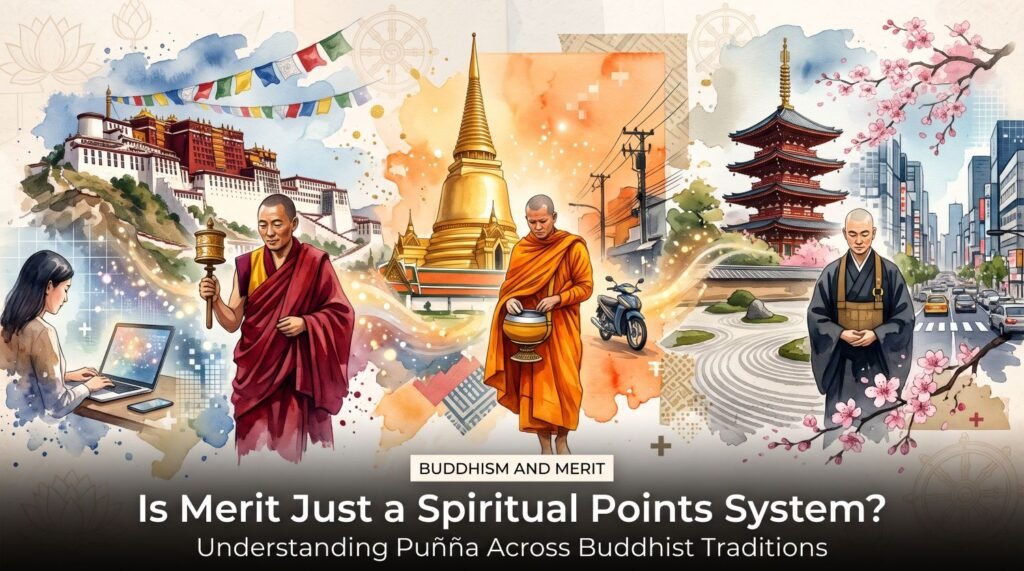
Mahāyāna Buddhism shifts the emphasis through the bodhisattva ideal. The practitioner does not seek merit solely for their own benefit but dedicates it to the awakening of all sentient beings. This practice of dedication of merit (pariṇāmanā) is not a transfer of spiritual points from one account to another. It is a mental act of orientation: the merit one has cultivated is offered for the welfare of others, and this offering itself further weakens self-centredness.
A common question in Mahāyāna thought is how merit relates to emptiness. If all phenomena are empty of inherent existence, why accumulate merit? The response is that precisely because things are empty and dependently arisen, actions have effects. Merit is understood as one of the two collections, the collection of merit and the collection of wisdom, which are described as the two wings of a bird. Without merit, the mind lacks the stability and energy needed to realise wisdom; without wisdom, merit alone does not liberate.
Vajrayāna Perspectives
In Vajrayāna and Tibetan Buddhist contexts, merit is cultivated through skilful means (upāya), such as prostrations, mandala offerings, and mantra recitation. These practices are not understood as a way of earning points with a deity. They carry ritual, devotional, and soteriological significance within their traditions. At the same time, they are frequently explained as methods that work on the practitioner’s mind and body. Prostrations are described as a remedy for pride. Mandala offerings are described as a remedy for miserliness and attachment. A practitioner performing a hundred thousand prostrations is not simply accumulating a quantity of merit. They are engaging in a disciplined process that tradition presents as loosening the hold of self-importance and inclining the mind towards liberation. The forms of practice vary across lineages and are embedded in specific ritual and doctrinal contexts, so it is important not to generalise from one tradition to another.
Applying the Teaching to Everyday Life
The shift from counting deeds to cultivating the mind changes how merit is practised in daily life. Instead of worrying about whether a donation is large enough, one can notice the quality of letting go that accompanies the act of giving. Instead of measuring spiritual progress by the number of practices completed, one can ask whether the mind is becoming more flexible, less reactive, and more inclined towards kindness.
Rejoicing in the good fortune of others is a simple and accessible way to cultivate merit. It directly counteracts envy and resentment, and it requires no external resources. Treating ordinary responsibilities, such as caring for family members or doing one’s work with care, as opportunities for service can also transform routine activity into a form of practice. The point is not to turn every action into a merit-earning transaction but to bring attention to the mental states that accompany what one is already doing.
Important Distinctions and Considerations
Several qualifications help prevent the idea of merit from becoming distorted. First, merit is not the goal of the Buddhist path. It is a support. The goal is liberation from suffering, and merit is valuable insofar as it contributes to that. Second, the language of accumulation can be misleading. The texts speak of merit as something that is gathered or cultivated, but these are metaphors for mental development, not descriptions of a spiritual bank account. Third, traditions differ in how they emphasise merit. Theravāda tends to focus on personal purification and the conditions for awakening, while also including practices of sharing and rejoicing in merit. Mahāyāna emphasises dedication for the benefit of others. Vajrayāna employs ritual and embodied practices as skilful means. These differences are real, and it is a mistake to treat one tradition’s presentation as the universal Buddhist position. Finally, merit is not a substitute for ethical action or for the hard work of insight. It is one element of a path that integrates ethics, mental cultivation, and wisdom. The traditions share a broad concern that merit supports the path, but they do not assign merit an identical doctrinal function in every respect.
Conclusion
Merit is not a spiritual points system. It is a way of describing the wholesome mental states and karmic potential that arise from acting with generosity, kindness, and understanding. The Buddha’s emphasis on intention shows that merit is fundamentally about the mind, not about external tallying. Whether understood as a foundation for favourable conditions in Theravāda, as a gift dedicated to all beings in Mahāyāna, or as a skilful means for transforming the mind in Vajrayāna, merit is not the final destination. It is part of the path that makes the destination possible, and it is always intertwined with the other elements of ethical conduct, mental cultivation, and wisdom.