1. Introduction
Dependent Origination is one of the most profound and central teachings in Buddhism. It explains the nature of existence, the arising of suffering, and the path to liberation. This teaching reveals how all phenomena arise in dependence upon causes and conditions, emphasizing the interconnectedness and impermanence of everything. Understanding Dependent Origination is essential for anyone interested in Buddhist philosophy or seeking to understand the nature of reality and suffering.
This deep dive will explore what Dependent Origination is, why it is important, and how it can be applied practically in daily life. The explanation assumes no prior knowledge and will clarify all terms, including Pali and Sanskrit words, with English translations.
2. What is Dependent Origination?
Definition and Meaning
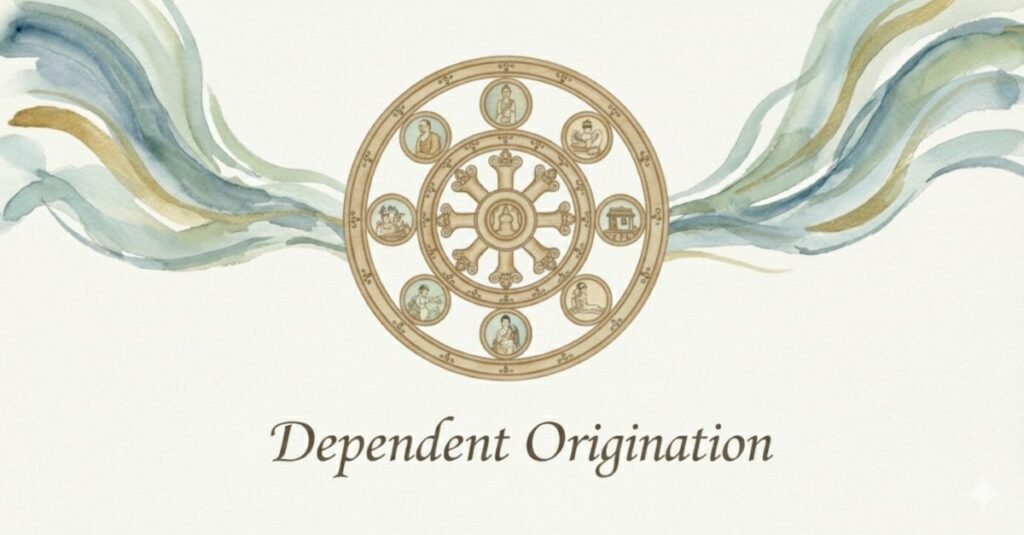
Dependent Origination, known in Pali as Paṭicca-samuppāda (literally “arising dependent on conditions”), is a fundamental Buddhist doctrine that describes how all phenomena arise and cease based on specific causes and conditions. It is often summarized by the formula:
- “When this exists, that comes to be; with the arising of this, that arises.
- When this does not exist, that does not come to be; with the cessation of this, that ceases.”
This means nothing exists independently or permanently; everything is conditioned and interconnected.
Pali Term: Paṭicca-samuppāda
- Paṭicca means “dependent on” or “conditioned by.”
- Samuppāda means “arising,” “origination,” or “coming into being.”
Together, they express the principle that phenomena arise dependent on other phenomena, not in isolation.
3. The Importance of Dependent Origination in Buddhism
Core Teaching of the Buddha
Dependent Origination is considered the heart or essence of all Buddhist teachings. The Buddha himself said, “He who sees Dependent Origination sees the Dhamma (the teaching); he who sees the Dhamma sees Dependent Origination”.
This teaching explains the causal chain that leads to suffering (dukkha) and how understanding this chain can lead to its cessation.
Relationship to Suffering and Liberation
Dependent Origination provides the answer to how to end suffering. It reveals that suffering arises due to specific causes and conditions, and by removing or transforming these conditions, suffering can cease.
Understanding this principle is directly linked to understanding the Four Noble Truths, the foundational Buddhist framework for comprehending suffering and its cessation.
Connection with Emptiness (Suññatā)
Dependent Origination is closely related to the concept of Emptiness (Suññatā), which means that phenomena lack inherent, independent existence. Because things arise dependently, they are empty of a permanent, unchanging essence.
4. The Twelve Links of Dependent Origination
Overview of the Twelve Links
The Buddha taught Dependent Origination through a sequence of twelve interconnected links (Dvādasa-Nidāna) that explain the cycle of birth, suffering, death, and rebirth. These links describe the process by which suffering arises and continues:
- Ignorance (Avijjā)
- Volitional Formations (Sankhāra)
- Consciousness (Viññāṇa)
- Name and Form (Nāma-rūpa)
- Six Sense Bases (Salāyatana)
- Contact (Phassa)
- Feeling (Vedanā)
- Craving (Taṇhā)
- Clinging (Upādāna)
- Becoming (Bhava)
- Birth (Jāti)
- Aging and Death (Jarāmaraṇa)
These links are not strictly linear but represent a dynamic, interactive process.
Explanation of Each Link
- Ignorance (Avijjā): Lack of understanding of the true nature of reality, especially the Four Noble Truths. It is the root cause of suffering.
- Volitional Formations (Sankhāra): Mental formations or karmic activities conditioned by ignorance. These are intentional actions that shape future experiences.
- Consciousness (Viññāṇa): Awareness or sentience that arises dependent on formations. It is the basis for experience.
- Name and Form (Nāma-rūpa): The mental (name) and physical (form) components of a living being.
- Six Sense Bases (Salāyatana): The six faculties—eye, ear, nose, tongue, body, and mind—that enable contact with the world.
- Contact (Phassa): The meeting of sense organs, objects, and consciousness, leading to experience.
- Feeling (Vedanā): Sensations or feelings that arise from contact, which can be pleasant, unpleasant, or neutral.
- Craving (Taṇhā): Desire or attachment to pleasurable experiences and aversion to unpleasant ones.
- Clinging (Upādāna): Intensified craving leading to grasping or attachment.
- Becoming (Bhava): The process of existence or becoming, conditioned by clinging.
- Birth (Jāti): The arising of a new existence or life.
- Aging and Death (Jarāmaraṇa): The inevitable decay and cessation of life, accompanied by sorrow and suffering.
This chain explains how suffering perpetuates itself through cycles of conditioned existence.
5. Philosophical Implications
No-Self (Anattā) and Impermanence (Anicca)
Dependent Origination supports the Buddhist doctrines of No-Self (Anattā) and Impermanence (Anicca):
- Because all phenomena arise dependently, there is no permanent, unchanging self or essence.
- Everything is in constant flux, conditioned by causes and conditions.
Avoiding Extremes: Eternalism and Nihilism
Dependent Origination offers a Middle Way that avoids two extremes:
- Eternalism: The belief in a permanent, unchanging soul or self.
- Nihilism: The belief that nothing continues after death, and actions have no consequences.
Instead, it shows a continuous process of cause and effect without a fixed self.
6. Practical Applications in Daily Life
Understanding Cause and Effect
Recognizing that all experiences and phenomena arise due to causes and conditions helps us see that:
- Our thoughts, feelings, and actions are not random but conditioned.
- Changing conditions can change outcomes, giving us agency to influence our experience.
Breaking the Cycle of Suffering
By understanding the links in Dependent Origination, especially craving and clinging, we can:
- Identify the roots of our suffering.
- Work to reduce ignorance and craving through mindfulness and wisdom.
- Interrupt the cycle that leads to further suffering and rebirth.
Mindfulness and Awareness of Conditions
Practicing mindfulness allows us to observe:
- How feelings arise dependent on contact.
- How craving and clinging develop from feelings.
- How these mental states condition our behavior and future experiences.
7. Practical Examples of Dependent Origination
The Oil Lamp Analogy
The Buddha used the example of an oil lamp to illustrate Dependent Origination:
- The flame burns dependent on the oil and the wick.
- If either the oil or wick is absent, the flame ceases.
This shows that phenomena arise dependent on multiple conditions, not independently.
The Growth of a Plant
A plant arises dependent on:
- Seed, soil, water, air, and sunlight.
- If any of these conditions are missing, the plant cannot grow.
This example illustrates the interconnectedness and conditionality of all phenomena .
Emotional Reactions and Anxiety
Anxiety arises dependent on:
- Thoughts, memories, physical sensations, and external situations.
- When these conditions change or cease, anxiety also ceases.
Understanding this helps us work skillfully with our mental states.
Social and Cultural Phenomena
Dependent Origination also applies to larger scales:
- Social attitudes like racism or sexism arise from shared opinions and perceptions.
- These collective delusions can be undone by changing conditions and understanding interdependence.
8. How to Cultivate Insight into Dependent Origination
Meditation Practices
- Mindfulness meditation on arising and passing away of phenomena helps experientially understand impermanence and conditionality.
- Observing the chain of dependent origination in daily mental processes deepens insight.
Reflective Inquiry
- Contemplating the twelve links and their interrelations.
- Reflecting on how craving and ignorance condition suffering.
- Investigating the nature of self and phenomena as dependently arisen.
Ethical Living and Karma
- Understanding that actions (karma) have consequences conditioned by causes and conditions.
- Cultivating wholesome actions to create positive conditions for future well-being.
9. Conclusion
Dependent Origination is a profound teaching that reveals the interconnected, conditioned nature of all phenomena. It explains the arising and cessation of suffering and provides a practical framework for understanding reality and transforming our experience. By deeply understanding and applying this principle, one can cultivate wisdom, reduce suffering, and move toward liberation.
10. References and Further Reading
- Dependent Origination Explained – YouTube
- How Buddha Solved Life | His Greatest Teaching – YouTube
- Dependent Origination: The Origination and Cessation of Suffering – The Wisdom Experience
- What is Dependent Origination in Early Buddhism? – YouTube
- Nothing Arises Without Cause • Buddhist Teachings on Why Things Happen | Zen Buddhism – YouTube