Introduction: The Altruistic Heart of Mahayana Buddhism
Imagine two people standing before a vast, stormy ocean, representing the suffering of the world. The first person, seeking immediate safety, builds a strong, personal boat to reach the far shore of peace. The second person vows to build a massive, sturdy ship to carry everyone across, and only once all are safe will they themselves disembark. This is the essential difference between the spiritual ideal of personal liberation and the path of the Bodhisattva.
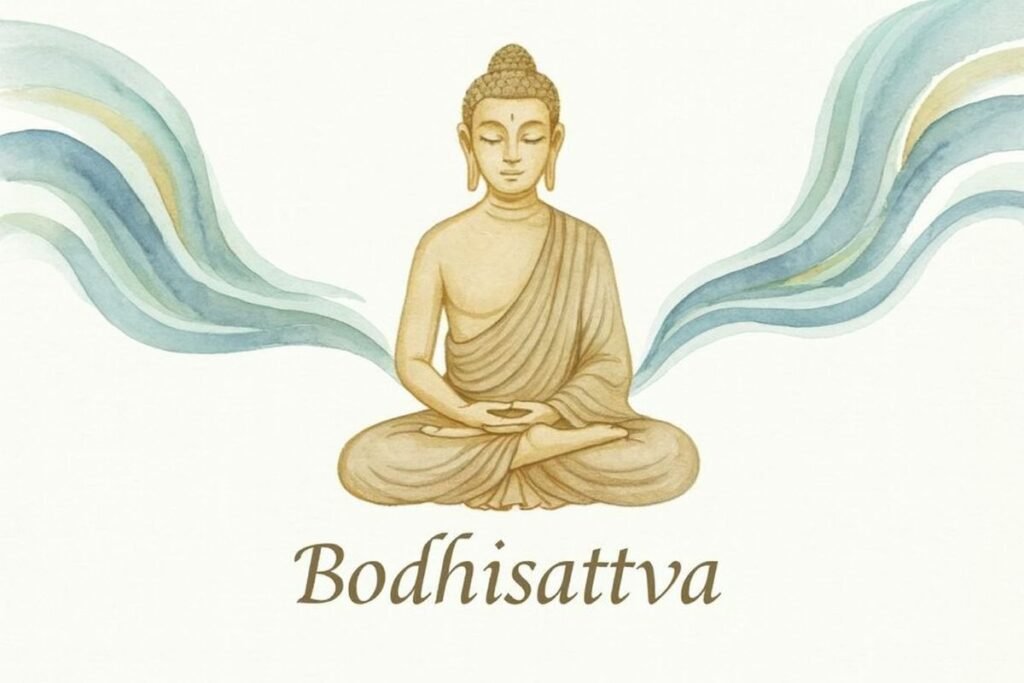
The term “Bodhisattva” (Sanskrit: bodhi = awakening, sattva = being) is one of the most significant and inspiring concepts in Buddhism, particularly within the Mahayana tradition. It represents a radical reorientation of spiritual life away from a primary focus on one’s own salvation and toward an active, compassionate commitment to the liberation of all beings. This is not merely a philosophical idea but a practical, step-by-step path of training the heart and mind.
This article will explore the Bodhisattva ideal. We will define what a Bodhisattva is and is not, examine the historical and doctrinal context within Buddhism, explain why this path is considered so important, and, most crucially, provide a thorough exploration of how its profound principles can be meaningfully applied in the midst of our ordinary, daily lives. The guide is written, it is hoped, in clear, simple English, with all foreign terms translated and explained, assuming no prior knowledge from the reader.
1: What is a Bodhisattva? Definition and Core Vow
1.1. The Literal Meaning and Its Implications
The Sanskrit word Bodhisattva is a compound:
- Bodhi: Meaning “awakening,” “enlightenment,” or “perfect understanding.”
- Sattva: Meaning “a being,” “essence,” or “one who is.”
A straightforward translation is “awakening-being” or “enlightenment-bound being.” This defines the Bodhisattva not by a fixed identity, but by a direction and a purpose. A Bodhisattva is any person, regardless of gender, background, or current spiritual attainment, whose life is oriented toward achieving the fullest possible awakening (Buddhahood) for a specific, altruistic reason.
1.2. The Defining Vow: Bodhicitta
The engine of the Bodhisattva path is Bodhicitta (Sanskrit: bodhi = awakening, citta = heart-mind). This is often translated as the “mind of awakening” or “awakened heart.” It has two inseparable aspects:
- The Aspiration of Bodhicitta: The sincere, heartfelt wish, “May I attain complete awakening to benefit all sentient beings.”
- The Action of Bodhicitta: The actual engagement in the practices and disciplines necessary to realize that wish.
Generating Bodhicitta is the formal beginning of the Bodhisattva path. It is the moment one makes the conscious choice to seek enlightenment not as a personal achievement, but as a tool to be of ultimate service. The classic vow expresses this:
“However innumerable sentient beings are, I vow to liberate them.
However inexhaustible the defilements are, I vow to eradicate them.
However immeasurable the dharmas are, I vow to master them.
However endless the Buddha’s way is, I vow to follow it.”
1.3. The Bodhisattva vs. The Arhat
To understand the Bodhisattva, it’s helpful to contrast it with the ideal of the Arhat (Pali: arahant), which is emphasized in the Theravada tradition.
- The Arhat: Focuses on achieving Nirvana, the cessation of personal suffering and the end of the cycle of rebirth (samsara), through diligent personal practice. The path is one of renunciation and inner purification to attain liberation from the world.
- The Bodhisattva: Postpones their own final entry into Nirvana. They choose to remain engaged in the cycle of rebirth, life after life, voluntarily taking on the suffering and challenges of worldly existence in order to skillfully guide others to liberation. The path is one of compassionate engagement within the world.
It is important to note that this is not a judgment of one being “better” than the other. The Arhat has achieved an incredible feat of freedom. The Bodhisattva path is described in Mahayana as a broad, inclusive motivation that naturally arises from a deep understanding of interconnectedness.
As a note – There are many Buddhist paths, and the purpose of this article is not claim any as superior or inferior. If they offer, wisdom, compassion, loving-kindness, and supportive motivation along the chosen path, then they are effective and to be commended.
1.4. Celestial and Earthly Bodhisattvas
The term “Bodhisattva” is used in two broad ways:
- Human Bodhisattvas (The Path): These are ordinary people like you or me who have taken the Bodhisattva vow and are actively working on the path. They may be beginners, struggling with their own anger and fear, yet committed to the ideal.
- Celestial or Archetypal Bodhisattvas (The Ideal): These are highly advanced, enlightened beings who embody specific perfected qualities. They are often objects of devotion and meditation in Mahayana Buddhism. Key examples include:
- Avalokiteshvara (Chenrezig in Tibetan, Guanyin in Chinese): Embodies the compassion (karuna) of all Buddhas. Often depicted with multiple arms to reach out to help all beings.
- Manjushri: Embodies the wisdom (prajna) of all Buddhas. Depicted wielding a sword that cuts through ignorance.
- Samantabhadra: Embodies the practice and virtuous activity of the Buddhas, representing the application of wisdom and compassion in the world.
These celestial figures are not distant gods but represent the ultimate potential within each practitioner. Meditating on Avalokiteshvara, for example, is a method to nurture one’s own latent capacity for infinite compassion.
2: The Bodhisattva in Buddhist Tradition
2.1. The Mahayana Context: “The Great Vehicle”
The Bodhisattva ideal is the defining characteristic of Mahayana Buddhism, which began to emerge as a distinct movement around the 1st century BCE to 1st century CE. The name “Mahayana” means “Great Vehicle,” contrasting itself with what it termed “Hinayana” or “Small Vehicle” (a pejorative label generally referring to the earlier schools, like Theravada).
The “greatness” of Mahayana refers to its scope of compassion and its goal of universal Buddhahood. It opened the path of ultimate awakening to everyone, lay and monastic alike, not just a monastic elite. The Bodhisattva, practicing in the world for the world, became the ideal motivation.
Key Mahayana Sutras that elaborate the Bodhisattva path include:
- The Lotus Sutra: Declares that the ultimate goal for all is Buddhahood and features the compassionate Bodhisattva Never Disparaging.
- The Perfection of Wisdom (Prajnaparamita) Sutras: Emphasize the union of wisdom and compassion, stating that a Bodhisattva helps beings while understanding that there is ultimately no separate “being” to help, a profound and non-attached compassion.
- The Avatamsaka (Flower Garland) Sutra: Portrays a universe of infinite interconnectedness, where the Bodhisattva’s actions benefit the entire cosmic web.
2.2. Theravada and the “Bodhisatta”
While the Bodhisattva ideal is most developed in Mahayana, the concept has roots in the earliest Buddhist texts. In the Pali Canon of the Theravada tradition, the term Bodhisatta (Pali equivalent) is used almost exclusively to refer to the historical Buddha, Siddhartha Gautama, in his many past lives before his final awakening as told in the Jataka Tales. In these stories, he cultivates virtues like generosity, patience, and compassion.
Thus, in Theravada, the Bodhisatta path is seen as the long, challenging training period of a future Buddha. It is a completely valid path, but not the one emphasized for contemporary practitioners, who are generally encouraged to follow the path to Arhatship. However, in some modern Theravada contexts, particularly in parts of Southeast Asia, the Bodhisattva vow is taken by some monks and laypeople.
2.3. Vajrayana: The Accelerated Path
Vajrayana Buddhism (the Tibetan tradition) is an extension of Mahayana that incorporates the Bodhisattva ideal into a framework of advanced, esoteric practices called tantra. In Vajrayana:
- The Bodhisattva vow is the absolute foundation. No tantric practice is undertaken without this basis of altruistic motivation.
- The path is seen as a means to achieve Buddhahood rapidly, in a single lifetime, precisely to be able to help beings more quickly and effectively.
- Meditation often involves visualizing oneself as an enlightened, celestial Bodhisattva (like Avalokiteshvara) to directly identify with those awakened qualities.
3: Why is the Bodhisattva Ideal Important?
3.1. It Transforms Spiritual Motivation from “Me” to “We”
The primary importance of the Bodhisattva ideal is its radical re-framing of the purpose of spiritual practice. The question shifts from “How can I find peace?” to “How can my peace contribute to our peace?” This motivation, rooted in Bodhicitta, is said to be infinitely more powerful and fruitful. It turns every action, no matter how small, into part of a vast, meaningful project of universal healing.
3.2. It Integrates Wisdom and Compassion
Many spiritual paths can veer toward an imbalance. One might pursue intellectual wisdom without warmth, or sentimental compassion without clear understanding. The Bodhisattva path insists on the union of Prajna (Wisdom) and Karuna (Compassion).
- Wisdom without Compassion could be cold, detached, and inactive.
- Compassion without Wisdom could be foolish, exhausting, and enable harmful patterns (e.g., helping in a way that creates dependency).
The Bodhisattva cultivates the wisdom that sees no separate self (making altruism natural) and the compassion that acts skillfully from that understanding.
3.3. It Provides a Framework for Ethical Engagement
The Bodhisattva ideal moves Buddhism squarely into the realm of social and ethical action. It is not a quietistic path of retreat. A Bodhisattva is encouraged to engage with the world’s problems, poverty, injustice, environmental degradation, not out of political ideology, but as a natural expression of compassion. This makes the philosophy deeply relevant to modern concerns about social justice, service, and global citizenship.
3.4. It Makes the Path Endlessly Meaningful
The commitment to liberate all beings is, by definition, a limitless task. This grand scope can infuse a practitioner’s life with profound meaning and resilience. Setbacks become learning opportunities, and personal suffering becomes a lesson in empathy. The path is no longer a finite race to a finish line, but a meaningful way of being in the world forever.
3.5. It Cultivates Patience and Redefines “Progress”
On the Bodhisattva path, “success” is not measured by blissful states or personal achievements, but by the depth of one’s compassion and the stability of one’s commitment. This fosters immense patience (kshanti). The Bodhisattva learns to work tirelessly without being attached to immediate results, understanding that positive actions plant seeds that may ripen far in the future.
4: The Practical Path: The Six Perfections (Paramitas)
The Bodhisattva’s training is systematically outlined in the Six Perfections or Paramitas (Sanskrit: paramita = “perfection” or “that which has reached the other shore”). These are not superhuman feats, but qualities to be cultivated in a gradual, genuine way.
4.1. Generosity (Dana)
This is the foundational perfection, directly countering greed and attachment.
- Practice: Giving is practiced at three levels:
- Material Giving: Sharing resources, time, and skills.
- The Gift of Fearlessness: Offering protection, comfort, and safety to those who are afraid or vulnerable.
- The Gift of Dharma: Sharing teachings, insights, or simply a wise and calming presence that helps others.
- Key Point: The perfection lies in the intention: giving freely, without expectation of reward or thanks, and without diminishing the recipient.
4.2. Ethical Discipline (Shila)
This is the practice of non-harming through body, speech, and mind. It creates the stable, trustworthy foundation upon which all other virtues grow.
- Practice: Following precepts (not harming, not stealing, not lying, etc.), but with a Bodhisattva’s compassionate twist. For example, a Bodhisattva might carefully tell a difficult truth if it prevents greater harm in the long run.
- Key Point: The discipline is not for personal purity alone, but to create an environment of safety and trust for all beings.
4.3. Patience (Kshanti)
This is the ability to endure hardship, criticism, and provocation without reacting with anger or bitterness.
- Practice: Actively working with irritation in daily life (traffic, difficult people). Contemplating that those who harm us are acting from their own confusion and suffering. This is not passive tolerance of injustice, but the inner strength to respond wisely rather than react vengefully.
- Key Point: Patience is an armor that protects your Bodhicitta from being destroyed by anger.
4.4. Joyful Effort (Virya)
This is enthusiastic perseverance on the path. It is the energy that fuels the other perfections.
- Practice: Finding joy in virtuous actions, celebrating small victories in your practice, and preventing discouragement. It’s the opposite of spiritual burnout.
- Key Point: Effort is balanced, not frantic striving, but a steady, joyful commitment, like a long-distance runner.
4.5. Meditative Concentration (Dhyana)
This is the cultivation of a calm, focused, and pliable mind. A scattered mind cannot enact great compassion.
- Practice: Regular meditation to stabilize attention. This includes mindfulness (sati) to remain present in daily activities, and loving-kindness (metta) meditation to actively cultivate goodwill.
- Key Point: Concentration is used as a tool for clearer seeing and more skillful action, not as an end in itself for blissful states.
4.6. Wisdom (Prajna)
This is the culminating perfection, the direct insight into the true nature of reality: impermanence, the emptiness (shunyata) of inherent existence, and the interdependence of all phenomena.
- Practice: Study of teachings, deep contemplation, and applying insight to deconstruct our rigid sense of self and other. It is seeing that the one who helps, the act of helping, and the being helped are not separate in an absolute sense.
- Key Point: This wisdom prevents compassion from becoming condescending or exhausting. You help because it is the natural expression of an interconnected reality, not because you are a “savior” for a “victim.”
5: Applying the Bodhisattva Ideal in Daily Life
You do not need to be a saint or a monk to walk the Bodhisattva path. The following are practical, accessible ways to integrate this ideal into everyday existence.
5.1. Cultivating the Motivation: Start Your Day with Bodhicitta
Begin each morning by setting a conscious intention. Sit quietly for a minute and think or say:
“Today, whatever I do, may it be of benefit. May my actions, words, and thoughts contribute in some small way to the well-being of others and not add to the confusion and suffering in the world.”
This simple ritual plants the seed of altruism that can influence your entire day.
5.2. Practice “Secret” Generosity
Perform small acts of kindness anonymously or without expecting recognition.
- Let someone merge in traffic with a friendly wave.
- Clean up a shared workspace without announcing it.
- Send a thoughtful message to a friend just to cheer them up.
This trains the mind in the pure joy of giving.
5.3. Transform Relationships into Practice Fields
See every interaction as an opportunity to practice a Perfection.
- With a Difficult Person: Practice Patience and Wisdom. Instead of reacting to their negativity, ask, “What pain might be causing this behavior?” Try silently wishing them well (metta).
- In a Conflict: Practice Ethical Discipline with your speech. Pause before speaking harshly. Can you express your need without blame? Listen deeply, this is a form of Generosity (the gift of attention).
- With a Suffering Friend: Practice Compassion. Don’t rush to fix their problem. Just be fully present, offering the “Gift of Fearlessness” by creating a safe space for them to be vulnerable.
5.4. Turn Daily Work into Bodhisattva Activity
Reframe your job or daily tasks. Whether you are a teacher, an engineer, a parent, or a cashier, ask:
- “How does my work alleviate suffering or create conditions for well-being?”
- “Can I do my tasks with more care, integrity, and kindness today?”
A Bodhisattva parent views raising a child as nurturing a future being who will impact the world. A Bodhisattva accountant sees ensuring financial clarity as preventing stress and conflict.
5.5. Embrace “Failures” as Teachings
When you lose your temper, act selfishly, or feel discouraged, do not use it as proof you’re not a “good Bodhisattva.” This is the most important practice. Instead:
- Acknowledge it mindfully without dramatic self-hatred.
- Apply Compassion to Yourself. “This is a moment of suffering. I’m learning.”
- Re-dedicate your intention. “Because I know how it feels to mess up, may my understanding help me be kinder to others who struggle.”
This process of falling and getting back up is the path.
5.6. The Practice of Dedication
At the end of the day, or after any positive action, take a moment to dedicate the merit. This is a powerful mental habit that prevents spiritual pride and reinforces interconnectedness.
“By this action (or by whatever good I did today), may any positive energy created contribute to the awakening and happiness of all beings.”
You are consciously linking your personal effort to the vast project of universal liberation.
6: Examples of the Bodhisattva Spirit in Action
Scenario 1: The Stressed Colleague
- Situation: A coworker snaps at you unfairly, clearly overwhelmed.
- Habitual Reaction: Snap back, complain about them to others, hold a grudge.
- Bodhisattva-Inspired Response:
- Pause (Concentration/Patience). Feel your own reaction without acting on it.
- Wisdom Reflection: “This isn’t really about me. They are drowning in their own stress.”
- Compassionate Action (Generosity): Later, you might say calmly, “That seemed like a really stressful moment earlier. Is there anything on your plate I can help lighten?” This offers the gift of fearlessness and connection.
Scenario 2: Environmental Concern
- Situation: Feeling despair over climate change and plastic pollution.
- Habitual Reaction: Numb out, feel helpless guilt, or become angrily judgmental of others.
- Bodhisattva-Inspired Response:
- Set a Wise Intention (Bodhicitta): “My actions will align with care for all beings who share this planet.”
- Joyful Effort in Discipline: Make mindful consumer choices, reduce waste, participate in a cleanup, not as a burden, but as a joyful expression of care.
- Skillful Speech: Discuss issues with friends not from a place of blame, but from shared concern and by offering simple, positive alternatives.
Scenario 3: Caring for a Family Member
- Situation: Caring for an aging parent who is sometimes ungrateful or difficult.
- Habitual Reaction: Resentment, burnout, feeling like a martyr.
- Bodhisattva-Inspired Response:
- See Them as a Precious Teacher: They are giving you the ultimate practice field for Patience and Compassion.
- Practice Self-Care as Generosity: Taking breaks to recharge is not selfish; it ensures you have the energy to care skillfully (the gift of sustainable compassion).
- Small Acts of Love: A gentle touch, a patient listening ear, making their favorite food, these are the perfections in action.
7: Common Questions and Misunderstandings
- “Do I have to believe in rebirth to be a Bodhisattva?” While the traditional framework spans countless lifetimes, the essence of the path is valid in a single lifetime. The commitment is to nurture an altruistic heart for as long as you live, and to act in ways that create positive ripples beyond your own life.
- “Isn’t this path overwhelming? I can’t save everyone.” The vow is about intention and direction, not omnipotence. You are not responsible for fixing the entire world. You are responsible for your own motivation and for doing what you can, where you are, with what you have. The “perfection” is in the sincerity of the effort, not the scale of the result.
- “Is this just being a doormat?” Absolutely not. Bodhisattvas can be fierce. Wisdom is what prevents compassion from becoming foolish. Setting strong boundaries, saying no to harmful behavior, and taking firm action against injustice are all expressions of compassionate protection for yourself and others. The difference is that the action is free from personal hatred.
- “Can anyone really do this?” The Mahayana teaching is that every single being has the potential for Buddhahood, the Buddha Nature. The Bodhisattva path is the process of uncovering that potential. It starts with the simple, courageous thought: “May my life be of benefit.”
Conclusion: The Endless Path of the Awakening Heart
The Bodhisattva ideal presents one of humanity’s most noble and challenging aspirations: to dedicate one’s life to the end of universal suffering. It is not a quick fix or a feel-good philosophy. It is a long, committed training in reshaping the very core of our being, from a default of self-concern to an orientation of other-concern.
The beauty of this path is that it meets you exactly where you are. You begin not by saving the world, but by offering a moment of genuine attention, by practicing patience in a long line, by dedicating the good energy of a completed task to the well-being of others. Each of these small acts, performed with the motivation of Bodhicitta, is a step on the great journey.
By integrating the Six Perfections into the fabric of daily life, we slowly transform our work, our relationships, and our challenges into the vehicle of awakening itself. The Bodhisattva path assures us that no act of kindness is ever wasted, and that the courageous choice to live for the benefit of all is the most meaningful life one can lead. It is an invitation to participate in the great, compassionate work of the universe, one mindful, generous moment at a time.
Recommended Reading & Resources: The Bodhisattva Path & Related Teachings
Books
Foundational & Classical Texts
- The Way of the Bodhisattva (Bodhicharyavatara) by Shantideva (8th Century CE). The single most influential and beloved text on the Bodhisattva path. It poetically details the cultivation of bodhicitta and the Six Perfections, blending profound philosophy with practical, heartfelt advice. Multiple translations are available (the Padmakara Translation Group version is highly regarded).
- The Lotus Sutra (Translation by Gene Reeves or Burton Watson). A major Mahayana sutra that powerfully articulates the Bodhisattva ideal, the universality of Buddha-nature, and the use of skillful means (upaya) to help beings.
- The Perfection of Wisdom in 8,000 Lines (Astasahasrika Prajnaparamita Sutra). A core “Perfection of Wisdom” text that explores the essential Mahayana insight of emptiness (shunyata) and how a Bodhisattva practices within that understanding.
Modern Commentaries & Practical Guides
- No Time to Lose: A Timely Guide to the Way of the Bodhisattva by Pema Chödrön. A contemporary, chapter-by-chapter commentary on Shantideva’s classic, making its teachings exceptionally accessible and relevant to modern life challenges.
- The Compassion Book: Teachings for Awakening the Heart by Pema Chödrön. A collection of teachings focused directly on cultivating compassion and fearlessness, core Bodhisattva qualities.
- Awakening the Heart: East/West Approaches to Psychotherapy and the Healing Relationship edited by John Welwood. An excellent anthology that explores the intersection of Buddhist compassion (including the Bodhisattva ideal) and Western psychology.
- Buddhism as Philosophy: An Introduction by Mark Siderits. Provides a clear, philosophical analysis of key Buddhist concepts, including a rigorous and comparative explanation of the Bodhisattva ideal versus the Arhat ideal.
- The Heart of the Buddha’s Teaching by Thich Nhat Hanh. While covering the full scope of basic Buddhism, this book beautifully explains the Mahayana perspective, interbeing, and engaged compassion, all of which are central to the Bodhisattva path.
On Specific Aspects of the Path
- Lovingkindness: The Revolutionary Art of Happiness by Sharon Salzberg. A definitive guide to metta (loving-kindness) meditation, which is a fundamental training for generating bodhicitta.
- The Places That Scare You: A Guide to Fearlessness in Difficult Times by Pema Chödrön. Focuses on practices like tonglen (giving and taking) that are direct methods for transforming personal fear and difficulty into compassion.
- The Wisdom of No Escape and the Path of Loving-Kindness by Pema Chödrön. Explores how to embrace all aspects of life as the path itself, a key Bodhisattva attitude.
Web Articles & Online Resources
Academic & In-Depth Articles
- “Bodhisattva” on the Stanford Encyclopedia of Philosophy. A thorough, academically rigorous entry detailing the historical development, philosophical foundations, and key debates surrounding the Bodhisattva concept.
- “Bodhisattva Ideal” on Lotsawa House. This site specializes in translations of Tibetan Buddhist texts. This section contains numerous short, translated teachings from Tibetan masters on various aspects of the Bodhisattva path.
Practitioner-Oriented Websites
- Access to Insight (accesstoinsight.org). While focused on Theravada and the Pali Canon, it contains the Jataka Tales (stories of the Buddha’s past lives as a Bodhisatta), which provide foundational narratives of the perfections (paramis).
- Lion’s Roar (lionsroar.com) & Tricycle (tricycle.org). These major Buddhist magazines regularly publish articles, interviews, and teachings on compassion, engaged Buddhism, and Bodhisattva practice by contemporary teachers like Pema Chödrön, Thich Nhat Hanh, and the Dalai Lama.
- Dharma Seed (dharmaseed.org). A vast archive of recorded Dharma talks. Search for teachers like Jack Kornfield, Sharon Salzberg, Joseph Goldstein, or Bhikkhu Bodhi and topics like “bodhicitta,” “the paramis,” or “loving-kindness” for accessible audio teachings.
Specific Articles of Interest
- “What is a Bodhisattva?” (Lion’s Roar). A clear, introductory article explaining the concept for a modern audience.
- “How to Practice Tonglen” (Pema Chödrön on LionsRoar.com). A step-by-step guide to this core Bodhisattva meditation practice for transforming suffering.
- “The Six Perfections of Mahayana Buddhism” (ThoughtCo. or LearnReligions.com). Well-researched, introductory overviews of the paramitas.
Note on Exploration: When reading web articles, especially from non-academic sources, it is helpful to consider the author’s background and tradition. The interpretations of the Bodhisattva path can vary subtly between Zen, Tibetan, and Western Buddhist perspectives, each offering valuable insights.