1. Understanding Stress: The Buddhist Perspective
1.1 The Fundamental Truth of Dukkha
In Buddhism, the common human experience we call “stress” is understood through the foundational concept of dukkha. This Pali word is most often translated as “suffering,” “stress,” or “unsatisfactoriness.” It describes a profound truth about existence: life, even at its best, contains an element of unease, vulnerability, and dislocation. Dukkha is not a pessimistic view, but a clear-eyed recognition of reality. It encompasses:
- Obvious suffering: Physical and mental pain, grief, loss, and despair.
- The stress of change: The anxiety that comes from knowing pleasant experiences, situations, and even our own health are temporary and will fade.
- A subtle, pervasive dissatisfaction: The background feeling that things are not quite right, that something is missing, even when life is objectively good.
Understanding stress as dukkha reframes it from being a personal failing or a unique problem to being a universal human condition. This shift is the first step toward coping effectively.
1.2 The Framework for Transformation: The Four Noble Truths
The Buddha’s primary teaching, the Four Noble Truths, is not a philosophy to believe in, but a diagnosis and prescription for the human condition. It is the core framework for understanding and coping with stress, relevant across all major Buddhist schools (Theravada, Mahayana, and Vajrayana).
- The Truth of Stress (Dukkha): Acknowledging that stress, in its many forms, is an inherent part of life. This is about clear recognition, not complaining.
- The Truth of the Origin of Stress (Samudaya): Stress arises from “craving” or “thirst” (tanha in Pali). This craving has three forms:
- Craving for sensory pleasures (kama-tanha).
- Craving for existence and becoming (bhava-tanha), the desire to be someone, to solidify our identity.
- Craving for non-existence or annihilation (vibhava-tanha), the desire to escape, to not be.
- The Truth of the Cessation of Stress (Nirodha): There is a way out. The gradual fading and cessation of this frantic craving leads to peace, a state of liberation called nibbana (nirvana).
- The Truth of the Path Leading to the Cessation of Stress (Magga): This is the Noble Eightfold Path, the practical, step-by-step guide for moving from stress to peace.
2. The Cause of Our Stress: Craving and Clinging
To cope with stress, Buddhism directs us to its source. Stress doesn’t just happen to us; it arises dependent on conditions. The primary condition is tanha (craving), which leads to upadana (clinging or attachment).
2.1 How Craving Manifests in Modern Life
We often think of craving as wanting a new car or dessert. In Buddhism, it is more pervasive. It is the mental habit of grabbing onto experiences we like and pushing away experiences we dislike. In modern contexts, this looks like:
- Clinging to Outcomes: The intense need for a project to succeed, a person to act a certain way, or for life to follow our specific plan. Stress arises when reality deviates.
- Clinging to Identity: The stress of protecting our self-image as “competent,” “liked,” “a success,” or “a good person.” Any threat to this story creates anxiety.
- Clinging to Sensations: The compulsive checking of phones for digital validation, overworking for the feeling of productivity, or overindulging to avoid boredom or sadness.
- Clinging to Views: The stress of needing to be right in an argument, clinging to political or religious beliefs rigidly, or being attached to a pessimistic worldview.
2.2 The Role of Ignorance (Avijja)
Underlying craving is a fundamental misunderstanding of reality, called avijja or ignorance. This is not a lack of book knowledge, but a misperception of how things truly are. We mistakenly believe:
- That impermanent things can provide lasting happiness.
- That a fixed, separate, and solid “self” exists inside us.
- That running toward pleasure and away from pain is the path to well-being.
This ignorance fuels the engine of craving. Coping with stress, therefore, involves cultivating wisdom (panna) to see through these misunderstandings.
3. The Practical Path: The Noble Eightfold Path for Daily Life
The Noble Eightfold Path is the detailed prescription of the Fourth Noble Truth. It is grouped into three essential trainings: Wisdom (Panna), Ethical Conduct (Sila), and Mental Discipline (Samadhi). It is a holistic path for transforming your relationship with stress.
3.1 Wisdom (Panna): Changing Your Relationship with Thoughts
1. Right View (Samma Ditthi): This is the foundation. It means adopting the framework of the Four Noble Truths as a working hypothesis for your life. Before reacting to stress, pause and ask: “What is the dukkha here? What craving or clinging is at play?” This shifts you from a victim of stress to an investigator of its causes.
- Practical Application: When overwhelmed at work, instead of spiraling into “This is terrible, I can’t handle it,” apply Right View: “There is stress here. Is it arising from my craving for perfection (bhava-tanha), my desire for the project to be easy (kama-tanha), or my wish to escape (vibhava-tanha)?”
2. Right Intention (Samma Sankappa): Cultivating the mental habits that lead away from stress. The Buddha outlined three:
* The intention of renunciation: Letting go of the compulsive grip of craving.
* The intention of good will (metta): Replacing ill-will, resentment, and hostility with kindness.
* The intention of harmlessness: Replacing cruelty and neglect with compassion.
- Practical Application: Before a difficult conversation, set a Right Intention: “May I speak from a place of good will, not from a need to win or defend my ego.” This creates an inner buffer against reactive stress.
3.2 Ethical Conduct (Sila): Creating a Foundation of Calm
Ethical living is not about guilt or rules, but about creating external and internal conditions conducive to peace. Unethical actions create agitation, guilt, and fear, powerful sources of stress.
3. Right Speech (Samma Vaca): Speaking truthfully, kindly, helpfully, and at the right time. Gossip, harsh words, and lies create relational strife and internal turmoil.
- Practical Application: Pause before speaking or sending a message in anger. Ask: “Is it true? Is it helpful? Is it kind?” This pause alone defuses stress.
4. Right Action (Samma Kammanta): Acting in ways that do not cause harm. Traditionally, this means not killing, stealing, or engaging in sexual misconduct. Modernly, it extends to acting with integrity, honesty, and care for others and the environment.
- Practical Application: Making conscious choices that align with your values, like being fair in a transaction or helping a colleague, builds self-respect and reduces the stress of internal conflict.
5. Right Livelihood (Samma Ajiva): Earning a living in a way that does not cause harm or increase suffering. A stressful job that conflicts with your ethics is a major source of dukkha.
- Practical Application: If a complete career change isn’t possible, you can bring Right Livelihood to your current job. Can you focus on the helpful aspects of your work? Can you practice integrity, kindness, and fairness within your role? This reframes work as part of your path.
3.3 Mental Discipline (Samadhi): Training the Mind Directly
This is the training of concentration and mindfulness, which directly calms the mind and provides the clarity to see the arising of stress.
6. Right Effort (Samma Vayama): The diligent cultivation of skillful mental states. It has four aspects:
* Preventing unskillful states (like anger, greed) from arising.
* Abandoning them if they have arisen.
* Cultivating skillful states (like kindness, calm).
* Maintaining them once cultivated.
- Practical Application: When you notice the first flicker of anxiety, that is the moment for Right Effort. Gently direct your attention to your breath or a calming phrase, preventing the anxiety from building into full-blown panic.
7. Right Mindfulness (Samma Sati): The heart of Buddhist stress coping. Sati means “awareness,” “remembering,” or “attention.” It is the practice of paying careful, non-judgmental attention to four foundations:
* The body (kaya): Sensations, breath, posture.
* Feelings (vedana): The immediate tone of experience as pleasant, unpleasant, or neutral.
* The mind (citta): Emotional and mental states (angry, distracted, concentrated).
* Mental objects (dhamma): Thoughts, patterns, and the teachings themselves.
- Practical Application (Mindfulness of Breath):
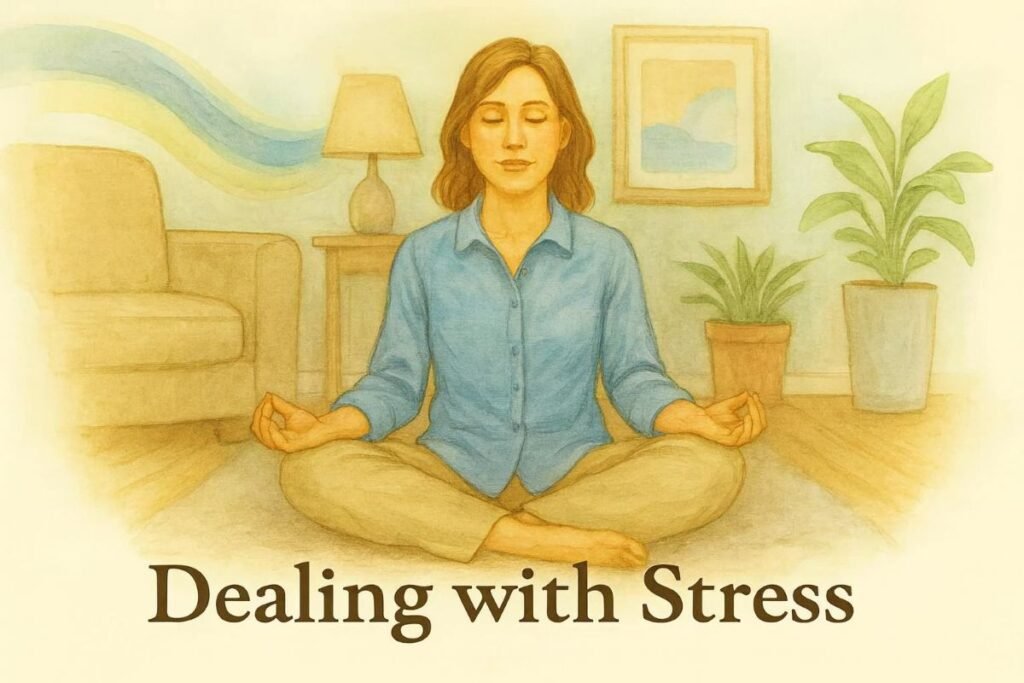
- Sit comfortably. Feel the natural rhythm of your breath at the nostrils or abdomen.
- Your mind will wander. This is normal. The practice is in the gentle return.
- Notice the feeling tone: Is the breath pleasant? Neutral?
- Notice your mind state: Is it restless? Calm?
This 10-minute daily practice builds the “mindfulness muscle” to notice stress early.
8. Right Concentration (Samma Samadhi): The development of deep, unified, tranquil focus, typically through meditation. This is the power that stabilizes mindfulness and allows for profound insight.
- Practical Application: After establishing mindfulness on the breath, gently narrow your focus to a single point, like the sensation at the tip of the nose. As the mind settles, a natural calm (samatha) arises. This calm is not the end goal, but a tool, a stress-free platform from which to observe the workings of the mind.
4. Key Concepts for Modern Stress Coping
4.1 Impermanence (Anicca)
Everything that arises passes away. Thoughts, emotions, sensations, relationships, and life circumstances are in constant flux. Our stress often comes from resisting this flow, wanting the good job to last forever, wanting the grief to end now.
- Application: When stressed by change, mentally note “This is anicca.” When a pleasant moment occurs, appreciate it fully while knowing “This too will change.” This reduces clinging and the shock of loss.
4.2 Not-Self (Anatta)
This is a profound and often misunderstood teaching. Anatta is not a claim that you don’t exist. It means that upon close inspection, you cannot find a permanent, independent, controlling “self” inside your experience. What you call “me” is an ever-changing process of body, feelings, perceptions, mental formations, and consciousness (the Five Aggregates, or khandhas). Much of our stress comes from defending, inflating, or worrying about this illusory solid self.
- Application: In moments of personal insult or failure, instead of thinking “I am a failure,” observe the process: “There is a feeling of humiliation. There is a thought ‘I am no good.’” This depersonalizes the experience, creating space and reducing suffering.
4.3 Equanimity (Upekkha)
Equanimity is a mind of balance, a spacious calm that remains undisturbed by the “eight worldly winds”: praise and blame, gain and loss, fame and disrepute, pleasure and pain. It is not indifference, but a wise, steady heart that meets all experiences without being knocked over by them.
- Application: Develop equanimity through reflection: “Praise arises and passes. Blame arises and passes.” When receiving exciting news or bad news, consciously feel the energy, then gently return your attention to your breath or body, grounding yourself in the present moment beyond the reaction.
5. Building a Daily Practice: From Theory to Life
A theoretical understanding is not enough. Wisdom must be cultivated through consistent practice.
5.1 Establishing a Formal Meditation Practice
- Start Small: 5-10 minutes daily is more valuable than 60 minutes once a week.
- Choose an Anchor: The breath (anapanasati) is most common. You can also use a phrase of loving-kindness (metta), body sensations, or even sound.
- Structure a Session:
- Settle: Sit comfortably, close your eyes, feel your body.
- Anchor: Bring attention gently to your chosen anchor.
- Notice Wandering: Your mind will wander into planning, worrying, remembering.
- Return Gently: Without judgment, note “thinking” or “wandering,” and return to the anchor. This return is the core practice of strengthening awareness.
- End Gently: After your time, expand your awareness to your whole body and surroundings before moving.
5.2 Practicing Mindfulness in Daily Activities
Formal meditation trains the mind for informal, all-day mindfulness.
- Mindful Eating: Eat one meal a day without screens. Notice colors, smells, textures, and tastes.
- Mindful Walking: Feel the contact of your foot with the ground, the shift of weight, the air on your skin. This can be done walking to your car or between meetings.
- Mindful Listening: In conversations, practice fully listening without formulating your response. Just hear.
- The STOP Practice (for acute stress):
- Stop what you are doing.
- Take a breath.
- Observe your body, feelings, and thoughts without judgment.
- Proceed with more awareness and space.
5.3 Cultivating the Heart Qualities (Brahma-viharas)
These “sublime abodes” are specific antidotes to stress-inducing mind states.
- Loving-Kindness (Metta): The wish for happiness for oneself and others.
- Practice: Silently repeat phrases like “May I be safe. May I be happy. May I be healthy. May I live with ease.” Then extend to a loved one, a neutral person, a difficult person, and finally all beings.
- Compassion (Karuna): The wish for relief from suffering for oneself and others.
- Practice: When you see suffering (in yourself or on the news), instead of turning away in overwhelm, silently offer, “May you be free from this suffering.”
- Sympathetic Joy (Mudita): Taking joy in the success and happiness of others.
- Practice: Counter envy by consciously appreciating a colleague’s promotion: “How wonderful that they are happy and successful.”
- Equanimity (Upekkha): As described above, balanced calm.
6. Working with Common Modern Stressors
6.1 Digital Overload and Anxiety
- View: The constant ping is a stream of vedana (pleasant/unpleasant feelings) designed to trigger tanha (craving for connection/information).
- Practice: Implement “mindful tech.” Before unlocking your phone, take one breath. Notice the intention: “Am I checking out of boredom (tanha)?”
- Practice Digital Renunciation: Designate tech-free hours. Notice the craving that arises and observe it as a passing mental event (anatta, anicca).
6.2 Work and Performance Pressure
- View: Pressure often comes from bhava-tanha (craving to be the “successful one”) and clinging to a specific outcome.
- Practice: Apply Right Effort. Focus diligently on the task at hand (Right Mindfulness), not the imagined future result. Perform the action for its own sake, as an exercise in skill and presence.
6.3 Relationship Conflict
- View: Conflict is fueled by clinging to views (“I’m right”) and to a fixed idea of the other person.
- Practice: Before responding, employ Right Speech and Deep Listening. Practice seeing the other person as subject to dukkha just like you. Can you respond to their suffering (karuna) rather than just their words?
6.4 Uncertainty and Fear about the Future
- View: Fear is resistance to the truth of anicca. We want a guaranteed, permanent future.
- Practice: Ground yourself in the present sensory world, feel your feet on the floor, listen to actual sounds. The future is a thought; the present is your only reality. Cultivate trust in your ability to meet what arises with the tools of the Path.
7. A Note on Schools and Traditions
The teachings and practices outlined here are core to Theravada Buddhism, which emphasizes the original Pali teachings and the direct path to liberation. Mahayana Buddhism (including Zen, Pure Land) embraces these foundations and expands on them, placing greater emphasis on the Bodhisattva ideal—postponing one’s own final peace to compassionately help all beings overcome stress. Its practices, like Zen meditation (zazen) and the contemplation of emptiness (sunyata), are profound methods for cutting the root of stress. Vajrayana Buddhism (Tibetan traditions) incorporates these and adds sophisticated tantric methods for working with energy and perception.
For the purpose of coping with daily stress, the foundational teachings of the Four Noble Truths and the Noble Eightfold Path, as preserved in all traditions, provide a complete and universally accessible toolkit.
8. Integration: A Lifelong Path
Coping with stress through Buddhist practice is not about achieving a permanent state of blissful numbness. It is about changing your relationship with experience. It is the movement from being tossed in the storm of reactivity to finding a steady center within the storm. You will still feel pain, grief, and fear, these are part of the human package. But they need not metastasize into pervasive, identity-defining stress.
The path is gradual. Start with one thing: five minutes of mindfulness of breath daily, or one act of conscious kindness, or pausing once when you feel irritation. In these small moments of awareness, you are weakening the chains of craving and ignorance. You are learning to be with life as it is, not as you crave it to be. And in that acceptance, in that clear seeing, lies a profound and accessible peace.
9. An Essential Note: When to Seek Professional Medical Help
Buddhist teachings and practices offer profound tools for understanding and transforming one’s relationship with stress, anxiety, and suffering. However, it is vital to state clearly and unequivocally: Buddhism is not a substitute for professional medical or psychological diagnosis and treatment.
The Buddha himself is often compared to a physician who diagnosed the illness of dukkha and prescribed the medicine of the Dhamma (the teachings). In the modern world, we understand that illnesses can be both spiritual/psychological and biological/clinical. A wise physician uses all appropriate tools for healing.
9.1 The Limits of Spiritual Practice
While meditation and mindfulness are powerful, they operate within a specific domain: the training of the mind and the development of insight. They are not designed to:
- Rebalance neurochemistry (although studies have shown the Buddhist practice of mindfulness and meditation can assist.)
- Directly treat trauma-induced physiological dysregulation.
- Cure clinical disorders rooted in genetic or biological factors.
Thinking of Buddhist practice as a cure-all can lead to spiritual bypassing, using spiritual ideas to avoid facing psychological wounds, trauma, or medical conditions that require specialized care. This can actually increase suffering.
9.2 Signs You Should Seek Professional Support
Consider Buddhist practice as one pillar of well-being, alongside physical health and professional mental health care. You should seek the help of a doctor, psychiatrist, or licensed therapist if you experience any of the following:
- Persistent and Overwhelming Symptoms: Feelings of depression, anxiety, or panic that are intense, unrelenting, and significantly interfere with your ability to function in daily life (work, relationships, self-care).
- Thoughts of Self-Harm or Suicide: Any thinking about harming yourself or ending your life requires immediate professional intervention. Contact a crisis hotline or go to the nearest emergency room.
- Symptoms of Trauma: Flashbacks, severe hypervigilance, emotional numbness, or nightmares related to past traumatic events. These are signs of Post-Traumatic Stress Disorder (PTSD) or complex trauma, which require trauma-informed therapy.
- Disordered Thinking or Perception: Experiencing hallucinations (seeing or hearing things others do not), delusions (fixed false beliefs), or severe paranoia. These require psychiatric evaluation.
- Inability to Perform Basic Tasks: When stress or low mood makes it impossible to get out of bed, feed yourself, or maintain basic hygiene.
- Substance Dependence: Using alcohol, drugs, or other substances to cope with emotional pain.
9.3 An Integrated Approach: Dhamma and Medicine
The Buddhist path and modern medicine are not in conflict; they can work together synergistically.
- Medicine Creates Stability: For someone with clinical depression, an antidepressant may help regulate brain chemistry enough that they can then engage meaningfully in mindfulness meditation. The medication helps lift the weight so the person can see the path to walk.
- Practice Supports Healing: For someone in therapy for trauma or anxiety, mindfulness skills can be invaluable for learning to tolerate difficult emotions and bodily sensations during treatment (e.g., in modalities like Trauma-Focused CBT or EMDR). The Buddhist teachings on impermanence and non-identification can provide a helpful philosophical framework for recovery.
- The Role of a Teacher: If you are working with a Buddhist teacher or meditation instructor, a good one will recognize the limits of their expertise. They should encourage you to seek professional help for clinical issues, just as a therapist might encourage meditation for stress management.
A Balanced View: Attending to your mental health with professional support is an act of compassion (karuna) and wisdom (panna). It aligns with the Buddha’s instruction to care for this body and mind, which are the vehicles for practice. It is also an expression of Right Action, taking the appropriate steps to alleviate suffering.
10. Summary and Integration
Coping with stress through Buddhist teachings is a journey of wise understanding and compassionate practice. It begins with recognizing the universal truth of dukkha and its root in craving and ignorance. The practical path forward is the Noble Eightfold Path, which develops wisdom, ethical living, and mental discipline through practices like mindfulness, meditation, and cultivating heart qualities like kindness and equanimity.
This path does not promise a life free of difficulty, but a transformed relationship to difficulty. It helps us see the impermanent (anicca), non-solid (anatta) nature of our experiences, creating space between stimulus and reaction. This space is where freedom grows.
Remember to approach this path with patience and self-compassion. Start small, be consistent, and integrate the practices into the fabric of your daily life. And always hold the wisdom to know when the support of a healthcare professional is the most skillful means to address your suffering.
By combining the ancient insights of the Buddha with the appropriate use of modern resources, you can navigate the stresses of the contemporary world with greater resilience, clarity, and peace.