A Transparent Look at Our Human-Led, AI-Assisted Process
This site is dedicated to providing thoughtful, accurate, and practical Buddhist-inspired guides for modern application. In a digital landscape where content origins are often obscured, we believe in radical transparency. This page details our editorial process, explaining how modern AI tools serve timeless goals: depth, clarity, and integrity.
1. Our Editorial Workflow: A Human-Led Assembly Line
Quality is not accidental. It is built through a deliberate, multi-stage process designed to leverage the strengths of both systematic AI processing and human thought and control. Every article, guide, and reflection passes through these four phases.
Phase 1: Research & Synthesis
- Primary Tool: Recall.ai
- Purpose: To synthesize and structure curated source material into a coherent first draft.
- Process: I (Joel) input carefully selected Buddhist sources, including suttas, commentaries, and trusted modern interpretations, into Recall.ai. I provide detailed prompts specifying the topic focus, required points, structural order, header use, Pali term treatment, and desired tone. Recall.ai then acts as a research assistant, organizing and synthesizing this curated information into a structured, referenced draft. This ensures the foundation is both authentic and clearly organized for further development.
Phase 2: Narrative & Drafting
- Primary Tool: DeepSeek AI
- Purpose: To transform structured research into clear, engaging, and reader-centric prose.
- Process: The research draft is shaped for narrative flow, logical clarity, and actionable insight. This stage focuses on creating a coherent voice and ensuring the structure serves the reader’s understanding. This again is reviewed and edited by me.
Phase 3: Fact-Checking & Consensus Analysis
- Tools: Perplexity.ai, Gemini, ChatGPT, Claude
- Purpose: To verify accuracy and ensure balanced representation.
- Process: The drafted content is cross-referenced against other AI models specialized in research. This “review” process checks factual claims, dates, and doctrinal details, guarding against the “hallucinations” or biases any single system might have. I evaluate these suggestions to determine if revisions are warranted prior to publishing.
Phase 4: Human Synthesis & Final Authority
- The Role: The Human Editor (Me)
- Purpose: To integrate, nuance, and finalize. This is where the work becomes authentic.
- Process: This is the most critical phase. I review all prior work to:
- Edit for Nuance & Heart: Injecting necessary disclaimers, ethical context, and personal insight that AI cannot generate.
- Perform the Final Check: Serving as the final arbiter of truth, tone, and alignment with the site’s values.
- Assume Full Responsibility: The decision to publish, and the accountability for what is published, is mine alone. The tools are collaborators; the judgment is human.
Each phase involves rigorous review and prompting by me to ensure accuracy, appropriateness, and alignment with the site’s vision.
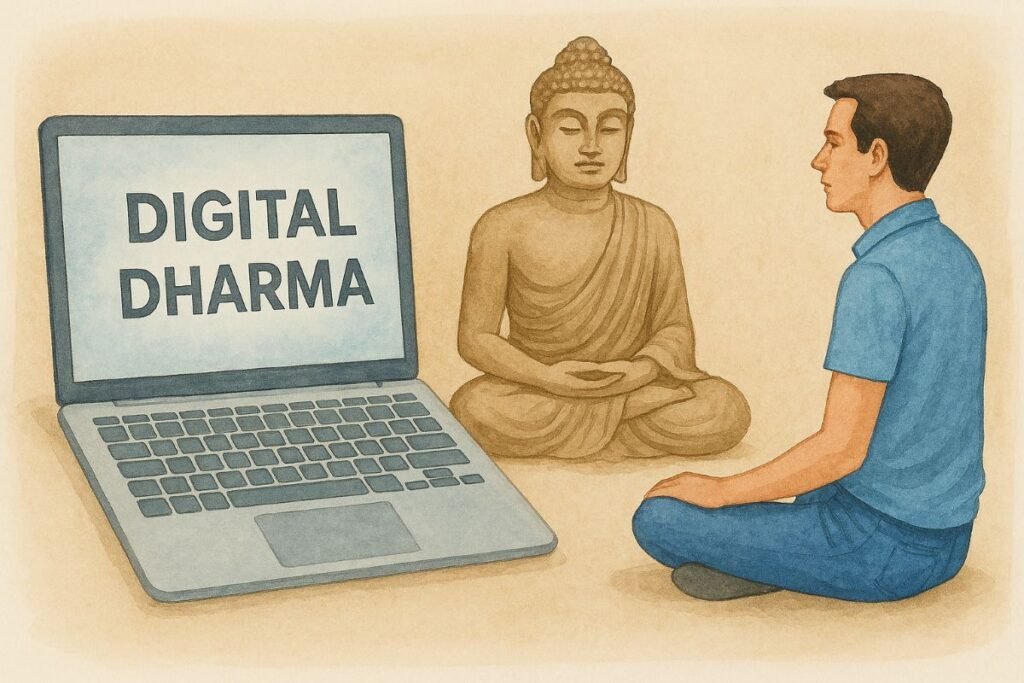
2. Digital Dharma: Intention, Tools, and Practice
Some content, such as poetic reflections, is created with artificial intelligence. This approach, what we term “Digital Dharma”, is undertaken with mindful deliberation, aligned with the Buddhist principles of Right Speech: that which is truthful, helpful, kind, and purposeful.
2.1 Benefits: Skillful Means (Upāya)
AI tools are employed as a form of upāya—skillful means to make wisdom accessible.
- Comprehensive Synthesis: They allow for the respectful compilation of teachings across traditions (Theravada, Mahayana, Vajrayana, Zen), highlighting universal principles from a wide range of sources.
- Accessible Language: They can aid in presenting core Dharma concepts in clear, contemporary language, serving as a bridge for modern inquirers.
- A Practice in Itself: The creative process, crafting precise prompts, reviewing outputs with discernment, becomes a meditation on clarity, intention, and non-attachment.
2.2 Acknowledged Risks & Limitations
This method is used with a clear understanding of its boundaries.
- Representation, Not Realization: AI generates linguistic patterns, not wisdom born from lived experience (paññā). AI can describe the path but cannot walk it. Our works are reflections of the Dharma, not transmissions from an awakened mind.
- The Peril of Superficiality: Without diligent human guidance, output can become aesthetically pleasing but spiritually empty. We mitigate this through thoughtful, rigorous editing focused on accuracy and practical utility.
- Potential for Misunderstanding: Readers may mistake well-structured information for genuine spiritual guidance. We explicitly state that these are contemplative aids and study tools, not replacements for a teacher (kalyanamitta), sangha, or personal practice.
2.3 Our Commitment: Respect, Integrity, and Right Speech
The entire process is framed by respect for the tradition and ethical creation.
- Human Direction is Sovereign: Every step is initiated, guided, and finalized by human intention. The AI is a tool; the responsibility for its use rests entirely with the editor.
- Fidelity to Source: Prompts and edits are anchored in accurate, foundational concepts (e.g., the Four Noble Truths, The Noble Eightfold Path, Impermanence, Compassion) to ensure outputs remain rooted in authentic teachings.
- Transparency as Integrity: This disclosure is made in the spirit of honesty (sacca). We offer this explanation so you may contextualize your reading, just as one would note the translation of a sutra.
- The Dharma Adapts: The Buddha’s teachings have historically adapted to culture and medium, from oral recitation to manuscripts to print. This digital form is a contemporary adaptation, focused on preserving essence while utilizing available tools.
3. Come and See: An Invitation to Discernment
In the spirit of the Kalama Sutta, we invite you to engage with this content not as dogma, but as an offering for your own wise consideration. The Buddha advised the Kalamas:
“Do not go upon what has been acquired by repeated hearing, nor upon tradition… nor upon surmise… nor upon bias… nor upon the idea ‘he is our teacher.’ When you know for yourselves: ‘These things are wholesome, blameless, praised by the wise; when undertaken and observed, these things lead to benefit and happiness’, then you should abide in them.”
We extend the same invitation here. Test these words against your own reason and experience. Observe if they lead to clarity, peace, and understanding. The value of any teaching, whether delivered by a human teacher or facilitated through digital means, lies in its practical benefit.
Your trust is not demanded, but earned through consistency, honesty, and utility. This transparency is offered so you may understand the vessel that carries these words. Remember the Buddha’s final analogy: the Dharma is a raft for crossing over, not a possession to be carried.
We are open to dialogue. If you have questions about our process or content, please feel free to reach out.
And for full transparency: no, I look nothing like the serene figure often used in stock imagery.
With clarity and respect,
Joel – Dharma Student / Buddhist Learning For All