Introduction: What Are the Four Foundations?
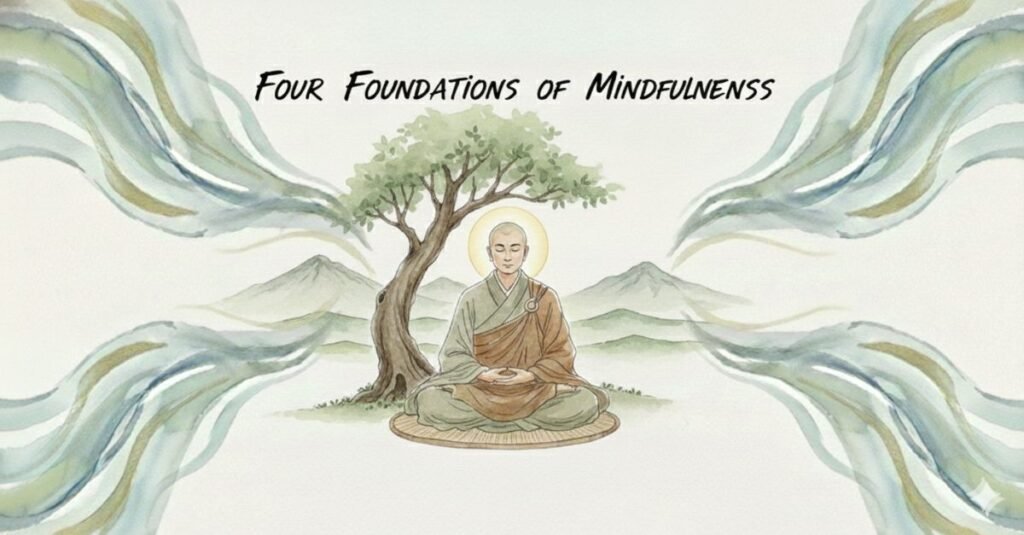
The Four Foundations of Mindfulness, known in Pali as Satipaṭṭhāna, form the cornerstone of Buddhist meditation practice and offer a complete framework for developing clear, stable awareness in daily life. The term combines sati, meaning “mindfulness,” “awareness,” or “recollection” (in the sense of remembering to be present), and paṭṭhāna, meaning “foundation,” “establishment,” or “basis.” Thus, Satipaṭṭhāna translates to “the establishing of mindfulness” or “the foundations of awareness.”
This teaching, famously presented in the Satipaṭṭhāna Sutta, is often called “the direct path” for purifying the mind, overcoming distress, and gaining insight. It is not merely a relaxation technique but a systematic training in seeing things as they are, without the filters of our preferences, judgments, and stories.
The four foundations are progressive areas of investigation:
- Mindfulness of the Body (Kāyānupassanā)
- Mindfulness of Feelings (Vedanānupassanā)
- Mindfulness of the Mind (Cittānupassanā)
- Mindfulness of Mental Objects (Dhammānupassanā)
This guide will explore each foundation in detail, explaining what it is, why cultivating it matters and, most importantly, how to apply it in the midst of your everyday life.
1. Mindfulness of the Body (Kāyānupassanā)
What It Is
Mindfulness of the Body is the practice of grounding our awareness in the direct, physical experience of the body. It is the foundational training of attention, using the body, which is always present, as a stable anchor to the present moment. This practice counters our tendency to live in the abstract world of thoughts about the past and future.
The classical teaching outlines several specific exercises:
- Mindfulness of Breathing (Ānāpānasati): Observing the natural breath.
- Mindfulness of Postures: Knowing “I am walking,” “I am standing,” “I am sitting,” “I am lying down,” as these actions occur.
- Mindfulness with Clear Comprehension (Sampajañña): Bringing deliberate awareness to all bodily activities (bending, stretching, eating, washing).
- Analysis of the Body Parts: Reflecting on the body as composed of various organs and elements (hair, skin, bones, etc.) to understand its nature.
- Analysis of the Elements: Contemplating the body in terms of earth (solidity), water (fluidity), fire (temperature), and air (motion & breath).
- Mindfulness of the Body’s Impermanence: Observing the body’s decay and mortality through practices like cemetery contemplations. (Note: for those unfamiliar with this technique, please seek guidance from an experienced Buddhist teacher.)
Why It Is Important
The body is the most immediate and concrete aspect of our experience. By learning to place attention here, we develop concentration (samādhi) and stability of mind. This foundation:
- Anchors Us in Reality: When anxious or lost in thought, sensation in the body is an undeniable fact of the present moment. Tuning into it interrupts cycles of worry.
- Cultivates Non-Judgmental Awareness: We learn to feel fatigue, pain, or pleasure without an immediate story of “good” or “bad.” We sense the sensation itself.
- Reveals Impermanence at a Gross Level: We directly see how sensations constantly change; an itch arises and passes, tension ebbs and flows, the breath is never the same. This insight into change (anicca) begins here.
- Reduces Identification: We start to see the body as a collection of processes (“there is aching”) rather than a solid, fixed self (“I am a person in pain”).
How to Apply It in Daily Life: Practical Exercises
This foundation turns every moment into a potential practice ground.
Formal Meditation Practices:
- Breath Awareness: Sit comfortably. Feel the physical sensations of the breath at the nostrils, chest, or abdomen. Notice the beginning, middle, and end of each in-breath and out-breath. When the mind wanders, gently return to these sensations. This is the primary anchor for mindfulness.
- Body Scan: Lie down or sit. Systematically move your attention through the body from head to feet or feet to head. Notice sensations in each part, tingling, pressure, warmth, coolness, or even numbness/absence of sensation. Observe without trying to change anything.
Informal Daily Life Practices:
- Posture Check-Ins: Several times a day, pause to ask, “What is my body doing right now?” Feel the feet on the floor in standing, the sit bones contacting the chair, the alignment of the spine. This brings you instantly present.
- Mindful Walking: Choose a short path (even 10 steps). Walk slowly, feeling in detail the lift, move, and place of each foot. Notice the shifting balance, the play of muscles. This can be done while walking to your car or down a hallway.
- Mindful Routine Activities: Pour a cup of tea with full attention. Feel the weight of the kettle, the sound of the liquid, the heat radiating from the cup. When washing dishes, feel the temperature of the water and the texture of the plates.
- Working with Pain: When physical discomfort arises, shift from “My back hurts” to investigating the actual sensation. Where is its precise location? Is it throbbing, sharp, or dull? Does it change? This investigative stance often reduces the suffering around the pain.
2. Mindfulness of Feelings (Vedanānupassanā)
What It Is
Mindfulness of Feelings is the practice of recognizing the affective tone of every moment of experience. Here, “feeling” (vedanā) has a specific meaning: it is not emotion, but the simple, immediate sense of whether an experience is pleasant, unpleasant, or neutral.
Every time there is contact between a sense organ (eye, ear, nose, tongue, body, mind) and an object, a feeling tone arises.
- Seeing a beautiful flower → Pleasant feeling.
- Hearing a harsh noise → Unpleasant feeling.
- Sensing the pressure of your clothing → Initially neutral feeling.
- Thinking a stressful thought → Unpleasant mental feeling.
The practice is to catch this basic, instantaneous “taste” of experience before the mind elaborates it into a story, emotion, or action.
Why It Is Important
Feelings are the hidden trigger for most of our behavior. We are driven by an unconscious cycle: seek pleasant feelings, avoid unpleasant ones, ignore neutral ones. This craving and aversion is a primary source of suffering (dukkha).
- By mindfully recognizing a feeling as just a feeling, we create a critical gap between stimulus and reaction.
- We see that feelings are impersonal and impermanent. A pleasant feeling doesn’t last, and an unpleasant one isn’t permanent. They arise due to conditions and pass when conditions change.
- This understanding weakens the power of cravings and aversions, leading to greater emotional freedom and choice.
How to Apply It in Daily Life: Practical Exercises
The practice is to become a discreet observer of this constant, subtle flow of pleasant, unpleasant, and neutral tones.
Formal Meditation Practice:
- Sit in meditation. As experiences arise: a sound, a thought, a bodily sensation, notice the feeling tone that accompanies it. Label it silently: “pleasant,” “unpleasant,” “neutral.” Do this with detachment, as if noting the weather. The feeling is not you; it is a passing condition.
Informal Daily Life Practices:
- The Feeling Pause: During daily activities, set reminders to pause and ask: “What is the predominant feeling tone right now?” Is drinking this coffee pleasant? Is the background hum of the computer neutral? Is the memory that just arose unpleasant?
- At the Moment of Trigger: When someone says something that irritates you, try to notice the very first flash of unpleasant feeling before the story (“they are rude!”) and the emotion (anger) fully form. Just note: “Unpleasant. Unpleasant.”
- Mindful Consumption: When reaching for a snack, social media, or entertainment, pause. Ask: “What feeling am I seeking to create or avoid?” Are you bored (unpleasant feeling) and seeking pleasant distraction? This awareness can create space for a more conscious choice.
- Expanding the “Neutral”: We often ignore neutral feelings, rushing to the next stimulation. Practice resting in neutral experiences, the feeling of the breath when it’s neither exciting nor troubling, the ambient sound of a quiet room. This cultivates contentment and stability.
3. Mindfulness of the Mind (Cittānupassanā)
What It Is
Mindfulness of the Mind is the practice of observing the state or quality of consciousness itself. It is not about the content of the mind (the specific thought), but about the container, its current condition.
The classic instructions guide us to notice: “The mind is with lust, or without lust. The mind is with hatred, or without hatred. The mind is deluded, or undeluded. The mind is contracted, or distracted, or developed, or freed…” and so on.
In simpler terms, you note:
- Is the mind greedy or generous?
- Is it angry or loving?
- Is it confused or clear?
- Is it focused or scattered?
- Is it expansive or contracted?
- Is it steady or agitated?
You are observing the weather patterns of consciousness, not getting lost in the storyline of the thoughts.
Why It Is Important
We commonly identify with our mind states. “I am an angry person,” or “I am a worrier.” This identification is a form of clinging that solidifies these states. Mindfulness of the Mind allows for dis-identification.
- You see that states are temporary: anger arises, persists for a while, and passes. It is a conditioned event, not your core identity.
- This observation reduces the secondary suffering of guilt or pride about these states. You can say, “There is anger,” rather than, “I am angry.”
- It provides crucial feedback for your practice. You can see if your actions are leading to a mind that is more concentrated, kind, and clear, or more scattered and reactive.
- It reveals the mind’s natural capacity to be aware of a state without being fully defined by it. This is a glimpse of freedom.
How to Apply It in Daily Life: Practical Exercises
This practice requires stepping back to observe the general tone of awareness.
Formal Meditation Practice:
- After focusing on the breath for a while, broaden your attention. Ask: “What is the overall state of mind right now?” Label it simply: “restless,” “calm,” “sleepy,” “bright.” Do this every few minutes, noticing how it changes.
Informal Daily Life Practices:
- State Check-Ins: Set periodic reminders. Pause and note: “Present mind state: rushed.” Or, “Present mind state: content.” Just name it.
- Observing Transitions: Notice the precise moment when your mind state shifts. For example, when you hang up the phone after bad news, watch how the mind shifts from “engaged” to “worried” or “sad.” See it as a transition, not a fixed reality.
- In Conversation: Listen to someone, and simultaneously be aware of the quality of your own listening mind. Is it receptive, impatient, planning a reply, or genuinely open? This meta-awareness can transform communication.
- Working with Strong Emotions: When a powerful emotion like anxiety takes over, instead of fighting it, turn toward the mind itself. Observe: “The mind is in a state of intense contraction and fear.” Holding it in this wider awareness can diminish its grip.
4. Mindfulness of Mental Objects (Dhammānupassanā)
What It Is
This is the most analytical foundation. “Mental Objects” (dhammas) here refer to specific categories of phenomena, or “patterns of mind,” that the Buddha identified as crucial for understanding suffering and liberation. Observing them means seeing how these patterns operate in your own experience.
The classical framework includes observing:
- The Five Hindrances (Nīvaraṇāni): Internal obstacles to concentration and clarity.
- The Five Aggregates (Khandhas): The components of subjective experience (Form, Feeling, Perception, Mental Formations, Consciousness).
- The Six Sense Spheres (Āyatanāni): The interaction of the six senses with their objects.
- The Seven Factors of Enlightenment (Bojjhaṅgā): The mental qualities that lead to awakening.
- The Four Noble Truths (Ariyasaccāni): The framework of suffering, its cause, its cessation, and the path.
For practical purposes, Mindfulness of the Hindrances and the Enlightenment Factors are the most directly applicable for daily practice.
Why It Is Important
This foundation moves mindfulness from simple awareness to insight (vipassanā). It provides a map to understand the “why” behind your mental states.
- By recognizing a Hindrance (like restlessness or doubt), you see it not as a personal failure but as a temporary condition that obscures clarity. You learn its causes (e.g., overstimulation feeds restlessness) and how it passes.
- By observing the Enlightenment Factors (like mindfulness, investigation, energy, joy, tranquility, concentration, and equanimity), you learn to nurture the conditions that support wisdom and peace.
- This analytical observation leads to profound insights into the impersonal, conditioned nature of all experience, the heart of the Buddha’s teaching on not-self (anattā) and liberation.
How to Apply It in Daily Life: Practical Exercises
This practice involves using the frameworks as lenses to examine your present-moment experience.
1. Working with the Five Hindrances:
These are: Sensory Desire, Ill-Will, Sloth & Torpor, Restlessness & Worry, and Doubt.
- Practice: When you notice your mind is dull or agitated, identify which hindrance is present. For example, if you’re procrastinating, you might find Sloth-Torpor or Restlessness.
- Investigate: What conditions nourish it? (Fatigue? Too much sugar? Unresolved conflict?) What conditions weaken it? (A short walk? A clear decision? Talking it out?)
- Apply the Antidote: Classical antidotes include: for Ill-Will, cultivate Loving-Kindness; for Sloth, energize the mind; for Restlessness, practice calming meditation.
- Daily Example: Feeling irritable (Ill-Will) after work. Note: “Hindrance of ill-will is present.” Investigate: “It arose after a frustrating meeting.” Apply: Do a short mettā (loving-kindness) meditation or consciously reflect on the other person’s humanity.
2. Cultivating the Seven Factors of Enlightenment:
These are: Mindfulness, Investigation, Energy, Joy, Tranquility, Concentration, and Equanimity.
- Practice: Periodically assess which factors are present or absent. Is your mind energized or lethargic? Is there a quality of joy or dryness? Is there balance (equanimity) or reactivity?
- Nourish What’s Weak: If “Investigation” is weak (mind is passive), ask a curious question about your experience. If “Joy” is absent, recall something you appreciate.
- Balance the Factors: Too much “Energy” without “Tranquility” leads to restlessness. Too much “Tranquility” without “Energy” leads to sleepiness. The practice is to adjust, like tuning an instrument.
- Daily Example: In a challenging project, you feel stuck (low Energy, low Investigation). You consciously take a break to walk (arouses Energy), then return and break the problem into smaller questions (applies Investigation).
3. Observing the Sense Spheres:
- Practice: Notice the process of contact. When a sound arises, see it as: Ear + Sound + Ear-Consciousness = Contact. Then observe the Feeling (pleasant/unpleasant) and any subsequent reaction that arises from that contact. This deconstructs experience into its impersonal parts.
Integration: How the Four Foundations Work Together
The Four Foundations are not separate practices but interrelated facets of a single practice of mindful awareness.
- The Body is the Ground: You always start by grounding awareness in the body (Foundation 1). When lost or overwhelmed, return here.
- Feelings are the Signal: From bodily or mental contact, a feeling tone arises (Foundation 2). Recognizing this signal is key to breaking automatic habits.
- The Mind is the Container: The feeling occurs within a broader mind state (Foundation 3). Knowing if the mind is greedy, hateful, or concentrated provides context.
- Mental Objects are the Map: Using the frameworks of hindrances and enlightenment factors (Foundation 4), you understand the dynamics of what’s happening in Foundations 1-3 and know how to skillfully respond.
A Flowing Example:
You’re working, and a loud noise startles you.
- Body: You feel a jolt of tension in the shoulders (Foundation 1).
- Feeling: You recognize an unpleasant feeling arose from the contact of ear and sound (Foundation 2).
- Mind: You notice the mind state became “startled and irritated” (Foundation 3).
- Mental Objects: You identify the Hindrance of “Ill-Will” toward the noise-maker, and see the Enlightenment Factor of “Tranquility” is absent (Foundation 4).
- Skillful Response: You apply the antidote: you take a deep breath (grounding in Body), accept the unpleasant feeling is fading (Feeling), gently release the irritated mind state (Mind), and consciously relax to cultivate Tranquility (Mental Objects).
Common Challenges and Considerations
- Expecting a Quiet Mind: Mindfulness is about awareness of what is present, whether it’s calm or chaotic. A “busy mind” is not a failure; it’s the primary object of practice.
- Judging Your Experience: The habit of labeling experiences “good” or “bad” is strong. The practice is to notice this judging as just another mental event.
- Forgetting the “How”: Mindfulness requires a gentle, curious, and kind attitude. Forcing awareness or becoming frustrated with distraction is counterproductive. The quality of attention matters as much as the focus.
- Integrating into a Busy Life: Start small. One minute of mindful breathing, three mindful sips of tea, one minute of mindful walking. Frequency is more important than long duration initially.
Conclusion: A Path of Direct Understanding
The Four Foundations of Mindfulness offer a timeless, practical, and profound path of training. It is a path of coming out of the narratives of the past and future and learning to dwell in the actual experience of the present. This is not for the purpose of escaping life, but for engaging with it more fully, clearly, and peacefully.
By systematically training awareness of the body, feelings, mind, and mental patterns, we develop the tools to see the fundamental nature of our experience: its impermanence, its susceptibility to stress when clung to, and its lack of a permanent, controlling self. From this clear seeing, wisdom and freedom naturally grow. The practice begins simply: with the next breath you take, the next step you make, the next feeling that arises. Right here, right now.