A Guide to Understanding Your Experience
Introduction: What Are the Five Aggregates?
The Five Aggregates, known in Pali as the Khandhas and in Sanskrit as the Skandhas, represent one of the most important and practical frameworks in Buddhist psychology. The word “aggregate” translates as “heap,” “bundle,” or “collection”, suggesting things gathered together that lack a singular, permanent essence.
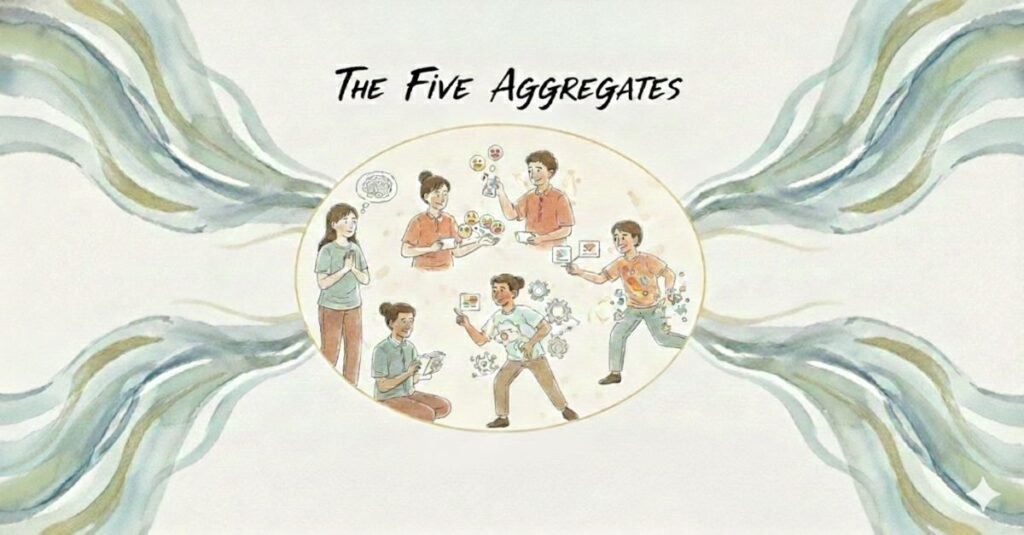
Rather than describing what we are, the aggregates describe what we experience. They break down the complex flow of human existence into five interconnected categories of phenomena. When the Buddha was asked, “What is a person?” he pointed to these five aggregates, suggesting that what we call “self” is actually a temporary, ever-changing process composed of:
- Form (Rūpa): Physicality and material experience
- Feeling (Vedanā): The affective tone of experience
- Perception (Saññā): The process of recognition and labeling
- Mental Formations (Saṅkhāra): Volitional and habitual responses
- Consciousness (Viññāṇa): The knowing of an object
This teaching isn’t philosophical speculation. It’s a map for investigation, a way to examine your present-moment experience to see clearly how it operates. Understanding the aggregates helps answer profound questions: Why do I suffer? What is this “I” I keep referring to? How can I find freedom from reactive patterns?
1. The First Aggregate: Form (Rūpa)
What It Is
Form refers to the material aspect of experience, anything physical or sensed. Traditionally, it includes the body and the external physical world, understood to be composed of the “four great elements”:
- Solidity/Earth Element: What is hard or soft; the experience of texture, mass, and resistance.
- Fluidity/Water Element: What is cohesive or flowing; the experience of liquidity, binding, and circulation.
- Temperature/Fire Element: What is hot or cold; the experience of temperature, metabolism, and maturation.
- Motion/Air Element: What is mobile or pressurized; the experience of movement, vibration, and breath.
In practical terms, Form is anything detected by the six senses: sight, sound, smell, taste, touch, and mental objects (thoughts/images experienced as “things”). Your aching back, the sound of rain, the weight of your phone in your hand, these are all rūpa.
Why It Is Important
We habitually identify with the body as “me” or “mine” (“my pain,” “my appearance”). This identification is a primary source of suffering; we fear its aging, sickness, and death. The aggregate teaching invites us to investigate: Is this body really a permanent, controllable “self,” or is it a constantly changing process of elements? Seeing the body as rūpa, as impersonal, conditioned phenomena, helps loosen the clinging that causes anxiety about our physical form.
How to Apply It in Daily Life: Practical Mindfulness of Form
The practice is to observe physical phenomena as physical phenomena, without immediately personalizing them.
- Body Scan Meditation: Systematically bring attention to sensations in different parts of the body. Note them simply as “pressure,” “tingling,” “warmth,” or “vibration”, impersonal rūpa arising and passing.
- During Physical Pain: Instead of thinking, “My headache is terrible,” experiment with observing: “There is a sensation of throbbing pressure in the region of the head. It is intense. It is changing.” This slight shift from “my pain” to “there is pain” can reduce secondary suffering (the mental anguish about the pain).
- In Movement: While walking, pay attention to the pure sensations of motion: the lift, swing, and placement of the foot; the play of muscles; the contact with the ground. See it as a dance of elements, not “I am walking.”
- With External Objects: Look at a tree. See it as patterns of color, shape, and light (rūpa) meeting the eye sense organ, rather than immediately getting lost in the story of “that beautiful maple in my yard.”
2. The Second Aggregate: Feeling (Vedanā)
What It Is
Feeling is the initial, immediate tone or “taste” of any experience. It is not emotion (which is more complex and belongs to the next aggregate). Vedanā is the simple, instantaneous registration of an experience as pleasant, unpleasant, or neutral.
Every moment of contact between a sense organ and an object produces one of these three feelings.
- Eye consciousness seeing a sunset → Pleasant feeling.
- Body consciousness touching a hot stove → Unpleasant feeling.
- Ear consciousness hearing background traffic → Neutral feeling.
- Mind consciousness remembering a mundane fact → Neutral feeling.
This feeling tone is automatic and precedes any complex story or reaction.
Why It Is Important
Clinging to pleasant feelings and resisting unpleasant ones is the fundamental engine of dukkha (suffering/stress). We spend our lives in a reactive cycle: chasing pleasure, running from pain, and ignoring the neutral. Vedanā is the critical link in the chain of dependent origination, the point where unwise attention can lead to craving and clinging, or wise attention can lead to letting go. By mindfully recognizing the feeling tone, we create a crucial gap between stimulus and habitual reaction.
How to Apply It in Daily Life: Practical Mindfulness of Feeling
The practice is to become a connoisseur of these basic feeling tones, noting them with bare attention.
- The Pause Practice: Several times a day, pause and ask: “What is the predominant feeling tone in this very moment?” Is the contact with your chair pleasant, unpleasant, or neutral? The taste in your mouth? The sound you’re hearing? Just label it: “pleasant,” “unpleasant,” “neutral.”
- In Conflict: When someone says something hurtful, try to catch the immediate flash of unpleasant feeling on contact with the words, before the story (“how dare they!”) and the emotion (anger) fully arise. Just note: “Unpleasant feeling. Unpleasant feeling.”
- Cravings and Aversions: When you crave a piece of cake, notice the pleasant mental feeling associated with the thought of it. When you avoid a difficult task, notice the unpleasant feeling associated with the thought of it. See how these simple tones drive complex behaviors.
- Meditation Instruction: In sitting meditation, a primary object can be to note the feeling tone of each sensation. The breath: is it pleasant, unpleasant, or neutral? A sound: pleasant, unpleasant, or neutral? This cultivates profound equanimity.
3. The Third Aggregate: Perception (Saññā)
What It Is
Perception is the mental function of recognizing, identifying, and labeling. It takes the raw data of Form and Feeling and answers the question: “What is this?” It matches current experience with memory.
- The eyes sense colored shapes (rūpa); perception recognizes, “That’s my coffee cup.”
- The ears sense a pattern of sound waves; perception identifies, “That’s a bird singing.”
- The mind senses a mental image; perception labels it, “That’s a memory of my first day of school.”
Saññā is what allows us to navigate the world. However, it is also what creates concepts, stereotypes, and fixed ideas. It is the aggregate responsible for “name” in the “name-and-form” (nāma-rūpa) duality.
Why It Is Important
We confuse our perceptions (mental labels) for reality itself. We believe “I am a failure” because perception labeled a past event that way and now applies it to our identity. We see someone and perception instantly labels them “friend,” “stranger,” or “threat,” triggering a cascade of pre-programmed reactions. Suffering often arises when we cling tightly to our perceptions as absolute truth, unable to see that they are interpretations, not the thing-in-itself.
How to Apply It in Daily Life: Practical Mindfulness of Perception
The practice is to witness the labeling function of the mind with detachment, recognizing it as a useful but limited tool.
- The “Naming” Game: In meditation or daily life, consciously note perceptions as they arise. “Perceiving ‘car.’” “Perceiving ‘anger.’” “Perceiving ‘planning.’” See them as mental events, not commands.
- Challenge Assumptions: When you have a strong perception about someone (“they’re lazy”), pause. Ask yourself: “Is this perception 100% true? Is it a permanent truth, or a temporary label based on limited data?” This opens space for other interpretations.
- With Self-Concept: Notice when perception labels your own experience in a limiting way: “I’m having a bad day” or “I’m not good at this.” See these as passing perceptions, not the totality of your being.
- In Misunderstanding: When you can’t find your keys and perception shouts, “I lost them!”, recognize that this is just a perception, not a fact. The shift can be from panicked frustration to calm looking.
4. The Fourth Aggregate: Mental Formations (Saṅkhāra)
What It Is
This is the most complex aggregate. Saṅkhāra means “that which is put together” or “volitional formations.” It encompasses all intentional, volitional, and habitual mental activity that shapes our response to experience.
It includes:
- Emotions: Love, hate, fear, joy, jealousy, confidence.
- Volitions/Intentions: The will to act, speak, or think in a certain way. This is the heart of kamma (action).
- Habits and Conditioning: Our ingrained patterns of thought and behavior.
- Attention and Evaluation: The factor of mind that turns toward or away from an object.
- Specific Mental Factors: Dozens are listed in the Abhidhamma, including effort, greed, generosity, mindfulness, and doubt.
If Feeling is the taste and Perception is the identification, Mental Formations are the chef’s decision, what to do with it based on all past training and habits.
Why It Is Important
This is the aggregate of karmic shaping. Our intentions (cetanā), which are part of saṅkhāra, create our future character and experiences. It is also the source of our deepest conditioning, the reactive patterns that cause repeated suffering. By understanding and working with this aggregate, we have the leverage to change our lives. Freedom is found not in destroying mental formations, but in no longer being blindly identified with and driven by them.
How to Apply It in Daily Life: Practical Mindfulness of Mental Formations
The practice is to observe the impulses and emotional energies that arise, creating space for conscious choice.
- Observe the Impulse Gap: Between a feeling/perception and an action, there is a volitional impulse (a saṅkhāra). Practice widening that gap. Feeling insulted (unpleasant vedanā) → perception “attack” → observe the rising impulse to retaliate (anger saṅkhāra). In that observation, freedom to choose a different response becomes possible.
- Label Emotions Mindfully: Instead of “I am angry,” practice “Anger is present” or “There is a strong mental formation of anger.” This de-identification allows you to investigate the anger without being consumed by it.
- Cultivate Beneficial Formations: Intentionally nurture mental factors like kindness (mettā), compassion (karuṇā), and mindfulness (sati). These too are saṅkhāras. By consciously choosing them, you reshape your habitual tendencies.
- Reflection on Intention: Before speaking or acting, especially in charged situations, pause to check your intention. “What saṅkhāra is driving this? Is it generosity or neediness? Truthfulness or fear?” Align your action with wise intention.
5. The Fifth Aggregate: Consciousness (Viññāṇa)
What It Is
Consciousness is the knowing of an object, the simple awareness that arises dependent on a sense organ and its corresponding object. It is not a thing, but an event, a “knowing” that lights up when conditions come together.
There are six types, corresponding to the six senses:
- Eye-consciousness: seeing (dependent on eye + visible form)
- Ear-consciousness: hearing (ear + sound)
- Nose-consciousness: smelling (nose + odor)
- Tongue-consciousness: tasting (tongue + flavor)
- Body-consciousness: touching (body + tangible object)
- Mind-consciousness: thinking (mind + mental object, like a memory or idea)
Crucially, consciousness is empty and dependent. It has no independent existence. It only exists as the knowing of a specific object through a specific door. When the conditions cease, that consciousness ceases.
Why It Is Important
We often mistake consciousness for a permanent, inner witness or soul, a stable “knower” behind experience. The aggregate analysis shows it to be a fleeting, conditioned series of discrete events. Seeing this undermines the last and subtlest place where we hold a sense of permanent self: in awareness itself. Understanding consciousness as dependent and impersonal liberates us from the deepest clinging.
How to Apply It in Daily Life: Practical Mindfulness of Consciousness
The practice is to observe the very knowing of experience, noticing its dependent and impermanent nature.
- Doorway Meditation: In meditation, notice which “door” consciousness is arising through. “Hearing consciousness is present.” “Thinking consciousness is present.” “Seeing consciousness is present.” Note how it switches rapidly.
- Observe Interdependence: When you hear a sound, notice the triad: ear organ (a form of rūpa), sound object (rūpa), and the knowing of sound (viññāṇa). Remove any one, and the experience vanishes. See consciousness not as “my awareness,” but as an impersonal event dependent on conditions.
- In Gaps: Pay attention to the brief moments between one conscious experience ending and another beginning. In deep sleep, where is “your” consciousness? This inquiry loosens the grip on consciousness as a personal possession.
- During Thinking: Notice that you cannot know the thought and be identified as the thinker at the same time. When you are fully aware of a thought as an object of mind-consciousness, the sense of a solid “thinker” recedes.
The Aggregates and No-Self (Anattā): The Liberating Insight
The Five Aggregates are not a theory about the self; they are the objects of investigation that lead to the direct insight of anattā, or not-self.
The logic of investigation is simple: If there were a permanent, satisfying, controllable self, we should be able to find it within or as these aggregates. Upon close examination:
- Form is impermanent (anicca), subject to decay, and not under our ultimate control.
- Feeling is impermanent, uncontrollably changing from pleasant to unpleasant.
- Perception is impermanent and often mistaken.
- Mental Formations are impermanent, conditioned, and often conflict with our wishes.
- Consciousness is impermanent, dependent, and ceases when its conditions cease.
None of these can qualify as a permanent self. We suffer because we cling to one or more of these aggregates as “me” or “mine” (“My body must be beautiful,” “I must always feel happy,” “My opinions are right”). The path to freedom involves seeing each aggregate for what it is: an impersonal, conditioned, empty process. As the famous refrain states: “This is not mine. This I am not. This is not my self.”
By applying mindful observation to the five aggregates in daily life, we gradually replace identification with clear comprehension. This leads not to nihilism, but to a lighter, more fluid, and compassionate way of being, free from the burden of defending a fixed “self” that never existed in the first place. It is a profound, practical path to understanding the nature of experience and finding peace within its ever-changing flow.