
Key Takeaways
- Holistic Preparation: Success in meditation is not solely dependent on technique. It requires a foundation of physical health, psychological integrity, and spiritual conviction. As the Buddha teaches in the Padhāniyaṅga Sutta (AN 5.53), these five factors of striving function as an interdependent set of enabling conditions rather than a simple checklist.
- The Role of Faith: Faith (saddhā) in the Buddha’s awakening acts as the primary motivator, providing the emotional resilience needed to sustain long-term practice. This is not blind belief but a working confidence that is tested and refined through practice, a disposition explored alongside the Buddha’s broader epistemology in the Kālāma Sutta (AN 3.65).
- Biological Balance: A middle way for the body, specifically smooth and balanced digestion and freedom from frequent illness, is explicitly cited as a prerequisite for a body fit for striving. The Buddha never dismissed the body. He integrated it as a vehicle for awakening.
- Radical Transparency: Honesty with oneself and one’s teachers removes the mental weight of deceit, which otherwise acts as a subtle barrier to deep concentration. When the mask of pretense is dropped, the energy once spent on maintaining a false persona becomes available for inner work.
- Dynamic Effort: Energy (viriya) must be roused up and consistent, directed toward the dual task of abandoning unskillful qualities and cultivating skillful ones. This is not grim endurance but the steady persistence of a practitioner who has seen the destination, as detailed in the teachings on the Four Right Efforts.
- Penetrative Insight: The ultimate goal is the wisdom of arising and passing away, a noble and penetrative understanding that leads to the complete ending of suffering. This wisdom is not intellectual but experiential, born of sustained contemplation of impermanence (anicca).
- Interconnection: None of these factors stands alone. Faith energizes effort. Health supports concentration. Honesty clears the way for wisdom. Wisdom in turn deepens faith. To neglect one is to weaken the entire path.
Introduction: The Five Factors of Striving
If you have ever sat down to meditate and found your mind wandering, your body aching, or your motivation collapsing, you have touched upon a fundamental truth of the Buddhist path. Meditation does not happen in a vacuum. The mind that rests on the cushion is the same mind that has been shaped by daily habits, beliefs about oneself, relationships with others, and even the state of the digestive system. The Buddha understood this intimately. Far from presenting meditation as an isolated technique to be applied mechanically, the early discourses repeatedly emphasize the conditions that make deep spiritual work possible.
Among the most concise and practical of these teachings is the Padhāniyaṅga Sutta (AN 5.53), known as the Discourse on the Factors of Striving or Factors That Support Exertion. This short but remarkably dense discourse lists five factors that together form a concise framework of essential supporting conditions for liberation-oriented practice: faith, health, honesty, energy, and wisdom. These are not merely suggestions for a better life. They are described as the enabling conditions for any practitioner serious about the end of suffering. While modern mindfulness often isolates attention training as a purely mental exercise, the Pali Canon presents meditation as an integrated way of living in which these five factors work in tandem.
Notably, the list makes no explicit mention of study or theoretical learning. It focuses entirely on living conditions and inner qualities, reinforcing the understanding that what is being described is the traditional threefold training of morality, concentration, and wisdom as it unfolds in practice. The word padhāna, meaning striving or exertion, signals that this training is primarily a self-directed, effortful process. This is the humble beginning of the middle way, a healthy body supporting a healthy mind as a vehicle for awakening.
Although AN 5.53 does not explicitly enumerate moral discipline among its five factors, those factors presuppose a life grounded in ethical restraint. Right speech, right action, and right livelihood create the psychological clarity and freedom from remorse that allow concentration and insight to deepen. A practitioner burdened by unresolved ethical breaches carries a subtle undercurrent of anxiety into every sitting, one that no amount of technique can resolve. The five factors described in this sutta build upon that ethical foundation rather than replacing it.
This article explores each of the five factors in depth, drawing directly from the sutta itself and from other canonical teachings that illuminate its meaning. Along the way, we will see how these factors connect to other key teachings such as the Five Hindrances (AN 5.51), the Four Right Efforts, and the concept of the noble friend (kalyāṇa-mitta). Each section uses plain language to explain deep ideas. The point is not to accumulate knowledge but to see more clearly what the Buddha considered essential for anyone serious about awakening.
The Architecture of Exertion
The Padhāniyaṅga Sutta does not present a linear checklist. It outlines a set of interdependent enabling conditions. If we extract the core requirements the Buddha laid out, they form a clear framework for physical and mental development.
| Factor (Pali) | Core Quality | Functional Purpose in Meditation | Canonical Reference |
|---|---|---|---|
| Saddhā | Enlightened Confidence | Eradicates doubt (vicikicchā) and provides emotional resilience | AN 5.53 and AN 3.65 |
| Appābādho | Physical Health | Supports the body’s capacity for sustained exertion through balanced digestion (sammā pariṇāmaṁ) | AN 5.53 and MN 36 |
| Asaṭho amāyāvī | Psychological Honesty | Eliminates the mental division of maintaining a false persona, removing makkha and māyā | AN 5.53 and MN 61 |
| Viriya | Roused Energy | Acts as the engine for the Four Right Efforts | AN 5.53 and AN 6.55 |
| Paññā | Penetrative Wisdom | Directly discerns arising and passing away (udayatthagāminī) | AN 5.53 and MN 10 |
1. Faith: The Foundation of Conviction
The first factor of striving is faith. In Pali, this is saddhā, a term that carries none of the passive or blind connotations that the English word faith often suggests. Saddhā is better understood as confidence or trust born of reason and experience, a disposition that motivates practice even before direct experience has fully confirmed it. The Padhāniyaṅga Sutta (AN 5.53) describes the practitioner as one who is endowed with faith, placing confidence in the Tathāgata’s awakening: that the Blessed One is an arahant, perfectly enlightened, accomplished in knowledge and conduct, a knower of the world, supreme guide, teacher of gods and humans, awakened, and blessed.
1.1 Confidence in the Tathāgata
The object of Buddhist faith is not a creator god or a set of doctrines to be accepted on authority. Rather, it is the person of the Buddha himself, specifically his awakening. The practitioner places confidence in the fact that the Buddha actually discovered the end of suffering and that his teachings are a reliable map to that same liberation. This faith is not irrational. It is a working hypothesis that motivates practice until direct experience confirms it.
This provisional quality of saddhā is important to understand correctly. The Kālāma Sutta (AN 3.65) is sometimes read as a charter for pure empiricism, a text that tells us to test everything and trust nothing. But its actual context is more nuanced. The Buddha instructs the Kālāmas to abandon teachings that they themselves observe lead to harm, and to embrace those they find lead to benefit. This is less a wholesale rejection of trust in a teacher than a call to verify teachings through practice rather than accepting them on the basis of tradition, hearsay, or mere logical inference. Saddhā in the Buddhist sense is therefore provisional at first, a willingness to try the practice, and becomes confirmed only through direct experience. It is faith in the sense of a scientist who trusts a method sufficiently to apply it rigorously, not faith in the sense of blind submission to authority.
When you sit down for a long meditation session, the mind inevitably encounters the Five Hindrances (AN 5.51): sensual desire, ill will, sloth and torpor, restlessness and worry, and doubt. It is this last hindrance, doubt (vicikicchā), that faith most directly counteracts. Doubt whispers that the practice is pointless, that liberation is impossible, that the effort is wasted. Faith answers that the Buddha walked this path and reached the end, that others have walked this path and reached the end, and that with sustained effort the same is possible.
Faith also provides the emotional fuel for the long arc of practice. Meditation is not always pleasant. There are days of boredom, days of pain, days when the mind seems utterly untrainable. Without faith, without the deep conviction that the struggle is meaningful, the practitioner is likely to abandon the path at the first significant obstacle.
In practical terms, developing faith means regularly recollecting the qualities of the Buddha, the Dhamma, and the Sangha. It means reading the stories of those who have walked the path before us. It means noticing, in one’s own practice, the small moments of clarity and release that begin to confirm the Buddha’s teachings. Over time, these small confirmations accumulate into something more stable: a settled confidence that the path works.
2. Health: The Biological Basis for Striving
The second factor addresses the physical body, a dimension of practice that is often neglected in modern, overly mentalized approaches to meditation. The Buddha famously taught that the body is a heavy burden, yet it is also the only instrument we have for awakening. The Padhāniyaṅga Sutta (AN 5.53) describes the ideal practitioner as someone who is rarely ill or afflicted, whose digestion is balanced and runs smoothly, neither too hot nor too cold, processing food well (sammā pariṇāmaṁ), so that the body is fit for striving (padhānakkhamā).
2.1 Balanced Digestion and the Middle Way
This passage contains a remarkable specificity that deserves careful attention. The Buddha does not merely say “be healthy” in a general sense. He points to a concrete, measurable condition: balanced digestion. The Pali describes what is eaten, drunk, chewed, and tasted digesting well, being neither too cold nor too hot, processing smoothly and making the body fit for sustained exertion. This is the precise meaning of padhānakkhamā, a body capable of bearing the demands of striving without breaking down or constantly pulling the mind toward physical discomfort.
Why such attention to digestion? The discourse recognizes a practical reality confirmed by ordinary experience: bodily discomfort and digestive imbalance strongly affect the mind. A body burdened by indigestion, chronic illness, or extreme lethargy becomes a constant object of distraction, pulling the mind away from the subtle work of insight. Equally, a body pushed to the opposite extreme, starved, depleted, or weakened by excessive austerity, is just as incapable of sustained exertion.
This teaching explicitly confirms the middle way at the level of bodily life, positioned between sensual indulgence, which burdens the body with excess, and self-mortification, which starves and weakens it. The Buddha rejected both extremes after his own failed experiment with severe asceticism, as recorded in the Mahāsaccaka Sutta (MN 36), where he recounts how emaciation left him unable to advance in practice, and how receiving nourishment restored the mental stability required for his awakening. Balanced health and good digestion are among the conditions that enable steady progress.
2.2 The Conditions for Striving
Another discourse, the Samaya Sutta (AN 5.54), directly complements AN 5.53 by listing five wrong times for striving: being old and overcome by old age, being ill, famine, danger, and schism in the community. The pairing of these two suttas confirms that health is not merely a nice-to-have but a genuine enabling condition for serious practice. When the body is seriously compromised, the mind’s capacity for sustained attention and investigation is compromised as well.
This does not mean that people with chronic illness cannot practice. Many have, and many have made remarkable progress. But it does mean that the ideal conditions for rapid advancement include a body that is not constantly demanding attention through pain, discomfort, or dysfunction. The sutta’s wording, “rarely ill or afflicted,” suggests that the goal is not perfect health, which may be impossible for many, but the relative absence of frequent or disabling illness.
2.3 The Body as Vehicle for Awakening
The Buddha’s treatment of health as a factor of striving represents a profound integration of the physical and the spiritual. The body is not to be rejected as an obstacle to awakening, nor is it to be indulged as an end in itself. Rather, it is to be cared for as a vehicle, a means of transport to the far shore of liberation. This is the practical meaning of the sutta’s phrase “fit for striving.”
For lay practitioners today, this translates into straightforward guidelines: eat a balanced diet, avoid overeating, get regular physical activity, maintain a consistent sleep schedule, and address any chronic health issues with appropriate care. The body is not the enemy of the spiritual life. It is the foundation upon which the spiritual life is built.
3. Honesty: The Psychological Requirement
The third factor addresses the domain of psychological integrity. The Padhāniyaṅga Sutta (AN 5.53) describes the practitioner as one who is not devious or deceitful, someone who reveals themselves honestly to the Teacher or to their wise companions in the holy life, presenting themselves exactly as they are.
3.1 Transparency and the Teacher
This factor is unique in the list because it explicitly involves relationship with others. While the other four factors deal primarily with personal states, honesty concerns how we present ourselves to those who guide us on the path.
The canonical emphasis here is significant. In Bhikkhu Bodhi’s translation the passage reads that the practitioner is honest and open, one who reveals himself as he really is to the Teacher and his wise fellow monks. Ṭhānissaro Bhikkhu adds further texture: the practitioner is neither fraudulent nor deceitful, and declares himself to the Teacher or to his observant companions in the holy life in line with what he actually is. Both translations foreground the relational dimension. It is not enough to be honest in one’s own mind. That honesty must extend to the living community of practice, specifically so that faults can be seen and corrected.
Why is honesty listed as a separate factor of striving? Because meditation is fundamentally a process of seeing things as they really are (yathābhūta). If a practitioner is habitually dishonest in their external life, if they pretend to be more advanced than they are or hide their struggles from their teachers, they develop a divided mind. Part of the mind is engaged in maintaining a false presentation, while another part is trying to observe the mind’s contents clearly. This internal division makes genuine stillness and clarity nearly impossible.
The Ambalatthika-rāhulovāda Sutta (MN 61) records the Buddha instructing his own son Rāhula on the centrality of truthfulness. Using the simile of a mirror, the Buddha teaches that just as a mirror is used for reflection, so one should reflect before, during, and after any action, speech, or thought, considering whether it leads to harm for oneself or others. The mirror simile is apt. A clouded or cracked mirror cannot give an accurate reflection. A mind maintained in deceit cannot give an accurate account of experience.
3.2 The Psychology of Secrecy
In early Buddhist psychology, concealment (makkha) and deceit (māyā) are classified among the secondary unwholesome mental factors (upakkilesa). When we hide our faults or fake our progress, the mind retains a subtle undercurrent of anxiety, a background tension that quietly undermines the capacity for stillness. By revealing our true state to a teacher, we undergo a process of psychological unpacking that removes this hidden pressure, rendering the mind unified and malleable enough to enter deeper concentration (samādhi).
The importance of the noble friend to this process cannot be overstated. The Upaḍḍha Sutta (SN 45.2) records one of the most striking exchanges in the Canon. Ānanda suggests to the Buddha that noble friendship is half of the spiritual life, but the Buddha corrects him directly: “Don’t say that, Ānanda. Noble friendship, noble companionship, noble association is the whole of the spiritual life.” It is in the presence of such a friend, a teacher or companion of integrity, that honest self-revelation becomes not only possible but genuinely transformative. The kalyāṇa-mitta provides the relational safety in which the mask can finally come off.
A parallel teaching, the Itivuttaka (Iti 35), draws a sharp contrast between false and genuine motives for spiritual practice. The holy life, the Buddha says, is not lived for the purpose of deceiving people or winning their admiration. Rather, it is lived for the purpose of restraint and the complete relinquishment of defilements. What is placed in the foreground here is the contrast between pretense and genuine practice, a contrast that maps directly onto the third factor of striving. To live the spiritual life as performance rather than as genuine exertion is precisely the failure mode this factor is designed to prevent.
3.3 Honesty as a Foundation for Insight
The third factor ensures that the practitioner’s inner world and outer presentation are aligned, creating a unified mind. This unity is essential for deep meditation. A mind split between appearance and reality cannot fully concentrate because part of its energy is perpetually devoted to maintaining the fiction.
In practical terms, this means cultivating an attitude of fearless honesty with oneself and one’s spiritual mentors. If a meditation session was scattered and unfocused, admit it. If you are struggling with a particular hindrance, name it. If you have doubts about the path, voice them. This honesty extends into the practice itself. In insight meditation, we are asked to observe whatever arises without adding or subtracting, without exaggerating our calm or minimizing our agitation. That honest noting is itself a form of the third factor of striving, enacted moment by moment on the cushion.
4. Energy: The Engine of Transformation
The fourth factor is viriya, or roused-up energy. The Padhāniyaṅga Sutta (AN 5.53) describes the practitioner as one who has aroused energy for abandoning unwholesome qualities and acquiring wholesome ones, someone who is strong, firm in exertion, and does not cast off the duty of cultivating skillful qualities.
4.1 Abandoning and Embracing
Energy is not simply working hard or enduring discomfort. It is directed effort with a clear purpose: the abandonment of unwholesome mental states and the cultivation of wholesome ones. This is the practical application of the Four Right Efforts: preventing unarisen unwholesome states from arising, abandoning arisen unwholesome states, producing unarisen wholesome states, and maintaining arisen wholesome states. These four efforts are not separate tasks but a single continuous orientation of the mind. The practitioner is always either consolidating ground already gained or working to gain new ground.
The word viriya is derived from vīra, meaning hero or strong one. As a mental factor, viriya is characterized in the Abhidhamma as the quality of ardent engagement in wholesome activity. Its function is to marshal the mind toward its chosen goal, sustaining momentum against the pull of inertia and discouragement.
4.2 The Quality of Acting
A useful distinction exists between viriya (energy) and vāyāma (exertion). Where vāyāma points to the act of effort itself, the outward striving, viriya points to the underlying quality and disposition that makes that effort possible: the deep-seated willingness to engage, the reservoir from which effort is drawn. From the moment body contemplation is established in formal practice, the energy that develops day by day is called bhāvanā-viriya, energy matured through meditation. When this energy is listed among the qualities conducive to awakening (bodhipakkhiyādhammā), it is called vīriyindriya, the faculty of energy, a capacity that has become stabilized enough to serve as a reliable base for further development.
4.3 Staunch Vigor
The sutta describes the energetic practitioner with three reinforcing qualities: being strong, being firm in exertion, and not casting off the duty of cultivating wholesome qualities. This combination points to a practitioner who has found the middle path between tension and laxity. The effort is not so tight that it creates stress and burnout, nor so loose that it drifts into complacency. This is precisely the balance the Buddha taught the lute-player Soṇa when he observed that Soṇa was straining so hard in walking meditation that his feet bled, urging him to tune his energy as one tunes the strings of an instrument, not too tight and not too slack (AN 6.55).
It is also here that mindfulness enters as the operational mechanism linking energy to wisdom. Energy without mindfulness becomes restless striving. Mindfulness without energy collapses into dull passivity. The two work together: energy keeps the mind engaged and investigative, while mindfulness keeps it anchored in the present moment, observing clearly whatever arises. This pairing is why the faculty of energy (vīriyindriya) and the faculty of mindfulness (satindriya) appear side by side in the standard lists of faculties and powers that support awakening.
In practice, energy manifests as the willingness to sit through discomfort, to return to the breath a thousand times, and to investigate a painful emotion rather than flee from it. It is the commitment to show up on the cushion day after day, regardless of whether the session feels good or bad. It is not the fireworks of intense effort at the start of a retreat but the slow, steady flame of someone who has understood that the path is long and who has made peace with that fact.
5. Wisdom: The Penetrative Insight
The final factor is wisdom, specifically the wisdom of arising and passing away. The Padhāniyaṅga Sutta (AN 5.53) describes the practitioner as one who possesses the wisdom that discerns arising and passing away, which is noble and penetrative and leads to the complete destruction of suffering.
5.1 Arising and Passing Away
This is the udayatthagāminī paññā, the wisdom that tracks phenomena to their arising and their cessation. It refers to the direct, experiential observation of impermanence (anicca) at the level of immediate experience rather than as a concept. When a practitioner sees with unwavering clarity that all conditioned phenomena are unstable and continuously changing, they begin to see that there is nothing stable enough to cling to. This is the insight that begins to loosen the mind’s habitual grip on experience.
The Satipaṭṭhāna Sutta (MN 10) asks the practitioner to contemplate the arising, the passing away, and both the arising and passing away of all phenomena encountered in the four foundations of mindfulness: body, feeling, mind, and mental objects. This contemplation is not a philosophical exercise but a direct observation of one’s own experience in the present moment. The Anattalakkhaṇa Sutta (SN 22.59), the Buddha’s second discourse, links this contemplation of impermanence directly to the realization of not-self. By seeing that form, feeling, perception, formations, and consciousness are all impermanent, subject to change, and incapable of being truly owned, the mind naturally releases its claim on them.
5.2 Noble, Penetrative, and Leading to the End of Suffering
The wisdom described in AN 5.53 is qualified in three ways. It is ariyāya (noble), nibbedhikāya (penetrative), and sammā dukkhakkhayagāminiyā (leading to the complete ending of suffering). Each qualification matters.
Noble signals that this is not ordinary reflective intelligence but the kind of insight that transforms the person who possesses it, insight aligned with the liberating vision of the noble ones. Penetrative means that it pierces through the surface of experience to what is actually happening, cutting through the habitual overlays of craving, aversion, and delusion. And leading to the complete ending of suffering reminds us of the sutta’s ultimate purpose. This is not a practice of psychological self-improvement, though it may include that. It is a practice aimed at the uprooting of the deepest causes of suffering.
It is worth noting that the sutta specifies the wisdom that discerns arising and passing away as the fifth factor rather than wisdom in general. This is not accidental. Many practitioners possess a degree of worldly wisdom: good judgment, discernment, social intelligence. But the specific wisdom required for liberation-oriented striving is this penetrative seeing of impermanence, cultivated directly through sustained mindfulness and investigation of experience as it unfolds.
5.3 Wisdom in Relation to the Other Factors
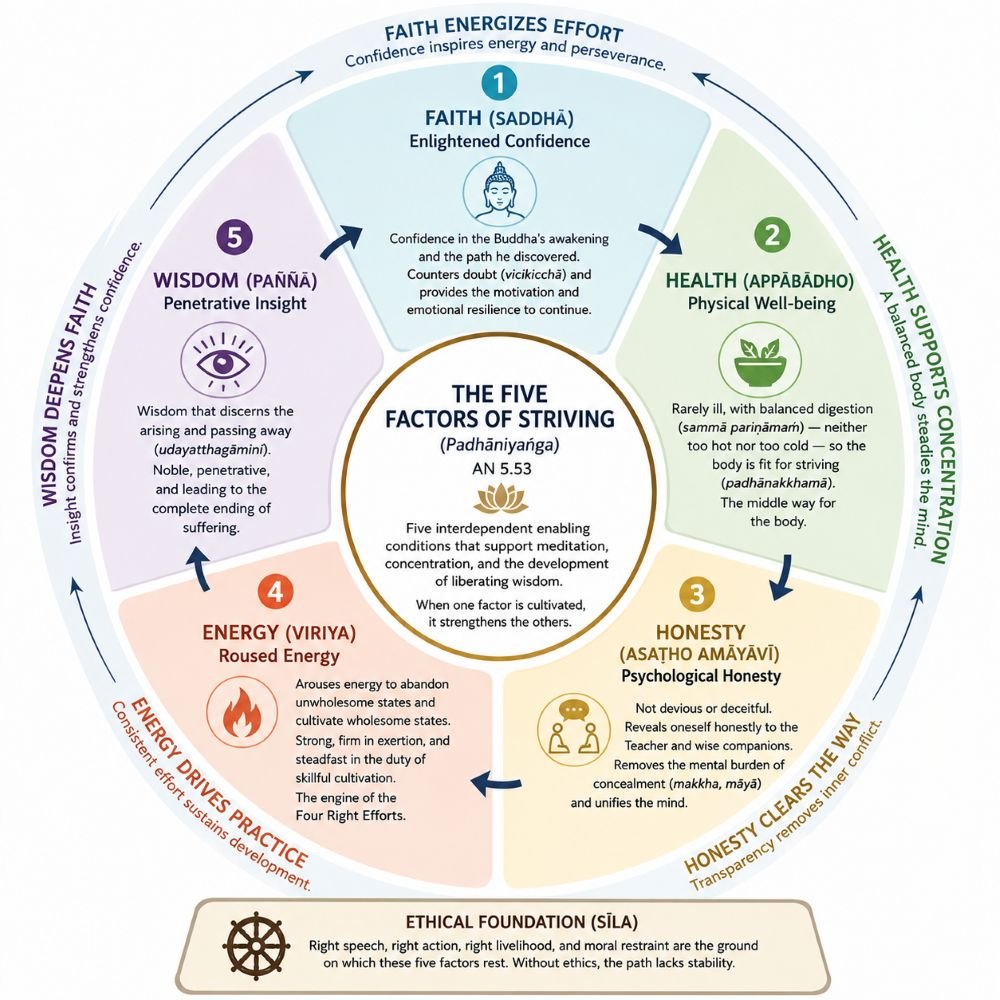
Wisdom does not arise in a vacuum. It depends upon the previous four factors: faith provides the motivation to practice, health provides the physical basis for sustained attention, honesty clears away the internal obstacles of self-deception, and energy provides the consistent effort required to maintain investigation. And wisdom, once it arises, deepens faith in turn. This is the virtuous cycle of the path: faith inspires effort, effort leads to mindfulness, mindfulness supports concentration, concentration enables wisdom, and wisdom confirms faith.
The sutta’s description of wisdom as leading to the complete ending of suffering reminds us of the ultimate purpose of all five factors. They are not ends in themselves. Faith is a means, not an end. Health is a support, not a goal. Honesty is a purification, not an achievement. Energy is the engine, not the destination. The goal is wisdom, the clear seeing that uproots clinging and brings suffering to its end.
In practical meditation, this wisdom begins as momentary glimpses: a sensation of warmth in the hand arises and then vanishes, a thought of anger arises and then dissolves, the sound of a bird appears and then fades. Over time, these glimpses become more frequent and more stable. Eventually, the mind begins to see that everything is like this, continuously arising and passing away without exception. And with that sustained seeing, the heart gradually releases its grip.
Conclusion: A Complete System for Awakening
The five factors of striving in the Padhāniyaṅga Sutta (AN 5.53) provide a concise and practical framework of enabling conditions for the spiritual life. By balancing the soft quality of faith with the hard quality of energy, and the physical needs of the body with the psychological demands of honesty, the practitioner creates favorable conditions for wisdom to arise. These factors are a reminder that meditation does not happen in a vacuum. It is supported by how we treat our bodies, how we relate to those who guide us, and the depth of our conviction that liberation is genuinely possible.
These five factors form the foundations for both monastic training and lay Dhamma practice. For the lay practitioner, the essentials are straightforward: develop faith in the Triple Gem through reflection and recollection, maintain physical health through moderation and sensible habits, cultivate radical honesty in all relationships and especially with spiritual mentors, apply consistent energy to meditation and ethical conduct, and steadily deepen the wisdom that sees impermanence clearly. Underlying all of this is the ethical foundation of the precepts. The five factors presuppose a life of moral restraint. Without that ground, the edifice of concentration and insight has nothing stable to stand upon.
These teachings are not abstract philosophy. They are a practical map. Consider them against your own practice. Do you have faith, not blind belief, but genuine confidence in the Buddha’s awakening and in the path he discovered? Is your body reasonably healthy, and is your digestion running smoothly? Are you living with honest transparency, both with yourself and with those who guide you? Is your energy consistently roused and not slackening? And are you cultivating the wisdom that sees the arising and passing away of phenomena, not as a concept, but as a lived, moment-to-moment observation?
If you can answer yes to these questions, you are well on your way. If not, the sutta gives you a precise map of what needs attention. The path to awakening is not mysterious. It is simply a matter of assembling the right conditions, these five factors, and then applying oneself with patience, persistence, and clarity.
The beauty of this teaching is its accessibility. You do not need to be a monk or a scholar. You need a sincere desire for freedom and the willingness to look honestly at your own life. Faith can be nurtured through reflection and study. Health can be improved through sensible habits. Honesty can be practiced in small, daily acts of truth-telling. Energy can be roused by remembering the preciousness of this human birth and the uncertainty of when the opportunity to practice may be lost. And as the other four factors mature and the mind is given the space and stillness to see clearly, the conditions become increasingly favorable for liberating insight to develop.
This is the Buddha’s gift: a path that is clear, gradual, and verifiable at every step. The five factors of striving are not a distant ideal but a living practice. Start where you are. Take one factor at a time. Trust the process.