Key Takeaways
- Walking meditation is a core, formal practice within multiple Buddhist traditions, valued equally with seated meditation for developing mindfulness, concentration, and insight.
- The practice has evolved distinct forms across traditions, including the caṅkama of the Thai Forest Tradition, Zen’s kinhin, and the mindful walking of Thich Nhat Hanh’s Plum Village, each with unique emphases but shared foundational principles.
- It offers a direct method to observe and understand core Buddhist teachings, such as impermanence, the Four Foundations of Mindfulness, and the integration of calm and insight, through the lived experience of the body in motion.
- A wide array of techniques exists, from basic step observation to mantra synchronization, body scans, and walking mettā, allowing practitioners to adapt the practice to their temperament and circumstance.
- Consistent practice trains the mind to maintain awareness during activity, creating a vital bridge between formal meditation and everyday life, and supporting ethical living through embodied presence.
Introduction
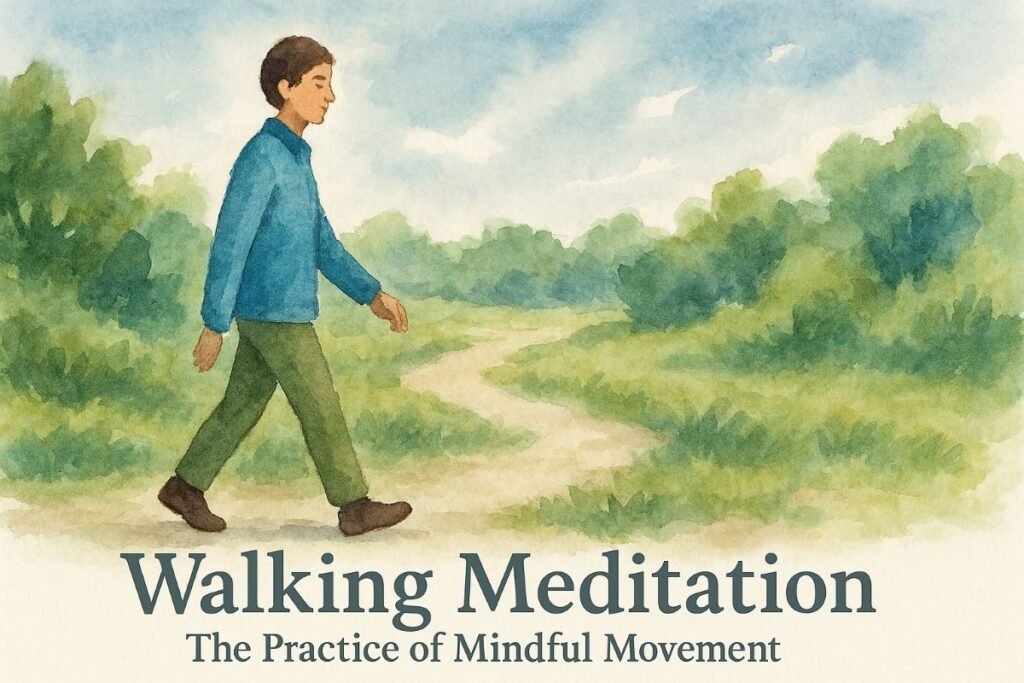
Walking meditation is the deliberate practice of bringing full, sustained attention to the simple, rhythmic activity of walking. In this practice, walking is disconnected from the goal of reaching a destination. Instead, the movement itself: the subtle sensations of lifting, moving, and placing each foot, becomes the complete field of study and the anchor for the mind’s attention. This transforms an automatic daily function into a profound discipline for cultivating awareness.
This form of meditation is not a preparation for “real” sitting meditation, nor is it a lesser practice. From the earliest records of the Buddhist monastic community, it has been held as a core contemplative exercise, often practiced in tandem with sitting to balance energy and deepen understanding. It provides a unique and essential way to investigate the nature of mind and body while in motion, offering insights that can be more difficult to access in stillness.
1. Historical Roots and Evolution of the Practice
Walking meditation, or caṅkama in Pali, is deeply embedded in the origins of Buddhism. Its development across different cultures and schools illustrates a shared commitment to mindful embodiment.
1.1 Origins in Early Buddhism and the Pali Canon
The practice finds its authoritative basis in the Pali Canon, the preserved teachings of early Buddhism. The Buddha frequently included walking meditation in his instructions for developing mindfulness. In the Satipaṭṭhāna Sutta (MN 10), the foundational discourse on the Four Foundations of Mindfulness, he explicitly includes mindfulness of the body while walking: “And further, monks, when walking, a monk knows, ‘I am walking’; when standing, he knows, ‘I am standing’; when sitting, he knows, ‘I am sitting’; when lying down, he knows, ‘I am lying down.’” [1]
The Anguttara Nikāya (AN 5:29) enumerates five benefits of walking meditation as taught by the Buddha: it builds endurance for travel, it strengthens effort in practice, it promotes physical health, it aids digestion, and the concentration achieved from it is long-lasting [2]. This established it as an integral part of monastic training, not merely a break between sitting sessions.
1.2 The Thai Forest Tradition and Caṅkama
In the 20th century, the Thai Forest Tradition, led by renowned masters like Venerable Ajahn Mun Bhuridatta (1870-1949) and his student Ajahn Chah (1918-1992), revitalized and emphasized walking meditation as a rigorous path to insight [3]. For forest monks, the walking path (caṅkama) was as central to their practice as their sitting spot.
Ajahn Chah often taught that walking and sitting meditation are two wings of a bird, both necessary for flight. In forest monasteries, monks would often practice caṅkama for hours each day, walking slowly back and forth on a straight, cleared path in the jungle. The instruction was direct: to be with the knowing of the body walking, to observe sensations with relentless honesty, and to see the three characteristics of impermanence, suffering, and non-self within the flow of physical movement. This tradition champions a bare, unadorned observation of the body’s process as a direct window into the nature of reality.
1.3 Japanese Zen Buddhism and Kinhin
In Zen Buddhism, walking meditation is known as kinhin. It is formally practiced in the meditation hall (zendo) between periods of seated zazen. While details vary by lineage, kinhin typically involves walking very slowly in a clockwise circle around the perimeter of the room. The hands are held in the shashu position, with one hand closed in a fist around the thumb and covered by the other hand, resting at the stomach or chest.
Attention is often placed on the coordinated rhythm of breathing and stepping. In many traditions, this involves taking only a half-step with each full breath cycle, making the pace exceptionally slow and deliberate. The great Zen master Dōgen (1200-1253) included instructions linking walking and zazen in his Eihei Shingi; the slow circular form of kinhin commonly practiced today was standardized in later centuries [4]. The practice embodies the Zen principle of carrying the same immovable, alert presence from stillness into motion, dissolving the barrier between formal meditation and every action.
1.4 Thich Nhat Hanh and Plum Village: Mindful Walking as Engaged Practice
The Vietnamese Zen teacher Thich Nhat Hanh (1926-2022) developed an approach to walking meditation that is profoundly accessible and relational [5]. In his Plum Village tradition, mindful walking is often practiced outdoors, in nature, and in a group. The pace is natural and relaxed, not ritualistically slow.
The practice is deeply intertwined with the cultivation of joy and gratitude. He encourages practitioners to smile lightly and to use silent phrases synchronized with steps, such as the gatha, “I have arrived, I am home” with the in-breath and out-breath [6]. This transforms walking into a celebration of being alive in the present moment. His teaching, widely credited as a major influence on contemporary mindfulness movements, frames walking meditation not only as an individual mindfulness exercise but as a foundation for “engaged Buddhism”, cultivating the peace and clarity within oneself that is necessary to walk peacefully and helpfully in the world.
2. Foundational Techniques and Methods
A rich variety of techniques exist within walking meditation, allowing practitioners to find approaches that resonate with their mind-state and deepen specific qualities of awareness.
2.1 Establishing the Basic Framework
The foundational container for practice involves several supportive elements:
- Choosing a Path: A straight, level path of 10-30 paces is traditional. This allows for repetitive walking without the frequent mental engagement of turning. The path can be indoors or outdoors. The key is that it is safe, relatively undisturbed, and dedicated to practice.
- Body Posture: The body is held upright but not rigid. The spine is aligned, the chin slightly tucked, and the shoulders relaxed. The gaze is soft and directed downward about two to three meters ahead, not looking at the feet but taking in the ground without focusing on details.
- Hand Position: Hands can be clasped gently in front of the body (right hand over left, thumbs touching), held behind the back, or allowed to hang naturally at the sides. The aim is a position that is stable, comfortable, and minimizes arm movement.
- The Mindful Turn: A detail emphasized in traditions like the Thai Forest Tradition is the mindful turn at the path’s end. One stops completely, composes the mind in stillness, and then turns deliberately, usually clockwise, before beginning the next walk. This ensures the turn is part of the meditation, not a mechanical pivot that breaks mindfulness.
2.2 Core Technique: Observing the Components of a Step
The most common instruction in Theravada-derived practice is to break down the step into distinct phases to counteract the mind’s tendency to perceive walking as a single, blurred event. Attention is placed on the physical sensations of each phase:
- Lifting: The intention to lift, followed by the sensation of the heel, then ball, then toes leaving the ground.
- Moving (or Swinging): The sensation of the foot moving forward through space, feeling the air against it, the lightness of the leg.
- Placing: The sensation of the heel making contact with the ground, followed by the sole, then the toes.
- Pressing/Shifting Weight: The sensation of weight transferring onto the now-placed foot, the solidity and pressure, as the other foot begins to lift.
The mental practice is to gently note these sensations, either with a soft internal label (“lifting, moving, placing”) or by simply feeling them without verbalization. When the mind wanders—which it will, repeatedly, the practice is to notice the wandering without irritation and to gently return attention to the very next sensation in the foot.
2.3 Variations in Pace
Adjusting the walking speed can train different faculties of mind:
- Ultra-Slow Walking: Moving with extreme deliberateness, taking 10-20 seconds per step. This magnifies every micro-sensation and is a powerful method (used in some insight traditions) for developing deep, penetrating concentration (samādhi) and for calming a very agitated mind. It reveals the impermanent, composite nature of what seems like a single movement.
- Medium Pace Walking: Walking at a speed that is simply “slow,” perhaps half of normal walking speed. This is a balanced, sustainable pace for longer periods of practice, fostering steady mindfulness (sati).
- Brisk Pace Walking: Walking at a normal or even purposeful speed while maintaining clear awareness of the body in motion. This practice is excellent for integrating mindfulness into daily life and for working with a dull or sleepy mind, as the increased energy counteracts heaviness.
2.4 Expanding the Field of Awareness
Once attention to the feet is stable, awareness can be systematically expanded:
- Full Body Awareness Walking: Instead of focusing narrowly on the feet, attention is opened to include the entire body walking. One feels the swing of the arms, the rotation of the torso, the movement of the head, and the whole body as a single, coordinated organism moving through space. This develops a unified sense of the body, as taught in the Kayagatasati Sutta (MN 119) on mindfulness of the body.
- Walking with a Mantra: A word or phrase is silently repeated in coordination with the steps. A traditional Pali mantra is “Buddho,” mentally saying “Bud-” on the left step and “-dho” on the right. This practice, emphasized by teachers like Ajahn Mun, uses the sound as an object of concentration, calming discursive thinking. The steps become a rhythmic support for the mantra.
- Walking Mettā (Loving-Kindness): The walking becomes a vehicle for cultivating boundless goodwill. With each step, one mentally radiates well-wishes: “May I be safe. May I be happy.” After a time, this intention is extended outward: “May all beings in this direction be safe. May they be happy.” This blends physical grounding with an open, compassionate heart.
3. Deepening the Practice: Stages and Challenges
Walking meditation is a progressive path. Understanding its potential stages and common obstacles provides a map for continued development.
3.1 Potential Stages in Practice
While experiences vary, practice often deepens in a non-linear fashion:
- Initial Stage – Establishing Attention: The primary task is the repetitive work of placing attention on the steps and beginning again when distracted. The experience may feel mechanical or frustrating.
- Intermediate Stage – Growing Continuousness: Moments of sustained attention become longer. The sensations may feel more vivid. One may begin to naturally notice the beginning and ending of each sensation, gaining an intuitive feel for impermanence (anicca). A subtle sense of calm or ease may arise alongside the walking.
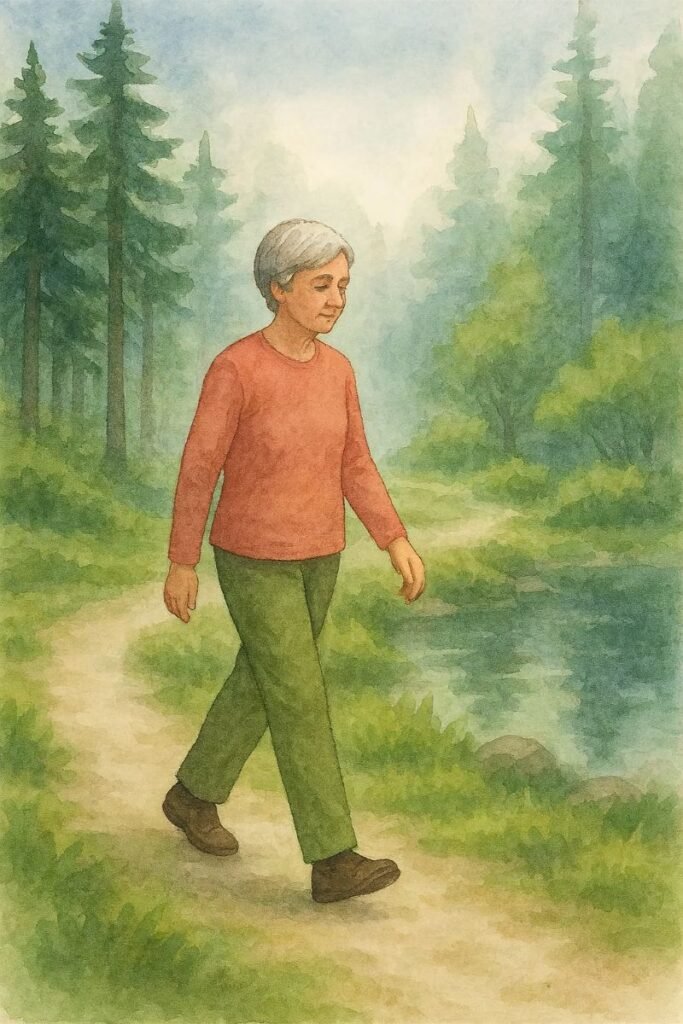
- Advanced Stage – Unification and Insight: The division between the observer and the walking can dissolve. There is simply the knowing of movement. The mind is bright, alert, and settled simultaneously. In this state, insights into the selfless, conditioned nature of the process may arise spontaneously and clearly. As the Visuddhimagga (a 5th-century Theravada manual) explains, concentration becomes so steady that one can maintain it even amidst minor external disturbances [7].
3.2 Working with Common Challenges
Difficulties are not signs of failure; they are the raw material of practice.
- Restlessness and Impatience: The body or mind may scream to move faster or stop. Instead of giving in, one can bring mindful attention to the feeling of restlessness itself. Where is it felt in the body? What is its texture? This investigative approach, rooted in the second foundation of mindfulness (mindfulness of feelings, vedanānupassanā), transforms the obstacle into the object of meditation.
- Physical Pain or Discomfort: Aches in the knees, back, or feet may arise. The first response is to adjust posture or pace wisely. If discomfort remains, it can be observed mindfully. Is the pain solid or changing? Is the suffering compounded more by mental resistance than by the raw sensation? This inquiry relates directly to the understanding of dukkha.
- Doubt and Boredom: The mind may insist, “This is pointless” or “This is boring.” These thoughts can be acknowledged as mere mental events: “Doubt is present.” One then returns to the tangible reality of the next step, questioning if the actual sensation of pressure or movement is itself boring, or if “boredom” is a story layered on top of it.
4. Walking Meditation and Core Buddhist Teachings
The practice is a living laboratory for investigating the Buddha’s most essential teachings.
4.1 The Four Foundations of Mindfulness (Satipaṭṭhāna)
Walking meditation is a direct application of this framework:
- Mindfulness of Body (Kāyānupassanā): This is the primary domain. One observes the body’s postures (walking, standing, turning) and the detailed bodily sensations and elements (earth, water, wind, fire) involved in movement.
- Mindfulness of Feelings (Vedanānupassanā): Pleasant, unpleasant, or neutral feelings arise, ease in movement, frustration with distraction, neutrality in routine. One learns to see them as bare feelings, not commands to act.
- Mindfulness of Mind (Cittānupassanā): The states of mind that come and go are observed: a concentrated mind, a distracted mind, a dull mind, a restless mind. One notes, “A distracted mind is present,” without identifying as that distracted mind.
- Mindfulness of Mental Qualities (Dhammānupassanā): One may notice the presence or absence of the Five Hindrances (e.g., restlessness, doubt) during the walk, or observe how the factors of awakening (e.g., mindfulness, investigation, energy) are being cultivated.
4.2 Observing the Three Marks of Existence
- Impermanence (Anicca): This is directly visible. Each sensation: lifting, placing, pressure – arises and ceases. No step is identical to the last. The intention to walk forms and dissolves. The entire experience is a continuous flow of change.
- Unsatisfactoriness (Dukkha): The mind’s craving for the walk to be more interesting, more peaceful, or simply over creates friction with the present reality. This subtle suffering is observable. So too is the inherent vulnerability of a body that can feel fatigue or discomfort.
- Non-Self (Anattā): Upon close inspection, one cannot find a permanent “walker” inside. There is intention, followed by a cascade of impersonal physical phenomena (muscle contractions, nerve signals, shifting balance). The walking happens, but no independent, controlling self is found directing it. It is a process, not an act by an actor.
4.3 Integration with the Noble Eightfold Path
The practice nourishes multiple path factors simultaneously:
- Right Effort: The sustained application to return attention to the walk.
- Right Mindfulness: The clear, present awareness of the body in motion.
- Right Concentration: The collected, unified mind that develops.
- Right Understanding and Intention: As insight into impermanence and non-self deepens, it informs one’s fundamental worldview and aims.
5. Integrating Practice into Daily Life
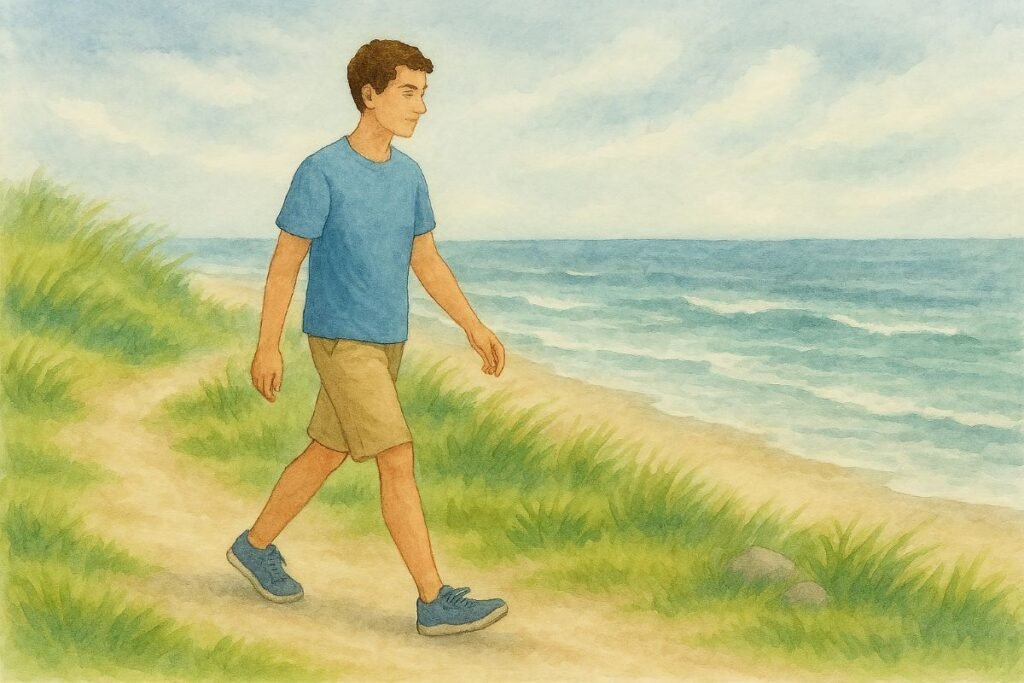
1The ultimate purpose of formal walking meditation is to cultivate a mind that can remain mindful in all activities.
- From Path to Pavement: The mindfulness of lifting and placing feet on a clear path can be directly transferred to walking down a sidewalk, through an office corridor, or in a grocery store aisle. One practices “knowing you are walking” amidst the complexities of daily life.
- Mindful Transitions: Short, one-minute periods of mindful walking can be used as conscious transitions between activities, after finishing work, before starting a meal, when moving from one task to another. This creates islands of presence that prevent the day from becoming a blur of autopilot action.
- A Support for Ethical Conduct (Sīla): A mind grounded in the present moment through practices like walking meditation is less likely to be overtaken by impulsive greed, aversion, or delusion. This embodied presence creates a pause between stimulus and reaction, supporting actions that align with the ethical precepts.
Conclusion
Walking meditation is a complete, time-honored path of practice that uses the body’s natural movement to cultivate a peaceful, alert, and insightful mind. From the forest paths of Thailand to the Zen halls of Japan and the mindful steps of Plum Village, it has taken diverse forms while maintaining its core purpose: to awaken to the present moment.
It demonstrates that mindfulness is not a fragile state reserved for quiet rooms but a resilient quality of attention that can be developed and carried into the flow of life. By walking with awareness, step by simple step, one trains the mind to meet all experience with greater clarity, balance, and understanding.
Glossary of Key Terms
| English Term | Pali/Sanskrit Term | Explanation |
|---|---|---|
| Anicca | Anicca | Impermanence; the fundamental characteristic that all conditioned phenomena are in a constant state of flux, ceaselessly arising and passing away. |
| Anattā | Anattā | Non-self; the core insight that there is no permanent, unchanging, independent soul or self to be found within any experience. |
| Caṅkama | Caṅkama | The Pali term for walking meditation, especially in the context of Theravada Buddhist practice. |
| Dukkha | Dukkha | Unsatisfactoriness, stress; a characteristic of conditioned existence, ranging from subtle unease to intense suffering. |
| Kinhin | Kinhin | The Japanese term for walking meditation in Zen Buddhism, typically performed between periods of seated zazen. |
| Mettā | Mettā | Loving-kindness; a boundless, warm-hearted goodwill cultivated as a meditation practice and ethical orientation. |
| Samādhi | Samādhi | Concentration; a unified, stable, and collected state of mind, free from distraction, developed through meditation. |
| Sati | Sati | Mindfulness; the faculty of present-moment, non-judgmental awareness and recollection. |
| Satipaṭṭhāna | Satipaṭṭhāna | The Four Foundations of Mindfulness (body, feelings, mind, mental qualities); the central framework for developing insight. |
| Vipassanā | Vipassanā | Insight; the clear, direct seeing into the true nature of reality (as impermanent, unsatisfactory, and non-self). |
| Zazen | Zazen | Seated meditation in Zen Buddhism, characterized by upright posture and alert, open awareness. |
References and Further Resources
Sutta Sources
- Satipaṭṭhāna Sutta (MN 10): The Discourse on the Foundations of Mindfulness. Translation by Ṭhānissaro Bhikkhu. Access to Insight.
- Anguttara Nikaya 5.29: The Five Benefits of Walking Meditation. Translation by Ṭhānissaro Bhikkhu. Access to Insight.
Teacher Biographies and Lineages
- Breiter, P. (2004). Venerable Father: A Life with Ajahn Chah. Buddha Dharma Education Association.
- Leighton, T. D. (2007). Zen Questions: Zazen, Dōgen, and the Spirit of Creative Inquiry. Wisdom Publications. (Discusses Dōgen’s teachings on practice).
- Nhat Hanh, T. (1991). Old Path White Clouds: Walking in the Footsteps of the Buddha. Parallax Press. (Biographical and teaching narrative).
- Nhat Hanh, T. (2015). How to Walk. Parallax Press. (Source for walking gathas and Plum Village approach).
Commentarial and Practical Guides
- Buddhaghosa, B. (5th c. CE). Visuddhimagga (The Path of Purification). Translated by Bhikkhu Ñāṇamoli. Buddhist Publication Society.
- Chah, A. (2011). Everything Arises, Everything Falls Away: Teachings on Impermanence and the End of Suffering. Shambhala. (Compilation includes teachings on walking meditation).
- Gunaratana, B.H. (2011). Mindfulness in Plain English. Wisdom Publications. (Includes a clear, practical chapter on walking meditation).
- Thanissaro Bhikkhu. (2002). Walking Meditation. Metta Forest Monastery. Available at Access to Insight.
Online Articles and Guides
- How to Practice Walking Meditation by Toni Bernhard. Lion’s Roar.
- Kinhin (Walking Meditation) by John Daido Loori. Zen Mountain Monastery.
Audio and Video
- Guided Walking Meditation with Sharon Salzberg. Insight Timer app.
- Plum Village App. Contains guided mindful walking meditations.
- Ajahn Sona: Walking Meditation Instructions. Birken Forest Monastery YouTube channel.